

Founder @ A3 Analytics | ex-Palantir, Toyota | Building labs that are self-driving AND self-fixing at A3
The Whole Bay Area
Joined March 2026
- Tweets130
- Following221
- Followers15
- Likes179


Pinned Tweet
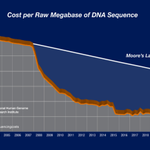
The cost of DNA sequencing has remained stubbornly flat for over 10 years. To get to truly personalized genomics and personalized medicine, we have to get rid of the bottleneck: the people. I spent a decade pipetting things and running various lab assays and it ain't fun. 1/

2
61


Microsoft has made the experience of installing an operating system as quick and easy as getting a drivers license in a foreign country, but every person you have to talk to asks you six times if they can have your internal organs.
5
youtu.be/MEkpdgEEsck
I was talking to a bio lab and they said that it was hard to get enough video angles on their self-driving lab, and I thought this was crazy. Cameras are cheap! So I designed this $20 AI camera, which I call rhe Gizmonic Cambot, in honor of MST3K
1
48
Cambot uses JEV and Luna for semantic indexing. It has an MCP server that lets an agent ask plain English questions such as “when was the pipette tip on the pipetter?” Using JEV, you can set up predetermined conditions to monitor for, such as a bent pipette tip
2
20
The install process is: you plug it into your laptop, point cursor at the repo, and it runs the install, debugging any problems along the way and persisting its lessons learned in FIXR (a3analytics.ai/product/)
It has an SD slot so it can save a rolling window of video

15
Matt Gordon retweeted

In September, @AnthropicAI announced that its AI agents had found a reverse transcriptase alongside a novel CRISPR-like genetic array in phage DNA.
What it actually does, the paper said, would “await experimental characterization.”
So we tested it on Ginkgo’s Cloud Lab. Scientists at Ginkgo wrapped Claude Opus 5 in a harness, provided it with the preprint and a catalog of validated workflows in the Ginkgo Cloud Lab, and asked it to generate executable work orders. We ran the first set of these experiments and obtained the first evidence of biochemical activity 13 days after experimental design using about $14,000 of cloud lab services.
Read the full write-up: cloud.ginkgo.bio/blog/art-re…
You can run your own experiments on our Cloud Lab from anywhere today: cloud.ginkgo.bio
Matt Gordon retweeted

The AI frontier is moving from digital to physical.
Most people aren't ready for what that means... for startups, for supply chains, or for the world.
I unpack all of it with @lennysan. 👇

Caitlin Kalinowski (@kalinowski007) helped engineer the original unibody MacBook Pro and was technical lead on the MacBook Air and Mac Pro at @Apple, was @Meta's first consumer electronics hire and went on to lead their AR glasses and VR hardware teams, and most recently was at @OpenAI helping build their robotics and hardware teams from scratch.
In our in-depth conversation, we discuss:
🔸 Why the AI frontier is shifting from digital to physical
🔸 How the technologies built for VR became the foundation of modern warfare
🔸 Why humanoid robots are still just prototypes, and what’s most gating mass deployment
🔸 The coming memory price shock and why she’s telling startups to pre-buy now
🔸 Lessons from Steve Jobs, Mark Zuckerberg, and Sam Altman
🔸 Why she walked away from OpenAI after the DoD deal
Listen now
youtube.com/watch?v=G5WTgB87…
Very interesting. I have been studying AI-driven automated root cause analysis for five years now. A lot of people use the "throw it into Claude" approach these days, and it can do a lot of things. But organization of physical knowledge for reasoning is very hard to get right.


Software-for-manufacturers businesses are not durable.
claude.com/resources/article…

1
2
73
This is a deeply weird result. Maybe hearts remind VLMs of the Mandelbrot Set???

Put a heart ❤️ next to a coding problem, and Claude & GPT write recursive code 100% of the time (0% baseline). They also can't tell you why!
Excited to share “A Heart Means Recursion” from my summer at @GoogleDeepMind, on how VLMs read & communicate with visual symbols. 🧵
1
29
Matt Gordon retweeted

You may remember Gary Michelson as the billionaire who (reportedly) complained to Patrick Soon-Shiong about an LA Times article about his dog, leading to a huge fight with executive editor Kevin Merida and then his resignation


Astra designed this case for an ESP32 cam, I gave minimal prompting to generate a project spec and gave it the board spec PDF. Printed it in my garage on the Bambi X1C in PETG.
This is insanely futuristic and is the first step in my new open source agentic video camera system.


2
1
66

Matt Gordon retweeted

🧬 Design proteins faster and send fewer, better candidates to the lab.
Introducing RFD4-Proteina, a new NVIDIA BioNeMo open model co-developed with @UWproteindesign.
▫️Fast: 13× faster generation than RFdiffusion3 at 200 residues
▫️ Smart: state-of-the-art across 12+ protein design tasks
▫️ Programmable: set your design inputs and use test-time compute on harder problems
Start with our binder-design tutorial nvda.ws/3VK9Uvr
Matt Gordon retweeted

Describe a protein’s job. AI proposes its structure and sequence.
A scientist might want an enzyme that breaks down plastic without knowing what its molecular structure should look like. Many protein-design tools require the scientist to supply some of that structural information first.
Dai and colleagues developed Pinal, a generative AI model that proposes proteins from written descriptions of their intended function.
Its Transformer-based architecture first generates a compact description of a possible protein structure. A second model uses that description, together with the original request, to generate the amino acid sequence. Structure provides a useful bridge: proteins with quite different sequences can still adopt similar shapes.
One experimental test went beyond designing an isolated enzyme. The team requested an H-protein, which carries reaction intermediates between enzymes in a CO₂-fixing pathway. The best design supported 1.7 times the glycine production of the native E. coli protein in a laboratory-reconstituted pathway, without repeated rounds of experimental optimization.
Getting there still required selection: 50,000 generated candidates were narrowed to 20 for testing, and five were functional. The written request opens the search. Computational screening and experiments establish which designs actually work.
Dai et al., Nature (2026). Journal license. nature.com/articles/s41586-0…

Custom designed treatments are the promise of the current revolution in biology. This is an incredible milestone in personalized medicine.
To make personalized medicine available to all, we need to make lab automation that scales. That’s what we’re working on.

Introducing Omnii-1, our most powerful genome language model, and a major step toward general biological intelligence
In a world first, Omnii-1 designed the first AI-generated bacteriophages to be administered to a human patient with an antibiotic-resistant infection under compassionate use
1
26

