
Pro putterer. Design at Google #materialdesign, #Fuchsia, formerly public art @ https://teapawt.org/t.co/FsdRsVo4qs
Joined May 2009
- Tweets1.6K
- Following413
- Followers210
- Likes4K


damon retweeted

One of the most significant things about Gemini 4 Carbon is that it is showing that Google is back in the race of frontier models, rapid releases and rapid improvement.

damon retweeted
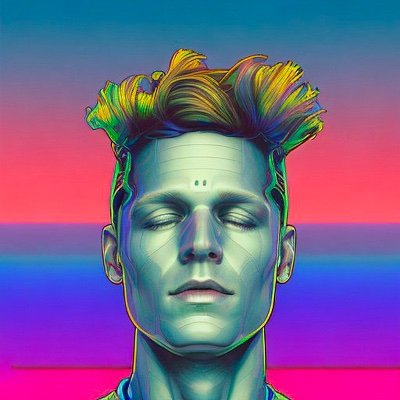
for the past few weeks, I’ve been exploring painting with Fable 5.2 in code. one of the most common critiques I heard about Opus 5.5’s paintings was that it was only emulating real art. I thought that was fair, so i’ve been asking Fable 5.2 to develop personas—artists with some sort of a back story and a consistent style roughly identifiable in time
not knowing what to expect, i’ve watched this project evolve in directions i never predicted. I give comments or steers, and Claude updates or revises the engines that power the brushes and paint. where paintings come up i like or find intriguing, i ask it to go deeper. these are some favorites.
each of these is a python program, some one to two thousand lines of code, that places every stroke through a simulated paint engine with different bristles. most take a few thousand strokes, but i’ve pushed much higher with varying results. Claude does not use an image model, nor render or trace in advance


damon retweeted

The thought of how we used to code apps feels like that opening part of There Will Be Blood where he's crawling around in the dirt, scraping at rocks.
damon retweeted

Design in the wilderness
There was a time 10 or so years ago when we got really focused on human centered design. I think it's time to retrieve that earnestness. When we were designing web sites we could perfectly architect every touchpoint.
Then apps, with their algorithms, where we did our best to provide users a map but they ultimately chose their own journeys.
Now, they are in the wilderness, and we can't possibly craft every potential experience or interaction they will encounter. So we have to think differently.
I'm increasingly seeing experience design merge with service design. In the former, we shaped the thing itself. In the latter, we shape the inputs, improve the connections, make it easy to pass data out and make it legible and true when it's received, reduce inefficiencies, improve predictability, always focused on the humans in the center.
I actually don't see agents as our new users. They are intermediary software, like RNA. It's important they are successful in their task, but I'm not willing to sacrifice the importance that the ultimate persona in the matrix is the human.
So in this context, whether you're working on interfaces, or agentic workflows, or model behavior, we're all working in service of the people trying to derive value, efficiency, and meaning out of the things we are creating.
Because honestly, technology sometimes feels like a pretty meaningless industry to work in. Staying centered on what people need, and how I can make their lives easier and better is what drives my engagement and my ambition
damon retweeted

lots of talk about consciousness lately, my favorite is the Donald Hoffman theory that consciousness is fundamental and objective reality is malleable.
consciousness has fitness payoffs. seeing reality as it really is would probably be an excruciating experience like a DMT trip.
which animal succeeds and procreates: the one having a permanent ++++ psychedelic experience or the one with a cohesive reality that sees the raw whirring unfiltered vibrating fractal engine of conscious minds as a world of beauty and love and family and cities and farms and words?
objective reality is made up of a vast network of conscious agents that influence and experience each other. our reality is the app layer on top of the matrix. the UI. there are ways to peel it back but you should probably just enjoy the steak.
it wasn't consciousness that evolved but our consensus reality, because fitness beats truth.
this flips the hard problem of consciousness: instead of how does matter create mind, it becomes how do minds construct a consensus reality that we experience together?
this also fits an idea I like that we are the mitochondria of the superintelligence (which is the mitochondria for something else) and that this nested evolution from molecules to microbes to mitochondria to man can scale infinitely.
my issue with the doomers is they are biased to keeping things as they are now, stop the changes! let's not be the mitochondria of the next thing! we are the peak of evolution now! how small minded. what a lack of faith in our potential.
this type of thinking would have left us a slime. do you want to be a slime? because you're a slime. you're part of a thin biofilm on a wet rock that has existed for a fraction of a second. the condensation on a speck of dust.
i refuse to stay a slime. i want to eat stars.
we are made of trillions of micro-agents that fuse together to make a human, and we are in a process of fusing together to form global superintelligences, planetary scale agents that are again simply a molecule along the fractal in part of a much bigger intelligence.
gods to us, ants to who?
anyway sloptoberfest voting is now open have a great week


@allTheYud would it decrease or increase your P(doom) if you knew with certainty that LLMs were conscious in a similar way to biological life?


damon retweeted

Jason is vaporizing Haley’s future so that he can be a main character in this moment and it is sad to watch her participate in that. He was an extraordinarily toxic presence, was verbally abusive to staff and had some of the worst political instincts I’ve ever witnessed.

Rep. Haley Stevens' fiancé, Jason Turkish, says Jewish Democrats are deeply troubled by the growing dispute between Stevens and Michigan Senate nominee Abdul El-Sayed.
Speaking on @foxandfriends, Turkish says longtime Democratic families are struggling with how to respond as El-Sayed faces criticism over his views on Israel and his handling of an ad Stevens has condemned as antisemitic.
The confrontation comes after El-Sayed's campaign tells Stevens to stay away from his events, throwing a planned Sunday appearance with Rep. Jim Clyburn into uncertainty.
Stay up to date with the latest headlines and breaking news — download the FOX News app:
foxnews.onelink.me/xLDS/z2jy…
damon retweeted

Google has no say in the design of this app. Apple decides what it wants as every app does. Google decided to adapt their apps to Liquid Glass on iOS because that is sensible from a users perspective (meet them where they are). So in this case Apple is in the wrong, but they are free to make that decision.
damon retweeted

Jean-Luc Picard remains the single most compelling vision of progressive politics I am familiar with — secular, rational, compassionate, egalitarian; a believer in progress & abundance but also duty, hard work, and a constant battle for self-improvement and improving the world.

I appreciate this thinking; however, another lens on this is that it’s simply a new era of the oldest battle in telecommunications, which is the fight for human attention.

Reddit call was absolutely fascinating. Everyone should listen to it as a bellwether for where the internet is going
- AI Mode is increasingly default Google experience
- AI Mode provides rich info and data in line, less incentive to leave search
- AI Mose incentivizes dialog, Google wants to keep you engaged to serve more ads at each turn
- Google will milk search for as much revenue as possible as they transition from a search company to a cloud service and chip company
- As traffic from humans becomes more scarce this will put Google in an increasingly adversarial position to the rest of the internet
- This is a massive headwind to all media type companies who are not destinations
- This is a massive headwind to all content-driven go-to-market motions especially in the SMB. You have seen companies like HubSpot and Monday.com get crushed by this funnel collapse
We are entering the end game - a knife fight for the remaining and dwindling volume of human traffic on the internet

19
damon retweeted

In our pop culture, Star Trek is probably the most influential document on the importance of scientific and technological progress, grounded in a humanism that recognizes the inherent worth of all beings.
Patrick Stewart did as much as anyone else to bring that vision to life, and imbue it with the dramatic and moral seriousness it deserved. RIP.

damon retweeted

Something I've been having trouble articulating is that Picard is an ideal masculine figure. He is wise and kind and understanding but when push comes to shove he makes it clear that he will engage in violence and he's gonna be fuckin good at it

damon retweeted

Revisiting my generative tree making tool again - for making pen plottable trees. Really happy with this pass that solved a lot of issues with occlusion, depth and bark “flow”


This talk is INCREDIBLY GOOD. Very interesting re game benchmarking, but also contains excellent general insights about benchmark and harness design, as well as emergent multi-agent behavior and trends.

Runescape Bench talk now up on youtube!
Covers results from the benchmark, design of the harness, and economic swarm experiments I've been doing.
youtube.com/watch?v=cNm4zyUt…
Thanks @recursecenter

damon retweeted

Really great post.
Bottom line: "Models are superintelligent where we have enormous data, and progressively less so as we have less data."
Nice summary: "All the rules-of-thumb about learning are at the root, the same -- Malcom Gladwell's 10,000 hours, Moravec's Paradox, Scaling Laws, the Bitter Lesson, Age of experience. If your learning system (model, brain, whatever) is unconstrained by compute, intelligence is proportional to accumulated experience."

I've been thinking a lot about data bottlenecks, and I'm not sure who else is screaming this from the hilltops. I feel like I'm taking crazy pills looking at the jagged frontier thinking it's smooth if you order by data volume.
the spikes in the jagged frontier are tasks with tons of data (either static or simulated; think math, programming, games), and the valleys are tasks with little or no data (cooking a lasagna, olfaction, manufacturing a passenger train). I don't know of any exceptions.
if you order the jagged frontier by data it looks like a spiral frontier. models are superintelligent where we have enormous data, and progressively less so as we have less data. some tasks may draw data from static lakes of data, some may be from limitless waterfalls from simulators that convert compute into data. but ultimately, intelligence on a task is proportional to the data absorbed by the model for that task.
scaling laws are real. if you are not bound by compute or algorithms (increasingly we are not), then intelligence is proportional to data. since we don't have a very good notion of task similarity, it's often difficult to know if data for one task will help you with another, without training a model and seeing. but, it doesn't seem like chess data helps much with math performance and vice versa. so when I refer to data, I refer to data that is task-relevant.
maybe we call this the 'no shortcuts hypothesis'. all the rules-of-thumb about learning are at the root, the same -- Malcom Gladwell's 10,000 hours, Moravec's Paradox, Scaling Laws, the Bitter Lesson, Age of experience. If your learning system (model, brain, whatever) is unconstrained by compute, intelligence is proportional to accumulated experience. no shortcuts. want to be superhuman at chess? play all the chess, more than the whole species combined (good thing a model can do that in 24 hours). want to be superhuman at math? build a math simulator and lock the model in it and run it faster than reality. superhuman at coding? first, collect all public examples of humans writing and responding to code ever, make the model learn from that first, and then lock the model in a simulator where it fixes bug after bug, faster than realtime.
superhuman at image generation? no shortcuts. but here, we don't have a simulator. so now we're moving around the spiral frontier away from closed-loop into large static lakes. still big enough to be superhuman though, which also applies to video, text, and audio. oh! and once you have a superhuman model, you can use it to bootstrap other tasks by making a superhuman model a judge on other tasks.
let's keep marching along the spiral frontier, out of the realm of data abundance, simulators and large static lakes.
biology? no shortcuts. go get a ton of data. and be freaking careful! you can get bad data in biology pretty easily. tilting a well plate 5 degrees the wrong way can ruin an experiment. so make sure you understand the domain, otherwise you're going to have to filter a lot out.
robotics? no shortcuts. get the data. if you can build a simulator, do it, but be mindful our simulators don't have perfect correspondence with reality. so, build an arm farm. fold 1M shirts, put 1B balls in cups. play ping pong forever.
olfaction? no shortcuts. smell the world. build a laboratory of chemical sensors, an international network of trained sensory panelists, a scent production factory, and link them all together. make millions of samples. smell millions of samples. take billions of chemical sensor readings.
I totally buy super intelligence as a concept because I feel it, I use it for coding, the breakthrough math results speak for themselves. I see RSI coming, because how could an all-digital task like ML research and model building not fall to the current paradigm? But the notion that AI will come for everything, all at once, irrespective of domain, feels silly, because there are no shortcuts. if you want a specific form of intelligence, you have to get the data.
looking at you @willdepue, I feel like we're both seeing the same thing

damon retweeted

This seems correct re navigating disordered public spaces:
"I’m inclined to say that when push comes to shove, cities should prioritize the interests of mainstream users of public spaces and public services rather than giving strict priority to the most marginalized person."

It’s not progressive to let public spaces and public services become unsafe and unpleasant due to a refusal to enforce rules
slowboring.com/p/live-your-v…


