

Sports Physical Therapist and Performance Coach. Board Certified in Orthopedic Physical Therapy (APTA) Certified Performance & Sport Scientist (NSCA)
St Louis, MO
Joined December 2019
- Tweets396
- Following366
- Followers282
- Likes1.4K





Dalton Schumer DPT, OCS, CPSS retweeted

Final Fall Stats:
8 IP, 3 H, 3BB, 7Ks, 0.750 WHIP, .111 BAA, 0 ERA
FB 87-89
Slider 75-78
Changeup 78-81
Uncommitted Sophomore looking for a home in the fall of ‘27
@cafletcher18 @MACC_Baseball @CooperHart8 @PB_Uncommitted

Dalton Schumer DPT, OCS, CPSS retweeted

Soph RHP Jack Brettschneider (@MACC_Baseball)
Physical arm with 3️⃣ pitch feel, strikes.
+ FB 88-89 mph, 2500+, 7 ft ext avg
+ SL 78-79 mph
+ CH 76-78 mph, 12 VB & 20 HB
#SCFall | @JackBrett45
🗣️: tinyurl.com/fpahpfys
The best rehab plan/strength program is the one the athlete does consistently.
Access to equipment, competitive level, age, family environment, available time, motivation, etc… lots of factors to consider.
I’ve learned over time that less can certainly be more, in many cases.
3
124
Technology usage is growing rapidly in the rehab and sports performance field.
I think it’s important now more than ever, with the growth of AI, to develop the skill of critically analyzing the data/information that tech is giving us when it’s presented to us.
1
2
352
6. Summary
Traditional grip testing may not be sufficient enough to establish strength baselines nor monitor fatigue after throwing.
Testing specific to the finger flexors may be better identifying weaknesses or fatigue in the primary medial elbow stabilizers.
1
43
5. More on Fatigue Testing
Mullaney et al 2025 OJSM tested traditional grip, middle, and ring finger flexion pre and post throwing 4innings.
After 4 innings:
Middle Finger 79% baseline
Ring Finger 93% baseline
Traditional Grip: 95% baseline
1
46
4. An aside on Torque and velocity
Torque generally has a weak positive correlation to velocity. The harder you throw, generally the more torque placed on your elbow.
1
44
Just for reference, the study’s high valgus group threw on avg 87mph and low valgus group threw on avg 82mph.
1
49
Ring finger fatigue post throw showed similar results, 94% of baseline post throw and was significantly different between high/low torque group,
Although total grip strength saw a decrease in both groups, the difference was insignificant different from high to low group.
1
56
McHugh et al 2023 IJSPT confirmed this.
They found middle finger flexion testing produced 66% & 74% max contraction of the FCU and FDS respectively. The ring finger produced 93% & 61% respectively.
The latter study I want to highlight in the fatigue discussion we led with…
1
89
3. Fatigue Testing
They had pitchers throw in game (58pitch avg)
Pitchers with “high” valgus torque (>50nm) had middle finger fatigue post game (88% of baseline) and incomplete recovery next day (95%).
1
75
3. Isolating FCU & FDS
Fukunaga et al IJSPT 2023 Showed that the middle and ring finger isolated the FCU and FDS over the pronator teres best.
1
77
Does grip strength matter for pitching?
The answer is a bit complex.
This thread doesn’t answer it all but hopefully explains that it’s more layered than a simple answer.
🧵…
1
6
1,930
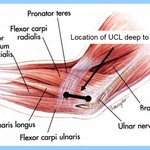
2. Within the flexor pronator mass lie the flexor carpi ulnaris (FCU) and flexor digitorum superficialis (FDS). They share attachments on the UCL (anterior band) and also cross the elbow joint, giving them their compressive capabilities.

1
122