








That awkward "let's hop on a new link" moment at minute 44? Gone. Free dMeet meetings now run a full hour. And 1:1 calls? End-to-end encrypted, no time limit at all.


Thanks @x402 for the feature.
Recording is live in @dMeetApp. On the agent side, the dTelecom x402 Gateway is already doing real volume:
$104K+ volume
49K+ transactions
70 buyers
Voice, STT and TTS paid per request in USDC. No API keys, no accounts.

ALT x402scan stats card for the dTelecom x402 Gateway: pay-per-use WebRTC, Speech-to-Text and Text-to-Speech for AI agents, paid in USDC via x402. US$104.65K volume, 49.46K transactions, 70 buyers, 12 resources.

Meeting recording is now live in dMeet - record, watch it back, download. The same recording layer is coming to the dTelecom Cloud API, so developers building real-time communication can add it to their own apps.
Meeting recording is now live in dMeet.
Record your group meetings, watch the replay in-app or download the file when you have permission - all saved to your meeting history, next to your AI summaries.
Built on the decentralized @dTelecom network.

ALT Recording is live in dMeet. Record your group meetings with one tap, watch the replay in-app or download the file when you have permission - all in your meeting history. Paid plans, iOS/Android/web.
dMeet is where we ship dTelecom's infrastructure to real users first. Scheduling is a small feature on the surface and a full path through the stack underneath: a booking link, a calendar, a live room, and AI transcription running on infrastructure we operate end to end.
You're paying for a scheduling tool you don't need.
Scheduling is live in dMeet, on every plan including Free:
• A direct booking link per meeting type
• Google Calendar sync, so your busy slots never get booked
• Guests see times in their own timezone automatically
• Picking a slot creates the meeting room, no separate video link to paste
One tool instead of two subscriptions.

Arabic is live in dMeet, the flagship app on the dTelecom network.
MENA is where real-time communication demand is growing fastest, and where privacy expectations are highest. Full RTL, self-hosted AI, no third-party model providers touching your meetings.
More builders on dTelecom shipping to more regions.

Agents don't fill out signup forms.
That's the whole reason we shipped on pay.sh. An agent that needs voice for thirty seconds shouldn't need a dashboard, a card on file, and a sales call first. It should just call the endpoint and pay for what it used.
Five real-time voice endpoints, live now.


.@dtelecom is now live on pay.sh
5 endpoints of real-time voice your agent can call with zero signup, just pay-as-you-need.
Run live WebRTC voice sessions, speech-to-text, and text-to-speech on demand.
Point your agent at it: pay.sh/services/dtelecom/voi…

dTelecom retweeted

.@dtelecom is now live on pay.sh
5 endpoints of real-time voice your agent can call with zero signup, just pay-as-you-need.
Run live WebRTC voice sessions, speech-to-text, and text-to-speech on demand.
Point your agent at it: pay.sh/services/dtelecom/voi…

5/
We built dTelecom to collapse that stack: voice, video, STT, TTS - one API on our own network of CPU and GPU nodes.
50-95% cheaper than centralized stacks. Up to 4x lower latency on speech recognition. 170M+ minutes served.
6/
$230M validated the category.
The question isn't the category - it's who assembles the stack the right way.
dtelecom.org
Most DePIN networks bootstrap the same way: token incentives first, hope demand shows up later.
dTelecom is #2 by payment volume on x402 - and none of it is incentivized.
Every payment is an AI agent buying voice, STT, or TTS because it needs it right now. Per request, in USDC. No accounts, no API keys, no human in the loop.
Real demand. Machine customers. Revenue on the network - rare for DePIN at this stage.
That's the difference between usage that pays for a network and emissions that simulate it.
x402.dtelecom.org

The Voice AI migration pattern we keep seeing:
Month 1: start on an orchestrator. Fast setup, demo ready in a day.
Month 6: 30K minutes/month. The bill is now a line item the CFO asks about.
So teams rebuild - and discover the stack is 3-4 vendors: RTC, STT, TTS, plus glue code. Each with its own margin baked in.
That rebuild typically saves ~80%. The catch: you're now managing 4 contracts and 4 failure points.
dTelecom collapses it to one API on our own infrastructure - voice, video, STT, TTS. The economics of self-hosting without the vendor sprawl.

Meeting-intelligence tools summarize one call.
The harder problem: making 6 months of company meetings answer a question.
That's what Shared AI Memory in @dMeetApp Team Workspaces does - built entirely on dTelecom infrastructure, end to end.
Introducing Team Workspaces.
Your company's meetings, turned into shared organizational knowledge.
Every workspace includes:
- Shared AI Memory
- Shared meeting history
- Shared AI credits
- Owner / Admin / Member roles
- Unified billing
Create persistent rooms for Marketing, Sales, Product, Client calls - each with its own link and its own history.
Then ask across all of them:
"What pricing objections came up in customer calls last month?"
"Why did we move the launch date?"
The more meetings you run, the smarter your knowledge base gets.
Live now: dmeet.org/about

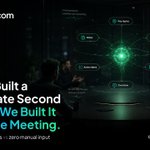
Meta built an AI 'second brain' for its workers.
63,000+ installs across engineering, PM, design, legal, finance. It took a dedicated team and a custom platform. They're now piloting a shared 'Third Brain.'
@dMeetApp does this from your meetings automatically. Every conversation → summarized → stored → queryable.
No manual input. No separate tool. The meeting is the knowledge base.

If you always wanted to query your calls and just get a reply - now you can.
Free to use > dmeet.org

This is the whole workflow now 👇
You: type 'What did we agree on for the Q3 budget?' dMeet: returns the answer.
Plus you still have:
- the meeting
- the date
- the knowledge base
No rewatching or scrolling transcripts. Your meeting history, queryable like ChatGPT.
Try it free → dmeet.org

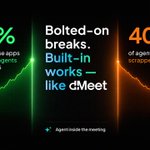
Gartner: '40% of enterprise applications will be integrated with task-specific AI agents by the end of 2026, up from less than 5% today.'
And the other half of the forecast: over 40% of agentic AI projects will be canceled by end of 2027.
The difference between the two? Infra.
Bolted-on agents break. Built-in agents work.
@dMeetApp's agents run inside the meeting.
Not on top of it.

