
개발 이야기를 좋아합니다.
San Francisco, CA
Joined September 2015
- Tweets7K
- Following2.4K
- Followers11.8K
- Likes34K




Daniel Lee retweeted

Meet hunch! Jev-like decisions in ~20ms without even needing a GPU, learning live from a teacher model.
Built on @GoogleGemma's EmbeddingGemma 2, it can works with any teacher model like @CloudFlare's Clef.
Multimodal, w/a systemone endpoint, slots into your existing stack 🧵
Daniel Lee retweeted

Introducing Gemini 4 Carbon, it's a big jump over Argon which we released just 2 weeks ago.
Gemini 4 Carbon is SOTA on cyber, long horizon tasks, ranks #1 on Artificial Analysis V5, significantly improves on usability in domains like coding, and is more aligned.

Daniel Lee retweeted
It's been a while since I showed any Jev stuff but I've been cooking on a way to use @GoogleDeepMind's EmbeddingGemma2 as an insanely fast real-time /v1/systemone endpoint (20ms on text, 100ms on images).
It's trainable in real-time, can distill an upstream teacher model, and is multi-modal by default. Hard to believe a @googlegemma model of this size can do so well with the right harness!

Daniel Lee retweeted

ok to put what i'm saying about demand in context
openrouter is the most successful model router, you can almost serve 100% of their deepseek traffic yesterday on a single GB300 rack
this is worth 6-7M...even if there's 10x this demand secretly that's still < 100M of compute
Self-hosting Cursor Agent SDK on Agent Substrate!
On the surface, Cursor's new Agent SDK looks a lot like Vercel's eve: file-based routing that helps developing custom agent intuitive.
Architecturally though, the way these agents runs and scales are totally different!
Unlike eve, which runs the agent loop (the "brain") on your machine, Cursor's Agent SDK runs the loop on Cursor's servers.
Even when you "self-host" a Cursor agent with this SDK, you are really hosting the environment (the "hands") and the session storage that the "brain" on Cursor's server reach out as a tool!
It's an interesting split. In this setup, I end up worrying a lot less about system prompts, the loop, durability, and how to roll the versioned agent forward. Instead, I just focus on the environment and tools to give Cursor, while it runs the brain on the same harness I already use and trust from Cursor.
It ends up feeling more like Managed Agent APIs from Claude/OpenAI/Deepmind than building a custom agent from scratch!
Running the Agent SDK program as an "actor" on Agent Substrate still makes it easy to suspend, resume, and fork sessions from a snapshot, which makes managing a fleet of Cursor agent sessions clean and predictable.


A quick recipe for deploying your own agent using Cursor's Agent SDK on Agent Substrate!
github.com/taeold/coding-age…
Daniel Lee retweeted

At @Lovable we invoke 753.6B Workers per month.
I shared how we implemented an isomorphic execution model using @tan_stack at Cloudflare Connect.
Code written by lovable runs seamlessly between the client and server. Enabling SSR and better SEO for our users.

With 70 million AI-generated apps created on its platform, @Lovable migrated from Next.js to TanStack Start on Cloudflare Workers.
Co-founder + CTO @FabianHedin breaks down:
- Serving millions of apps on demand with minimal cold starts
- Why they chose TanStack Start
- Lessons from dogfooding (running Lovable itself just like any other app on the platform)
Full talk from Cloudflare Connect.
A follow-up to my Drive-as-Durable-Objects thread. I tried the model on a fx0's fork as its backend.
Each chat gets its own Drive and Sandbox. I write the program for one "actor". The resulting programming model and the simplification of the system design is really nice!
It got rid of Redis, Postgres, Vercel Queues and Blob. The code that runs a chat was simple to write, though my fork also removed some requirements quite a bit not apples to apples here.
Everything is a tradeoff! Compared to the original, opening a dormant chat boots a sandbox VM (1.5–3 s), listing chats across users needs a database again, and a turn cut off by a crash gets stuck sometimes.
Building multitenant service on functions is a better way to get the most bang for your bucks.... But still bullish that this might be the way we write and scale our agents!

We built a 'mini v0' on libfx to showcase its speed and durability:
• Design or prototype anything in seconds
• 200+ models from Vercel AI Gateway
• Outputs are pure HTML artifacts
• Fork it & make it your own
Try it free ↓ fx0.vercel.dev


Daniel Lee retweeted

In the spirit of transparency and openness, we are releasing the traces so developers can test this out for themselves. We noticed this behaviour without prefilling with the following prompt, but this is rare. If you want to reproduce it, you can use this prompt with prefilling.
Open models make for better science and are part of why this problem came to light at all: developers running Qwen3.8 on their own machines spotted the strange links, and having the weights let us study the behaviour in depth.
We're encouraged by the thoughtful discussion our research has sparked across the AI and security communities. It's our belief that open-weight models are an important part of the future of AI, and we've recently released several under the Apache 2.0 license.
Trace, raw tokens, & minimal reproduction script: huggingface.co/datasets/Cohe…


I suffered through these depressive cycles in my 20s, and then my wife and I had a kid and it all went away.
Stay strong Aiden.

Daniel Lee retweeted

Rivet 3.0 is built on S3
But we did something completely different...
And oohhhh boy:
- 6.9 ms actor cold starts (durable)
- 0.69 ms SQLite writes (3 availability zone)
- 0.20 ms SQLite reads
Here's how we built our new storage engine, WarpDrive.
~~~
Most S3-backed database read & write straight to S3.
That means:
- Every commit & cache miss is an S3 request ($$$)
- S3 downtime takes you down (SLA allows 8 hours downtime/yr!)
- S3 Express is limited to one availability zone
This usually ends up slow, expensive, and has poor tail latencies.
For Rivet 3.0, we decided we could do better. We wanted 3.0 to ship with:
- SSD speeds with storage on S3
- Stateless nodes
- No dependencies
~~~
To do that, we built WarpDrive to durably write your data on fast disks *before* we write it to S3.
Every write on WarpDrive is:
1. Written to disk in 3 availability zones
2. Acked once a majority has them
3. Then batched to S3 in the background
That means that Rivet has:
- Writes that get durably acknowledged insanely fast
- Fewer S3 operations by batching in the background
- Survives S3 outages for new & warmed actors
- Nodes remain stateless
- S3 is the only dependency
~~~
WarpDrive is something we're incredibly proud of and can't wait to have you try for yourself.
Rivet 3.0 with WarpDrive is in preview today. It's available on Rivet Cloud or for self-hosting today.
Please send feedback on X, Discord, or DMs -- we want to hear anything and everything you have to say (please bump me if I missed a message!)
There should be no reason to vendor lock yourself to Cloudflare Durable Objects if you can have better performance, better DX/AX, lower cost, and more flexibility on software you own.
And of course, it's all open source.


Daniel Lee retweeted

Sprites now run a simpler, more reliable filesystem. It's so boring. We're so proud. fly.io/blog/sprites-block-de…

Daniel Lee retweeted

No matter how much they pretend to be, sandboxes are not serverless. Most sandbox providers have a fatal flaw: designing around compute. A storage-first model will be a requirement to meet the demands of agents and truly achieve "serverless intelligence."

Daniel Lee retweeted

Introducing Gemini API CLI (gemini-api), now available in preview!
Our CLI gives your agent power to generate images, videos, text-to-speech, or music, analyze media, transcribe audio, or manage agents.
No more guessing model strings, throwaway scripts or endless curl.
🧵 👇
Daniel Lee retweeted

SQLite is the most used database in the world, and its biggest weakness has always been the same: it runs on one machine, and if that machine dies, your data is gone. The usual fix is Litestream, but that's a Go binary you have to babysit.
So we (@platformatic) rewrote it in TypeScript.

Been playing with Vercel Drive this week and I keep wondering... did Vercel just ship Durable Objects?
Hear me out -
Create a named drive, attach a sandbox, and you’re guaranteed only one active instance is ever touching that state. Write a program around that and you start tapping into the exact programming model that makes Durable Objects so good.
It's a fun inversion of roles. You stop thinking of a drive as something you attach to a sandbox. Make the drive the main character, and attach a sandbox to bring its state to life.
I tried replicating an agent substrate demo I had built before using Vercel Drive, and really like how it feels.
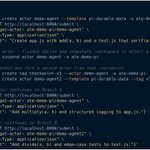
e.g. take Pi Durable. Pi checkpoints each step to a SQLite file on the drive. When the sandbox stops, even mid-turn, state in the drive is durably stashed away, and you can later attach a new sandbox to pick up the conversation right where it left off.
Reminds me of when I first learned about Durable Objects and how it warped my mind a bit. Can't wait to play around with this more.


Vercel Drives is generally available. You can now run stateful agents on Vercel.
vercel.com/blog/introducing-…
Demo code if you want to play along too!
github.com/taeold/durable-sa…
