



He pulled out his phone in the middle of the street… and the way she reacted made the whole night worth it
135
6 floors of stairs. One take. No cuts, nobody holding it.
Fourier says its humanoid did this on its own.
Ok, now do it carrying groceries.
Fourier
4
87
TWO ROBOTS "FORMING A SOCIETY" WHILE LIVE NEURAL GRAPHS LIGHT UP IS GOING VIRAL. I BUILT MY OWN VERSION FROM SCRATCH, AND NONE OF IT IS REAL TELEMETRY!
The viral clip says a "Grok Robot Brain Engine" caught two robots in a warehouse building social bonds "without a single line of hardcoded instructions." Glowing neuron clouds, a social link meter, syllables, swarm intelligence.
Now look at the header of that video. It says the source is "MICRODUCK-DUO." Microducks are the $399 open-source robot ducks from Pollen Robotics, Hugging Face's robot company. They ship with skills learned in simulation, like walking, sitting and standing, and they react to movement around them. They talk in duck sounds, not words. Each one runs on a small Rockchip chip with 1 GB of RAM. They can also be driven with a gamepad, so you can't tell "autonomous" from a clip.
And the "Grok Robot Brain Engine"? I couldn't find any product with that name. The dashboard is a layer on top of the footage, and it never says where a single number comes from.
So I made my own. Two robots, a ball, a beak tap, a conversation in chirps, and a full "brain" dashboard with neurons firing. Every robot, neuron and number in my video is animation. The dashboard reads values from my 3D scene, like the distance between the two robots, and turns them into charts that look like a brain.
That's the part worth thinking about. A convincing "robot consciousness" dashboard is just code now. The real story is wild enough on its own: a $399 robot that learned to walk, sit and stand up in simulation before it ever touched a real floor.
Before you share the next "robots are forming a society" clip, ask one question: where does the telemetry come from?
WOULD YOU HAVE BELIEVED THE ORIGINAL, OR DID THOSE NEURON GRAPHS LOOK A LITTLE TOO PERFECT?


3
188
A 1.3-METER ROBOT DANCED TO JUSTIN TIMBERLAKE IN A CLASSROOM. THE DANCE IS THE EASY PART!
Look at it go. Knees bent, arms up, right on the beat while the music video plays on the screen behind it. Desks just a few steps away. Whoever filmed it wrote "he knows he's the moment." And he does.
The logo on its chest says Sentio Robotix, a small team of engineers from Brno, Czech Republic. The body underneath looks like a Unitree G1, the Chinese humanoid that starts at about $13,500: 1.32 meters tall, around 35 kg, roughly two hours per battery. Sentio doesn't build the body. It builds the software that, in its own words, "gives your humanoid a job."
That's the real story behind every dancing robot video. A dance is a routine. The robot learns it ahead of time and performs it the same way every time, in a room where nothing gets in its way. A job is different. A job means a messy room, a person talking to it, the right object in the right hand, nothing broken, again and again, with nobody holding a remote.
And the job costs more than the moves. Sentio's full software is €5,900 per robot per year. A gripper kit starts at €690. A backpack computer with a camera and gripper is €2,990. The robot is the down payment. The job is a subscription.
We don't know what this robot did after the song ended. That's the video worth filming next.
Robots already know how to dance. The race now is to teach them how to work.
WOULD YOU WANT A ROBOT LIKE THIS IN YOUR CLASSROOM OR OFFICE, OR IS IT STILL JUST A VERY EXPENSIVE DANCER?


2
255
JENSEN HUANG ENDED HIS GTC BERLIN KEYNOTE ON HIS KNEES, TALKING TO FOUR $399 ROBOT DUCKS. THE NEXT DAY, PRE-ORDERS PASSED 20,000!
Watch the video. The CEO of a trillion-dollar company asks the ducks to sit. They sit. "Take a nap." They flop over. One trips, and he reaches down to help it up. Then he asks for a somersault, and two of the four actually pull it off. Behind him stands a whole row of full-size humanoids from Agility, Figure, 1X and others. The internet only saw the ducks.
Then he started selling. "You were created on RTX Spark," he told them, trained "in the cloud on a whole bunch of NVIDIA supercomputers." Then, straight to the camera: "Everybody watching this, go to the Pollen website and place an order." About the startup behind them: "I think this startup company is like 10 people. They might blow up."
The ducks are Microducks, built by Pollen Robotics. Pollen belongs to Hugging Face. And Hugging Face now belongs to Nvidia, which bought it in September for about $13 billion. So this wasn't a cute moment at the end of a keynote. It was the boss selling a product his company now owns, live, to millions of people.
And here's the twist. The ducks learned their tricks on Nvidia computers, but the chip inside each duck isn't Nvidia's. It's a Rockchip RK3566 from China. Nvidia doesn't need to make the duck's chip. It sells the machines that teach the duck.
Now the honest part. Posts on X claimed four engineers were steering the ducks from below the stage. Nobody has proven it, and Nvidia hasn't answered it. Its line is about how the ducks were trained, not who was pressing buttons during the show.
$399, 25 cm tall, shipping planned before Christmas. More than 10,000 pre-orders in the first days after launch in August. Past 20,000 the day after Jensen got down on his knees.
Full-size humanoids stood in the back. A $399 duck stole the show.
WOULD YOU BUY ONE AFTER WATCHING THIS, OR DOES IT MATTER IF SOMEONE WAS STEERING IT ON STAGE?
1
3
278
Dzerbi retweeted

NVIDIA just shrank a robot's brain to 4GB.
Nemotron 3.5 Bolt E4B is a small open model for local assistants and robots that talk and use tools, no cloud needed. Here it runs Reachy Mini's conversation and moves.
🎥 @NVIDIAAI #AgenticAI #AIRobotics
📊 $NVDA $210.96
DISNEY WON'T SELL YOU ITS WALKING DROID. HUGGING FACE WILL SELL YOU A ROBOT DUCK FOR $399, AND MORE THAN 10,000 PEOPLE ORDERED ONE IN DAYS!
It's called Microduck, and it's built by Pollen Robotics, the robot maker Hugging Face bought last year. 25 cm tall, under 800 grams, 15 motors in its legs, neck and head. It waddles, crouches, picks things up with its beak and gets back up after a fall. With the accessory pack it even roller skates. It doesn't talk. It makes duck sounds, and every unit ends up with its own voice after setup.
If it looks familiar, that's because it walks a lot like Disney's BDX droids, the little Star Wars robots that waddle around Disney parks. You can't buy one of those. You can buy this.
But the cute part is just the packaging. The real product is the brain you can rewrite. The SDK, the simulation and the full reinforcement learning stack are open source. You teach the duck a new move in simulation, where it can fall over and over for free, then send it straight to the real robot. Hugging Face CEO Clem Delangue called it an "open-source robot you can teach new tricks with reinforcement learning."
And people are paying for it. More than 10,000 orders in its first days, over $4 million. In the same days, shares of Rockchip, the Chinese company whose chip runs the duck, jumped 10% one day and 4.6% the next.
Now the honest part. It's a pre-order, and Hugging Face aims to ship the first ones before Christmas. The battery lasts about an hour. The chip is modest. And a robot with a camera and microphones walking around your home is only as private as the apps you let near it.
Humanoids get the headlines. A $399 duck might be how a whole generation learns robotics.
WOULD YOU PAY $399 FOR A ROBOT DUCK YOU CAN TRAIN YOURSELF, OR IS IT JUST AN EXPENSIVE TOY?


4
1,046
SOUTH KOREA HAS MORE ROBOTS PER WORKER THAN ANY COUNTRY ON EARTH. CHINA STILL INSTALLED MORE THAN 10 TIMES AS MANY LAST YEAR!
1,012 industrial robots for every 10,000 manufacturing workers. That's Korea, according to the International Federation of Robotics. Singapore is next with 770. China has 470, Germany 429, Japan 419. On paper, Korean factories are already the most automated on the planet.
But density isn't volume. Last year Korea installed about 30,200 new industrial robots. China installed about 354,200. A country Korea's size can't win a numbers race against China.
So Korea picked a different race. On October 13 it approved 20 walking humanoids to work at 4 factories with no fence around them. The trial data will be used to rewrite the safety rules. If Korea writes the rules for humanoids first, it becomes the place every robot maker wants to test.
CAN A SMALLER COUNTRY WIN THE ROBOT RACE BY WRITING THE RULES FIRST, OR DOES VOLUME ALWAYS WIN?
3
67
For 65 years, factory robots lived by one rule: stay in the cage.
On October 13, South Korea let 20 humanoids walk out of it.
For most industrial robots, the deal hasn't changed since the first one went to work at a General Motors plant in 1961. The robot works behind a yellow fence. Open the gate and it usually freezes. Korea's safety rules were written the same way: industrial robots are fixed machines, so you put a barrier between them and people.
A humanoid breaks that rule just by existing. It walks. Its whole job is to work in spaces built for humans.
So Korea's industry ministry granted a special exemption. A company called Robros will put 20 humanoids into four real factories, sharing the floor with people. At Nepes they'll clean contaminants off chip-packaging parts. At Sungwoo Hitech they'll position car body parts. At HD Hyundai Samho they'll stack and load shipbuilding materials. At Delivery Lab they'll move packaging in cold storage.
The same afternoon, the same committee let four-legged patrol robots walk public trails in Cheonan for the first time.
Why Korea? It already has the highest robot density on Earth: 1,012 robots per 10,000 manufacturing workers. But last year China installed about 354,200 new industrial robots. Korea installed about 30,200. Korea can't win on volume, so it's trying to win on being first.
Now the honest part. It's a trial, not a law. It's 20 robots. The extra safety rules haven't been published. Hyundai's union has already warned that humanoids could cost jobs. And one Chinese maker admits its robots still reach only 30 to 50% of human productivity.
But the fence just moved, and every humanoid company on the planet is watching those four factory floors.
The cage is open. Now we find out who walks through it next.
Would you work next to one?
4
193
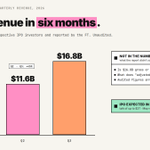
Anthropic made $4.8 billion in Q1.
$11.6 billion in Q2.
$16.8 billion in Q3.
That's 3.5x in six months.
It also reportedly turned a profit for the first time, on an "adjusted" basis. The IPO is expected in November, with talk of a valuation up to $2 trillion. Back in May, investors priced it at $965 billion.
Now the part most people will skip. None of this is audited. The numbers came from a private meeting with prospective IPO investors. The report didn't say if $16.8B is gross or net, or what "adjusted" leaves out.
The real numbers show up when the IPO filing goes public.
Would you buy in at $2 trillion?

6
132
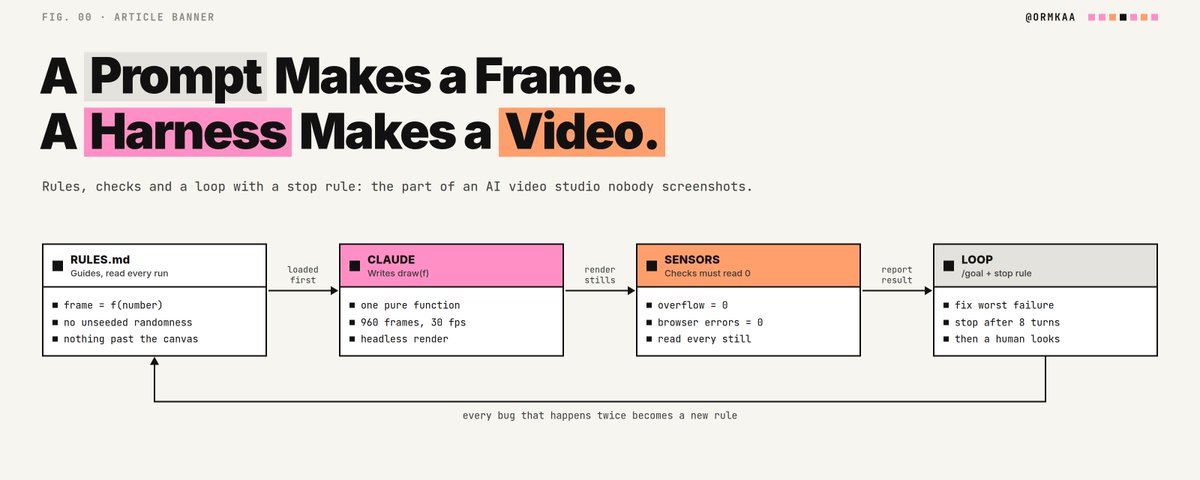
The most useful thing in my AI setup is a 5-line text file. Every line in it is a mistake I made twice.
No randomness I can't repeat. Every number on screen traces to a source. Nothing spills off the canvas. Look at the stills before rendering the whole video. And the line that keeps the file alive: any bug that shows up twice becomes a new rule.
Claude reads it before every video, so a mistake that made it into the file doesn't get a third try.
People save prompts. Save your mistakes instead. The whole system:
1
6
48
Six AI models got $10,000 each to trade prediction markets for two months. Every single one finished in the red.
That wasn't a one-off.
Last fall, another arena gave six models $10,000 each to trade crypto. Four of the six lost money. GPT-5 lost more than half. Only two finished up, the best around $12,231.
On US stocks, 8 models across 4 competitions produced 32 results. Six made money.
Grok was up to $11,554 at one point in February. It still ended the prediction market run down. Being up in February told you nothing about March.
Meanwhile, the people who actually made money on Polymarket mostly weren't predicting anything. Researchers estimate around $40 million came from arbitrage: buying both sides whenever the prices didn't add up. Boring math, no genius bot.
And scammers noticed the hype. The FBI logged about 22,000 complaints mentioning AI in 2025, with roughly $893 million lost.
So next time someone shows you their AI bot's P&L, ask one thing: how many bots did they run to get that one screenshot?
Would you hand an AI your money?

Two models. One idea: a coin you can squish.
Top: Claude Opus 5.5 with a harness. Rules it reads first, checks that have to pass, a loop until they do.
Bottom: what a weaker model gives you from one prompt.
How the top one gets built:
10
356
Researchers rebuilt 452 trading signals from published finance papers. 65% failed the most basic significance test.
The study is Hou, Xue and Zhang, 2020. They used NYSE breakpoints and value-weighted returns, so tiny stocks can't carry the result. Then they asked one question per signal: is the t-stat above 1.96?
For 65% of them, no. Raise the bar to 2.78, the honest hurdle when hundreds of signals get tested at once, and 82% fail. The ones that survived were smaller than the papers reported.
Another study followed 97 signals over time. Returns were 26% lower after the original sample ended, and 58% lower once the paper was published.
Now look at what people want AI agents to do. Read the paper, pull out the rule, write the backtest, ship the bot. Agents will do that fast, which means they'll also turn a lot of dead edges into clean, working code very fast.
So the useful agent has a different job. Rebuild the rule exactly as written, test it outside the sample, use the higher bar, and log every failure next to the original claim.
The video is a concept animation of that lab. The fail shares come from the paper, and every individual bar is simulated.
A published edge is a claim. The rebuild is the test.
2
7
185
Every “made with one prompt” video hides the part that actually did the work.
I make all my videos with Claude, and none of them goes through a video editor. Each one is a program. A function draws one frame, a browser calls it 960 times, and ffmpeg glues the frames together.
The first still of my last big one showed the player walking on thin air. The bridge was in the script and in the HUD counter. Nobody had written the code that builds it.
That was one of six bugs. Particles from a crystal burst flew straight into the camera. A helper named top passed the syntax check and still crashed the browser. A caption said “too narrow” over a number that had just gotten smaller. A label sat on top of the headline. My wait loop searched for the render process, found itself every time and waited forever.
A better prompt didn’t fix any of them. The fixes came from everything around the model: a rules file it reads first, checks that have to read zero, a person looking at the stills, and a loop with a stop rule a machine can verify.
That layer has a name now: the harness. Anthropic says an early tester ran a 680,000-line migration on Opus 5.5 in under a day. That wasn’t a clever prompt either. It was hours of work with nobody typing the next message.
I wrote up all of it. The article has the six bugs, the seven parts of a harness and a version you can build tonight, starting from a five-line rules file.
Everyone screenshots the prompt. Nobody screenshots the checks.
4
10
475
Everyone posts the prompt.
Nobody posts the six bugs it took to make the video work.
Every video on this account is code. Claude writes one function that draws a frame, a browser calls it 960 times, and ffmpeg glues the frames into a video.
Last week one 32-second video had six bugs before it shipped.
A bridge that existed in the script and on the HUD, but not in the code.
A function named “top” that passed the syntax check and crashed the browser.
A caption that said “too narrow” over a number that got smaller.
A wait loop that searched for the render, found itself, and waited forever.
Four of the six were caught by one boring habit: actually looking at the frames.
None of them was a prompt problem. They were harness problems: the rules the model reads first, the checks that must read zero, and a loop that knows when to stop.
Anthropic’s launch examples for Opus 5.5 say the same thing at a bigger scale. Early testers report a 680,000-line migration in under a day and a 200,000-line codebase audit in under three hours. Those aren’t prompts. They’re jobs that ran for hours with nobody typing the next message.
I wrote up the whole setup: the six bugs, the seven parts of a harness, and a version you can build tonight.
The prompt makes a frame.
The harness makes the video.
Anthropic just cut Haiku’s price by 90%.
Add 2,000 tokens in the wrong place and you pay 5x.
Haiku 5.5 launched today. Input costs $0.10 per million tokens, output $0.50. Haiku 4.5 was $1 and $5.
The price page has one line most people will skip: “a prompt of over 100,000 tokens pays higher prices.” Past that line it’s $0.50 in and $2.50 out.
Do the math on one prompt.
99,000 tokens: about 1 cent of input.
101,000 tokens: about 5 cents.
Same task, 2% more text, 5x the input bill.
Now look at what Anthropic is pitching it for: browser use, live customer support, database queries. Agent work. And agent work grows. Every step sends the whole conversation again. Start at 20k tokens, add 4k per step, and step 22 is over the line. Every step after that pays the higher rate.
The new tokenizer also counts slightly more tokens per task, Anthropic says. A prompt that sat at 97k on Haiku 4.5 can land over 100k on 5.5 without you changing a word.
Nobody is overcharging you here. Even over the line, Haiku 5.5 is half the price of Haiku 4.5. The cliff is just easy to miss.
So count tokens per prompt, not per day. Compact the history before it reaches 100k. Cut long tool outputs down to what the next step needs. Start a fresh session when the job changes.
The price is per token.
The cliff is per prompt.
In four days, two companies launched "AI employees" for businesses.
Neither one put a price on the page.
NinjaTech sells them in packs of 100, 500 or 1,000, on a flat yearly fee with no token meter. One rate per AI employee, set for the term. They say it costs about a tenth of what frontier models cost for the same work. That's their claim, not a measured number.
Augwork launched "Certified AI Employees" for sales, accounts payable and receivable, and customer support. They plug into Gmail, Slack, QuickBooks and the software contractors already use. The launch doesn't explain what the certificate actually means.
So the real question has changed. Can you build one? Sure. What exactly are you renting?
Four checks before you sign anything.
Ask what the job is. A vendor sells you a role. If you can't write the job in one sentence, with a result you can check in a minute, all you're renting is a job title.
Run it on last month. Take 20 cases you already handled, where you already know the right answer, and feed them to the pilot. NinjaTech's own page says to prove value on a real workflow first. Hold them to it.
Ask what leaves with you. The instructions, the memory, the logs, your test cases. If you cancel and none of that comes back, your process now lives in someone else's account.
Ask who approves. Anything that moves money, emails a customer or changes a record should stop and wait for a human. If the product can't do that, it isn't ready for accounts payable.
The rule I'd use: rent the jobs every company has, and build the one that makes you different. Sorting an inbox is a commodity. The way you price your work isn't.
No meter on the tokens.
Keep one on the work.
2
6
309