

@LeverhulmeTrust ECR Fellow @Durham_theology. PhD from @kingsclassics. Early Christianity // Late Antiquity // Greco-Roman Culture.
Cambridge, England
Joined June 2017
- Tweets1.4K
- Following501
- Followers1.1K
- Likes3.9K





Ed Creedy retweeted

“The need to promote ourselves and push ahead, to command the attention and adoration of our audiences: it all fades as you trudge, pottery-crunching step by step, up the side of this monument to human fragility. Jars of clay filled with riches beyond compare. Finite, broken beings filled with an infinite, unbreakable divinity. Human necessity turned lasting glory. Behind that unassuming gate, across from the uninspiring petrol station forecourt, we are reminded of the quiet glory of the Christian life.” @edcreedy
plough.com/articles/the-quie…

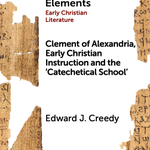
Great to join @Jcsolheid on his @PatristiCast podcast yesterday to discuss all things Clement of Alexandria in light of my new study on Clement and the Catechetical School, out recently with @CambUP_Religion.
Watch or listen in at the link below.
edwardcreedy.substack.com/p/…
An excellent statement, and one with salience for scholars of early Christianity and antiquity well beyond Biblical Studies.

Ed Creedy retweeted

The latest issue of Vetus Testamentum features a statement from the editors: "We reject with prejudice the usage of GenAI for brainstorming, structuring, and composing studies of the biblical text and its historical and social contexts."


Ed Creedy retweeted
“In the backstreets of a city suburb, with the laughter of children from a nearby school carried by the wind across the gently rising hillside, Monte Testaccio hints at an antidote to the power and might for which Rome is so often celebrated. The quiet glory of this mountain of potsherds urges us to shrug off the burden of self-exaltation.” @edcreedy
plough.com/articles/the-quie…
New from me @Plough - 'The Quiet Glory of Potsherds'.
On Rome, the Apostle Paul, and true human glory.
plough.com/articles/the-quie…
Yes, helpful reflections. In UK free church contexts, the slow death of ecclesiology and - often - distinctive polity has been a serious misstep. These things matter greatly, but we so willingly disregard, and so rarely teach them.

A fantastic performance of Euripides’ Ion for the Cambridge Greek Play 2026 at the @ArtsTheatreCamb. The acting was both witty and moving, and Euripides’ dialogue still sends shivers down the spines of audiences 2500 years later. Wonderful.

In a tradition stretching back to the depths of antiquity, through the post-reformation growth of non-conformity, comes modern miscellany writing from a small British Baptist press, intriguing! @gracepubbooks
shop.gracepublications.co.uk…

I, too, aspire to have obscure (publishable) academic afterthoughts a decade after my initial interest.

I've been delighted by the interest in 'Clement of Alexandra, Early Christian Instruction and the Catechetical School'. It remains free to read until *this Thursday*. If you're looking for a hit of early Christian educational culture, look no further.
cambridge.org/core/elements/…

I'm not American but I think this is bang on. One of the cultural practices that a Christianising Roman Empire turned its back on was spectacular criminal executions. Such acts were deemed to appeal to sinful vice, and to be far from the purity of sight called for in Scripture.

This is still free to read online for the next nine days, don't miss your chance to explore all things Clement, Catechetical and Christian in second-century Alexandria!

Don’t miss your chance to read the new Cambridge element, Clement of Alexandria, Early Christian Instruction and the 'Catechetical School' by Edward J. Creedy @edcreedy! Free access available until 15 October at
cup.org/4iAFQvB
#cambridgeelements #religion

I posted this thread a few days ago. After reflecting further, I've written a longer piece over on my substack.
I specifically address the new resource from Mere Orthodoxy, 'The Faith Received', and lay out some of my concerns in greater detail.
edwardcreedy.substack.com/p/…


I conclude with a question, and a suggestion.
We need to be blunt: what is TFR actually offering its readers with its AI-generated translations?
And could we be better? What is TFR centred its human authors and readers in its approach? Think what this resource could be...
I appreciate I haven't thought of every dimension, and I hope I haven't been unfair in my criticism (I welcome graceful engagement from @mereorthodoxy folk), but I do think these conversations are important. If we don't have them now, when will we?
This is both wise and true. Human creativity in all its forms is an intrinsic reflection of the Creator God, and in its very *being* it is simply impossible for a machine to replicate that. Glad such comments are being made, disseminated, and celebrated.

In this era of artificial intelligence, it is becoming urgent to distinguish human art from what machines produce. There is an ontological difference, even before an aesthetic one, between art and what a machine can generate through statistical calculation based on millions of images created by others. Algorithms lack the spark of humanity. For this reason, the Church wishes to renew an alliance with artists and cultural institutions to safeguard our humanity.