

America's Most Secure Cellphone Service (https://xitter.cf/t.co/KgeWAAAUe9)
San Francisco, California
Joined January 2012
- Tweets3.8K
- Following6
- Followers9.3K
- Likes2.7K


You can secure your phone and still leave a recognizable trail online.
On DailyCyber with @BrandonKrieger, our GM Mark Kreitzman explains why going “off-grid” with a smartphone is harder than it sounds.
Browser fingerprints, device characteristics, and advertising identifiers create different ways to recognize activity and connect it across services. You don’t always need to type your name for a tracker to recognize a returning browser.
For executives, founders, and crypto holders, that raises an important question: how easily can your browsing, public identity, and sensitive accounts be connected?
At @efani, protecting mobile identity is central to our work. It belongs alongside attention to the apps, browsers, and accounts you use every day.
Watch Mark’s explanation. Full interview in the next post. 👇
Can you really go “off-grid” with a smartphone?
Watch Efani GM Mark Kreitzman’s full DailyCyber conversation with @BrandonKrieger on mobile privacy, SIM swapping, and protecting your digital identity.
youtube.com/watch?v=oMJIultg…
🔒 What if sensitive data on your phone could look like empty storage?
Encryption protects the contents of your data. Plausible deniability addresses another question: can someone tell that the hidden data exists?
In this clip, Josh Thomas, Founder and CEO of Deniable, explains to @efani’s Mark Kreitzman how Deniable’s hidden environment is designed to blend into encrypted storage when locked.
He demonstrates a separate space for apps, browser history and photographs; including a photo that does not appear in the main environment.
For executives, journalists and crypto holders, the privacy question goes beyond who can read your messages. It also includes what someone could discover by inspecting your unlocked phone.
Watch the explanation and demo. Full interview and Deniable website in the next post. 👇
How does a hidden phone environment work?
Josh Thomas explains Deniable’s approach to encrypted storage and plausible deniability in our full interview with Mark Kreitzman.
Watch:
youtu.be/WQ8vnYbrXrU
Explore Deniable:
deniable.io/
🚨 BREAKING: The U.S. government has BANNED DeepSeek AI from federal civilian IT systems over national security concerns.
DHS has ordered agencies to remove DeepSeek technology, including third-party tools using its models, and stop future purchases.
The warning extends to mobile privacy.
Researchers previously found DeepSeek's iOS app transmitting some device data without encryption and using weak security practices.
For executives, crypto investors and high-risk individuals, sensitive AI prompts and device data deserve far more scrutiny.
Here's what you need to know. 🧵👇

For executives, crypto investors and enterprise users, AI prompts can expose:
• Confidential business plans
• Private communications
• Financial details
• Internal documents
A phone connected to sensitive accounts should never become an uncontrolled channel for sending data to AI providers.
At @efani, we believe mobile security must extend beyond the cellular network.
Audit AI apps, review permissions, restrict sensitive uploads and verify third-party integrations.
The DHS order applies to federal civilian systems, but the privacy lesson applies to everyone.
What if deleting your data isn’t enough - and the next privacy strategy is making your profile harder to trust?
On DailyCyber with @BrandonKrieger, our GM Mark Kreitzman makes a provocative case for “data poisoning”: using aliases and a separate public-facing phone number to make collected information harder to connect to your real identity.
For founders, executives, and crypto holders, the question matters: how easily can someone connect your public presence to the number tied to your sensitive accounts?
At @efani, we see reducing unnecessary exposure and protecting your mobile identity as complementary goals.
Could deliberate data confusion become part of privacy protection? Watch Mark’s take, then find the full interview in the next post. 👇
Watch Efani GM Mark Kreitzman’s full conversation with @BrandonKrieger on DailyCyber.
They discuss personal data exposure, SIM swapping, and the challenges of protecting your mobile identity.
youtube.com/watch?v=oMJIultg…
🔒 Some phone privacy protections need to go deeper than an app.
If someone forces you to unlock your phone, protecting sensitive information depends on how the device handles access, encryption and separate environments.
That is why Deniable is an operating system.
In this clip, Josh Thomas, Founder and CEO of Deniable, explains to Efani’s Mark Kreitzman why its approach to plausible deniability requires system-level control. He discusses its @GrapheneOS foundation, verified boot, and the options for getting a preconfigured phone or installing the software on a supported device.
For executives, crypto holders and anyone carrying sensitive information, understanding WHERE a security feature operates helps you understand what you are trusting it to protect.
Watch Josh explain the difference. Full interview and Deniable website in the next post. 👇
Why does Deniable need its own operating system? How do you install it?
Josh Thomas explains the architecture and setup options in our full conversation with Mark Kreitzman.
Watch:
youtu.be/WQ8vnYbrXrU
Explore Deniable:
deniable.io/
‼️ Hackers are using FAKE Meta job interviews to steal Facebook and Google accounts, even when 2FA is enabled.
Malwarebytes uncovered a phishing campaign using fake Calendly pages to book 30-minute recruiter calls.
Victims choose a slot, enter personal details and complete a fake CAPTCHA.
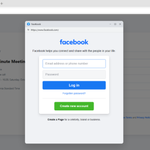
Then comes the trap: fake Facebook and Google logins that steal passwords and 2FA codes in real time.
Your phone's security codes can become the attacker's way in.
🧵


Your phone is part of this attack.
Scammers can request SMS/WhatsApp OTPs, authenticator codes and Google sign-in approvals.
If your Google account falls, attackers may also access email, recovery options and password resets for other services.
High-value accounts face serious exposure.
Protect yourself:
- Verify recruiters independently
- Use passkeys or hardware security keys
- Never share OTPs or approve unexpected prompts
- Secure your mobile number against SIM swaps and unauthorized port-outs
- Review recovery settings and active sessions
Your phone number deserves protection too. This is what we do @efani!
⚠️ Your crypto security plan needs an answer to: “Unlock your phone. Now.”
An attacker who threatens you directly may never need to crack a password. That is the danger behind a “wrench attack” - using physical coercion to force someone to surrender access to their assets.
Your phone can reveal wallet apps, exchange accounts, private conversations and clues about what you own. For high-value targets, that exposure deserves serious attention.
In this clip, Efani’s Mark Kreitzman and Deniable founder Josh Thomas discuss the “decoy wallet” analogy: revealing a limited environment while keeping more sensitive information separate.
Josh explains how that thinking informs Deniable’s approach to phone privacy. It cannot guarantee safety during an attack, but it raises a question every crypto holder should consider:
How much would someone discover if they forced you to open your phone?
At @efani, we see phone-number protection, account security and device privacy as connected parts of protecting your digital life.
Watch the clip. Full interview and Deniable details in the next post. 👇
Watch Josh Thomas and Mark Kreitzman discuss crypto security, coerced unlocking and Deniable’s approach to phone privacy.
Full interview:
youtu.be/WQ8vnYbrXrU
Learn about Deniable:
deniable.io/
🚨 A 5-day-old domain was already copying Microsoft Teams’ login screen and interface.
Researcher Steven Lim flagged teams-cloud[.]live on October 18, warning organizations to block it.
For employees joining meetings on their phones, a familiar Teams screen can make an unexpected login request look legitimate. Entering work credentials there could put confidential conversations, company files and client information at risk if attackers gain access.
Bookmark this thread for the warning signs and protective steps.

A company name in the address proves nothing.
The reported amgen[.]teams-cloud[.]live subdomain still sits under teams-cloud[.]live.
That does NOT establish an Amgen breach. The report also provides no confirmed victim count or evidence of captured passwords.
On mobile, open Teams directly and verify unexpected login or update requests with IT.
Enterprises: block the reported domain, investigate visits and enforce phishing-resistant MFA using passkeys or FIDO2 security keys.
A copied login page should never be enough.
#Cybersecurity #Microsoft #Efani