


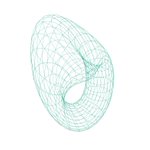
Very funny! (at least to those who know some geometric algebra). Well done by @EelcoHooge71137
Steven De Keninck retweeted

Article is out now
youtu.be/YdrfkUiG0j8

The Philosophical Transactions from the Royal Society Theme issue "Modern Applications of Geometric Algebra" is now available in open access at royalsocietypublishing.org/r…

Steven De Keninck retweeted

If you are a mathematician, then you may want to make sure you are sitting down before reading further.
Steven De Keninck retweeted

Solid mathematical ideas almost always outperform contrived engineering tricks.
For years deep learning has been dominated by increasingly complex architectural hacks: CNN blocks, attention layers, channel mixers, residual pathways, normalization stacks.
Every few years a new architecture is announced as if it were a revolution.
One of the most famous examples was Kaiming He and Residual Networks (ResNet). At the time he was paraded around the AI world like a celebrity because residual connections supposedly “solved” deep learning.
But these were largely engineering patches.
Now something much more interesting appeared.
A new architecture called CliffordNet returns to mathematics — specifically Clifford Algebra, developed in the 19th century by William Kingdon Clifford.
Instead of stacking arbitrary modules, the model is built around the geometric product
uv = u·v + u∧v
A single algebraic operation that simultaneously captures inner product structure and geometric interactions.
In other words: the math already contains the interaction mechanism.
No attention blocks.
No mixer layers.
No architectural spaghetti.
The result:
• 77.82% accuracy on CIFAR-100 with only 1.4M parameters
• roughly 8× fewer parameters than ResNet-18
And with strict O(N) complexity.
The paper even suggests that once geometric interactions are modeled correctly, feed-forward networks become largely redundant.
A good reminder for the AI community.
Engineering tricks can dominate for years.
But eventually mathematics shows up and deletes half the architecture.
Paper:
[arxiv.org/pdf/2601.06793?utm…)
19th century geometry just walked into computer vision.

PGA turns out to be quite eloquent a language for dealing with k-simplices and k-complexes. We explore that in this writeup filled with general, elegant and dimension agnostic formulae.
researchgate.net/publication…


Steven De Keninck retweeted
Clifford Algebra Neural Networks are undeservedly dismissed for being too slow, but they don't have to be!
🚀Introducing **flash-clifford**: a hardware-efficient implementation of Clifford Algebra NNs in Triton, featuring the fastest equivariant primitives that scale.

Steven De Keninck retweeted

peeterjoot.com/2025/08/11/ne…
New version of my book now tagged and uploaded: GAelectrodynamics.V0.3.6.4.pdf

To understand rotations, you must first understand reflections.
My CGI2025 talk on coordinate free circular splines.
youtu.be/m317-cYs8q4
Steven De Keninck retweeted

Logarithmic maps are incredibly useful for algorithms on surfaces--they're local 2D coordinates centered at a given source.
@yousufmsoliman and I found a better way to compute log maps w/ fast short-time heat flow in "The Affine Heat Method" presented @ SGP2025 today! 🧵
Steven De Keninck retweeted

Ok. This is my life’s work as seen by C Jaimungal.
Done in near isolation from community for reasons I do not grasp, Geometric Unity has never received this kind of treatment in 40 yrs.
I’m sort of speechless and don’t know what to say. except “Thank you.” before I watch it. 🙏

Huge news... I've been working on something assiduously and secretly since last year. It's been several months in the making, with several rewrites and several re-edits. It's finally ready to be released, thus shadow dropping it now. It's a 3-hour iceberg on @ericweinstein's Geometric Unity. I work on understanding and explaining different Theories of Everything for a living, and this one is unlike any other you've seen. This iceberg covers the graduate-level math, but it also constantly provides explainers aimed at different levels for those who are uninitiated with physics and differential geometry. Enjoy.
Steven De Keninck retweeted

🚨 If you're interested in interpretable Neural Operators and AI4Science, I'll see you at #ICLR2025, Poster #32, Poster Session 3, Hall 3 + Hall 2B, Singapore EXPO, April 25th!🇸🇬
📜 read it here: lnkd.in/dvi_S6Dm – at Singapore

Steven De Keninck retweeted

I've updated my blog post to walk through the remaining technical details of our Surface Winding Numbers algorithm: now the calculus of the algorithm is explained a bit more in detail.
The post, paper, code, etc. is all here: nzfeng.github.io/research/WN…

My SIGGRAPH 2023 presentation of "Winding Numbers on Discrete Surfaces", authored with @MarkGillespie64 and @keenanisalive , is now on YouTube: youtu.be/QnMx3s4_4WY
Steven De Keninck retweeted

ENGAGE workshop is back! This workshop focusing on Geometric Algebra, has deadlines approaching:
Abstract submission: April 31, 2025.
Paper submission: May 2, 2025.
Check it out! engage-workshop.org/
#GeometricAlgebra
Steven De Keninck retweeted

Our paper got a prize :)
Cheers to lead author @johannbrehmer, and fellow co-authors Sönke Behrends, and @TacoCohen.
Our results hint that yes, also at large scale of data and compute, if your data has symmetries, you might be better off building these into your network.


Steven De Keninck retweeted

Entropy is one of those formulas that many of us learn, swallow whole, and even use regularly without really understanding.
(E.g., where does that “log” come from? Are there other possible formulas?)
Yet there's an intuitive & almost inevitable way to arrive at this expression.
Steven De Keninck retweeted

I have always been disappointed that more instruction sets don’t have peak-efficiency block move and fill operations. REP MOVS/STOS in x86/x64 is still pretty great, although not optimal in all cases. news.ycombinator.com/item?id…
There is certainly a bias against it due to not being RISCy, but even a tiny SoC today would barely notice the addition of a little move engine grafted onto the CPU. In fact, many already do have various DMA engines available, but they aren’t accessible to user mode programs, or properly integrated into the cache hierarchy.
CPU architectures target doing the easy things in hardware and letting software work out all the messy edge cases, which was evolutionarily adaptive for a long time, but while RISC instructions handily beat out microcode, actual hardware gates in parallel handle picky edge cases better than software, as shown with a lot of compression acceleration.
Game machines often had DMA and blitters that were easily programmable and could completely saturate memory bandwidth. coranac.com/tonc/text/dma.ht…
GPUs have dedicated memory move engines, but at the high level you sometimes wind up using shaders to block copy memory, which is terrible.
The benefit for CPU architectures would be that an instruction could automatically tailor itself to the exact memory configuration it is running on, which even the most specialized hand-coded routines can’t do in a forward compatible way. There are dozens of different cache and memory controller configurations in the wild right now.
It can be argued that it just isn’t worth it – the last statistics I saw had memset/memcpy operations only consuming a few percent of most program mixes, but that may have changed, and probably doesn’t include all the inlined small operations. Also, most truly high performance programming arranges to completely avoid copies and fills altogether.
However, much of Moore’s Law’s million-fold progress is a compounding of small improvements, and any improvement on existing code is the minimum speedup, which may be exceeded as programming styles adapt to the new capabilities.
While we are at it, integrate better cache control, which can wind up being much more significant. I miss DCBZ and friends on non-PPC architectures. ibm.com/docs/vi/aix/7.2?topi…
And maybe even allow it to be fully asynchronous, with different priorities relative to conventional instructions. Again, hardware like that exists, it just isn’t user mode accessible on most systems.
Of course, it has to actually be great, not just exist. I remember early rumors in the 80s that the Apple IIGS’s 65816 CPU would have a 2 cycle/byte block move instruction, but MVN / MVP wound up being 7 cycles/byte. Disappointing. snes.nesdev.org/wiki/MVN_and…