





ALT Most of us learn in 1D. We read more. Maybe we watch a few videos. Then we wonder why nothing sticks. In Varun Mayya’s “This Is How You Become 10x Smarter,” one idea stands out: multimodal learning . AI models got a lot smarter when they stopped being just “text” and started understanding images, audio, video, and code together . Humans work the same way. If you only read, your understanding is flat. But if you also watch, build, explain, and teach, each mode reinforces the others. The goal isn’t to become a content creator. It’s to become someone who can think and communicate across formats, because that’s how you truly internalize what you’re learning.

ALT LLMs don’t process words or characters. They process tokens. Why? Tokens are the fundamental units of text (or data) that LLMs actually use to understand and process language. This finally clicked for me when I looked at the trade-offs: If you use whole words as units, the vocabulary explodes with names, slang, typos, and every new term the internet invents. If you use characters, your sequences get huge, and attention suddenly becomes slow and expensive. Tokens are the middle path: subword chunks that appear again and again across words. They keep the vocabulary manageable, the sequences shorter, and still carry enough meaning for the model to learn useful patterns. The part I’d been underestimating: this “invisible” design choice — how we tokenize — quietly shapes everything: model size, speed, context limits, even some of the weird failures you see in the wild. Now, when I explore a new model, “what tokenizer was this trained with?” feels like a more useful first question than

ALT Mathematics is the language of the universe; LLMs translate our language into math and math back into language. Here’s what that loop looks like in simple steps: Step 1 – Identify Notice patterns in text: repetition, predictability, structure, hierarchy in sentences. Step 2 – Formalize Choose the math for each pattern: probabilities for “what comes next”, vectors for similarity, trees for structure, logic for rules. Step 3 – Encode (Language → Math) Turn words into mathematical objects (numbers, embeddings, structures) that capture those patterns. Step 4 – Compute (Math → Math) Do the “thinking” in math space: combine vectors, update probabilities, optimize a loss — all pure computation. Step 5 – Decode (Math → Language) Map the mathematical result back into natural language: pick tokens, form sentences, match tone and style. Every LLM interaction is a Language → Math → Language loop, with the model acting as a translator between our words and the universe’s language.

ALT The new efficiency stack: MaaS → SaaS → Business SaaS (Software as a Service) we know. Cloud apps. Subscriptions. Makes business faster. MaaS (Model as a Service) is the new layer. AI models via API that power how SaaS gets built. Not a feature inside SaaS. The foundation it runs on. What this means for business: MaaS lets SaaS teams ship faster and smarter. Business gets better tools without doing the AI work themselves. Simple flow: MaaS accelerates SaaS. SaaS accelerates business. Progress in MaaS is wild. The bottleneck? SaaS integration at reliable scale.

ALT One word for AI post‑2020: SCALE We talk a lot about “AI breakthroughs.” But the real breakthrough after 2020 wasn’t a brand‑new idea or some magical new architecture. It was scale. We scaled - data - compute - and deployment points That’s how AI went from research labs to something you can open on your phone. Scale is the quiet difference between “this is interesting” and “I can actually build with this now.”

ALT We have endless metrics for model performance. How many do we have for data quality? Data quality still feels like a guessing game. We can track accuracy, AUC, F1 to the third decimal. Dashboards, alerts, weekly reports… all focused on the model. But ask “How good is our training data?” and the answers are usually fuzzy: “clean enough”, “we did some checks”, “it should be fine”. If “garbage in, garbage out” is still true, shouldn’t we be more precise about the “in”? Right now I’m exploring what a simple, practical set of **data‑quality metrics** could look like. Curious how others do this: how do you measure data quality today, beyond gut feel?

ALT Why do we call it “prompt engineering” and not just “prompt writing”? Because a good prompt isn’t written once. You: add clear rules test it on many questions change words and structure keep improving it until the answers are reliable That’s more than writing. That’s designing how the AI behaves. So the word “engineering” isn’t hype. It’s a reminder to treat prompts like real system pieces, not throwaway text.

ALT The models went multimodal. The “LLM” tag stayed stuck. LLM = Large Language Model LMM = Large Multimodal Model LMMs are built on top of LLMs: Keep the language model as the core. Add encoders for other modalities (image / audio / video). Those encoders turn non‑text inputs into vectors. Map those vectors into the same space as text. Feed everything into the same LLM backbone. The LLM still does the main reasoning, just over more kinds of input now. LMM = LLM + Modality Encoders + Projector (into LLM token space). When you think about GPT‑4o or Gemini, what’s the word in your head: LLM, LMM, or just “AI”?


ALT RAG hype confused me. Retrieval isn't new... right? Search engines were optimized for this. Generation must be the "new" part I thought. 𝗜 𝘄𝗮𝘀 𝘄𝗿𝗼𝗻𝗴! The difference? 𝗥𝗲𝘁𝗿𝗶𝗲𝘃𝗮𝗹 𝗲𝘃𝗼𝗹𝘂𝘁𝗶𝗼𝗻. OLD → Search engines used keyword matching NEW → RAG uses keywords + 𝘀𝗲𝗺𝗮𝗻𝘁𝗶𝗰 𝘂𝗻𝗱𝗲𝗿𝘀𝘁𝗮𝗻𝗱𝗶𝗻𝗴 Generation gets all the headlines. But 𝗿𝗲𝘁𝗿𝗶𝗲𝘃𝗮𝗹 𝘄𝗮𝘀 𝘁𝗵𝗲 𝗿𝗲𝗮𝗹 𝘂𝗽𝗴𝗿𝗮𝗱𝗲 all along.
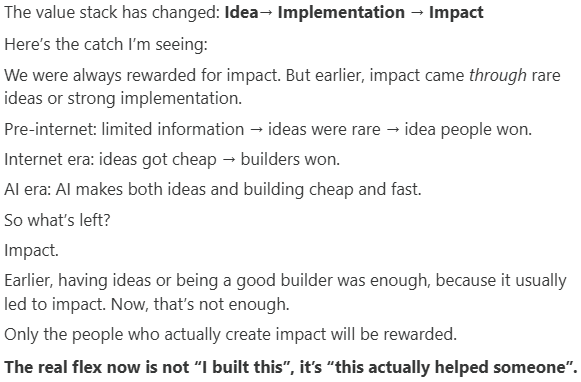
ALT The value stack has changed: Idea→ Implementation → Impact Here’s the catch I’m seeing: We were always rewarded for impact. But earlier, impact came through rare ideas or strong implementation. Pre‑internet: limited information → ideas were rare → idea people won. Internet era: ideas got cheap → builders won. AI era: AI makes both ideas and building cheap and fast. So what’s left? Impact. Earlier, having ideas or being a good builder was enough, because it usually led to impact. Now, that’s not enough. Only the people who actually create impact will be rewarded. The real flex now is not “I built this”, it’s “this actually helped someone”.

