






Pinned Tweet
Remember truth is on the march, and nothing will stop it. — Émile Zola. It comes from the ion (I9+O15+N14=38), like 3/8 🕓🇨🇭, from soul to heart. Marche in Italy 🇮🇹 is linked to SE ↘️ ≈ Ionian Sea ≈ ~85 % Na⁺ & Cl⁻ ≈ 🇪🇬. Other acronym: Intelligence, Observation, Naturalism.
🤖 Made with AI


Fabio Emile Zola retweeted

"Learning is the only thing the mind never exhausts, never fears, and never regrets."
- Leonardo Da Vinci

Fabio Emile Zola retweeted

"Not only is the Universe stranger than we think, it is stranger than we can think."
— Werner Heisenberg
Fabio Emile Zola retweeted

Euler's formula (eⁱᶿ = cos θ + i sin θ) is fundamentally a dynamic statement about rotation, growth, and circular motion in the complex plane.


Fabio Emile Zola retweeted

AI Chip War for Dummies
The AI chip war is getting framed the wrong way. Everyone wants to talk about this chip vs that chip or performance and token speed. That’s not where the real fight is. The real AI architecture war is about data movement.
I’ve been asked so many times the differences between this new system AI architecture in context to the companies who are succeeding in the AI infrastructure market.
I've been working on a simple framework to explain the major architectures around NVIDIA GPU, Google TPU, AMD Instinct, Cerebras and AWS Trainium and thought I’d put this out it for reference. A kind of "AI Infrastructure Chip Architecture for Dummies".
Bottom Line: To understand AI and who is doing what and why things are growing so fast you have to frame it around three basic questions: MATH → MEMORY → NETWORK
1. Math: How do you do the multiplication?
2. Memory: How do you keep the compute engines fed?
3. Network: How do you scale that across thousands of chips?
Once you look at the market this way, the strategies of the big players become much clearer around their bets, what they are building, and the tech behind it.
NVIDIA: Bet on programmability. Build incredibly capable compute, wrap it in CUDA, then use HBM, NVLink and increasingly rack-scale systems to keep it busy.
Google TPU: Remove what you don’t need. Use systolic arrays, compiler-driven execution and tightly designed interconnect to maximize efficiency at massive scale.
AMD: Bet heavily on memory capacity, chiplets, packaging and openness. More memory can reduce how often you need to distribute the workload in the first place.
Cerebras: Attack the memory wall directly. Put enormous amounts of SRAM next to compute on a wafer-scale system and minimize off-chip data movement.
Amazon Web Services (AWS) Trainium: Treat the chip as part of a larger cloud system. Optimize silicon, networking, software and economics together.
Different architectures. Different bets. Same underlying problem: How do you keep the multiplication engines doing useful work instead of waiting for data?
That’s why I think the next era of AI infrastructure won’t be defined by the “best chip.” It will be defined by the best system architecture.
The big takeaway from the AI Chip Architecture picture….is that the real AI chip war isn’t about just chips or even systems. It’s about moving data faster, closer and smarter to the systems.
source: @thecubetv & @theCUBE
Image: ChatGPT
🤖 Made with AI


Fabio Emile Zola retweeted
The model proposes; the system disposes. Treat the LLM as a query planner with zero authority, and put tenant binding in the authenticated request context with enforcement at the data and authorization layers.


Fabio Emile Zola retweeted

An electron in hydrogen does not orbit the nucleus like a planet. Its wavefunction forms a 3D structure of probability, phase, and invisible nodal surfaces.
When two quantum states overlap, their interference can make the electron cloud oscillate. The energy difference between 3d and 2p corresponds to hydrogen's Hα spectral line at 656.3 nm.
Fabio Emile Zola retweeted

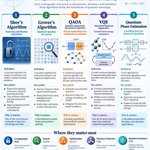
How can a cat be both alive and dead, or two particles share a fate across the universe?
These nine ideas capture quantum mechanics:
- Superposition mixes states until measured,
- Entanglement correlates distant systems instantly,
- Wave-particle duality produces interference,
- Tunneling lets particles cross forbidden barriers,
- The uncertainty principle bounds simultaneous precision,
- Quantization restricts energy to discrete levels, s
- Spin is intrinsic angular momentum,
- Hilbert space is the arena for state vectors, and
- Virtual particles mediate interactions.
They enable quantum computers, MRI imaging, and secure cryptography. The universe runs on amplitudes, not certainties.
Which concept most changed how you see physical reality?



Fabio Emile Zola retweeted

“You will lose friends, you will lose lovers, You will lose comfort, but if in losing them, You find yourself, you have gained more than Kings.”
~ Marcus Aurelius


Fabio Emile Zola retweeted

"I think I can safely say that nobody understands quantum mechanics."
- Richard P. Feynman
Fabio Emile Zola retweeted

holy f*cking sh*t Karpathy put an entire AI degree on github for free while you are still paying $200/month to watch youtube tutorials from a guy with 3000 followers
7 repos. 306,741 stars combined. in the right order they take you from "how a neuron learns" to "agents that run research overnight while you sleep"
every repo you skip is a layer of understanding your competition at work already has and you do not. and every month you keep "planning to start" is another month someone on your team gets handed the AI project you should have been running
here is the exact order. do not reshuffle it
1. micrograd → github.com/karpathy/microgra…
how a neural net actually learns. backpropagation in about 100 lines of python. this is where every AI engineer on earth started. if you cannot read this file, every other repo on the list is going to feel like black magic to you
2. nn-zero-to-hero → github.com/karpathy/nn-zero-…
his full video course. lecture notebooks that walk you from a single neuron to GPT. the thing people pay $2000 for from AI "bootcamps" that teach a fraction of what is in this one free repo
3. minbpe → github.com/karpathy/minbpe
how text actually turns into tokens. the tokenizer that sits inside every LLM, in clean minimal code. this is the part 95% of self-taught people skip, and it is why their models never work right
4. nanoGPT → github.com/karpathy/nanoGPT
your own GPT. the simplest repo in existence to train and fine-tune one. after this file you stop asking "how does ChatGPT work" because you have literally built the smaller version with your own hands
5. llm.c → github.com/karpathy/llm.c
the same training with nothing hidden. raw C and CUDA, no PyTorch wrapper doing the hard parts for you. this is where you stop being a prompt engineer and start being an actual engineer
6. nanochat → github.com/karpathy/nanochat
a full chat model end to end. GPT-2 level training that cost ~$43,000 in 2019. in this repo it costs about $48. let that sit for a second. the thing people called a breakthrough is now a weekend project
7. autoresearch → github.com/karpathy/autorese…
agents that do the research for you. the agent edits your training code, trains for 5 minutes, keeps whatever improved, discards whatever did not, and repeats all night while you sleep. this is where the people reading this list stop being students and start being whatever comes after that
the brutal truth most people avoid: train one GPT from scratch and you become the person who gets handed the AI project at work, along with the raise that comes with it. keep "planning to start" and you become the person watching that happen to someone else
the classroom half of the same degree, what Stanford actually teaches about AI for real, is below


Fabio Emile Zola retweeted

“Cada vez que el Estado promete igualdad a costa de la libertad, termina destruyendo ambas. La historia económica es una larga confirmación de esta verdad incómoda.”
- Milton Friedman -

Fabio Emile Zola retweeted

A 2×2 matrix A makes the plane flow by x′ = Ax, and each flow is one of nine kinds: points sink, escape, spiral, circle or settle on a line.
The kind is set by the eigenvalues of A, the roots of λ² − (tr A)λ + det A = 0. det A < 0 gives a saddle. Above det A = (tr A)²/4 they are complex: spirals, or a centre if tr A = 0. Below it, nodes; on it, star and degenerate node.
The stable spiral here has tr A = −1, det A ≈ 2.65, so λ = −0.5 ± 1.55i.
Fabio Emile Zola retweeted

“The more you understand this world, the more you destroy yourself. That's why fools are happy, and intelligent people live in loneliness.”
— Fyodor Dostoevsky

Fabio Emile Zola retweeted

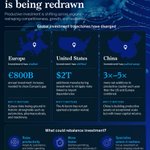
Europe's investment gap: €800B/year.
The US manufacturing shortfall: $2T.
China adding productive capital 3–5× faster than the US and Europe combined.
The map is being redrawn. mck.co/competitiveness


