

I still like viruses 🦠👩🏽🔬🔬in love with DCs🫶🏼 Postdoc @NDMOxford | PhD @institut_curie | Tweets are in Catalan, English, French or Spanish. 📸🏔️📖🧵🌷🥐
Joined January 2011
- Tweets23.5K
- Following2.7K
- Followers4.8K
- Likes50.5K







Pinned Tweet
🙌Check our latest #Review 👀 📚 We dissect the nature of DC-targeting lentivectors and their induced immune responses to help identify the knowledge gaps of one of the most promising and powerful tools for immunotherapy 👇💥💉

🆕 DC-targeting #lentivectors for cancer #immunotherapy
This comprehensive review from @estergeama & @sarahlrj explores the world of lentivectors in #InVivo immunotherapy, with a special focus on #DendriticCell targeting 👉bit.ly/3SLqUxG

Ester Gea-Mallorquí retweeted

#ScienceSaturday
🧬 What if we could help the immune system’s cancer-fighting T cells regain their ability to attack tumors, even after they become exhausted?
🔬 New research published in Nature identifies a potential way to do just that. Scientists found that targeting a protein called ZMYND8 can restore signaling pathways that help CD8+ T cells maintain their cancer-killing abilities, rather than progressing toward a more dysfunctional state.
🛡️ Why does this matter? T-cell exhaustion is a major challenge in cancer #immunotherapy. When T cells are exposed to persistent signals from cancer cells, they can gradually lose their ability to mount an effective attack. Researchers found that removing ZMYND8’s inhibitory influence strengthened IL-2 signaling, which helps support T-cell activity and function.
💡 The findings are especially promising because targeting ZMYND8 enhanced antitumor activity in preclinical models, particularly when combined with IL-2 therapy or immune checkpoint blockade. The researchers also observed improvements in human T cells in laboratory studies, offering insight into the potential relevance of this approach.
🚀 Although more research is needed before this strategy can be translated into patient care, the study offers a new avenue for investigating how we might strengthen the immune system’s response to #cancer.
📖 Read the full study in Nature:
nature.com/articles/s41586-0…
@hongbo_chi @StJudeResearch @StJude

Ester Gea-Mallorquí retweeted

The personalized neonantigen vaccines to treat cancer, already shown to work in malignant melanoma, and in trials of pancreatic cancer, glioblastoma, renal cell cancer, and triple-negative breast cancer.....now ovarian cancer. Results from a Phase 1 trial
nature.com/articles/s41591-0…

Ester Gea-Mallorquí retweeted

1. CRISPR came from basic research on bacteria.
2. Optogenetics started with a discovery in algae.
3. The GFP protein comes from jellyfish.
The biggest breakthroughs all trace to scientists follow their curiosity. This is one huge reason why we must keep funding basic research!
Ester Gea-Mallorquí retweeted
A remarkable study of 12 million single-cells (RNAseq) from 8 cohorts plus proteomics to determine the immune cells linked to healthy aging. Major findings included:
—thymic involution is central (decline in naive T cells and thymic emigrants)
—elevated immune system activation, inflammaging
—CD8+ memory cells (GZMB+) high frequency
—CMV seropositivity and chronic disease
@ImmunityCP by @maxim_artyomov and colleagues
cell.com/immunity/fulltext/S…

Ester Gea-Mallorquí retweeted

🦉The vaccine got T cells in — but mostly not the ones that mattered.
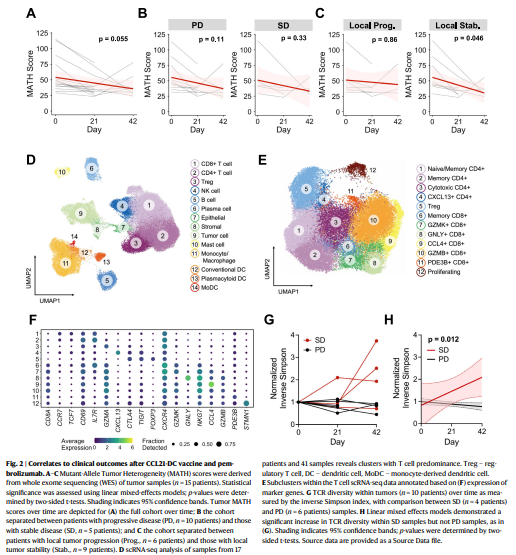
CCL21-engineered dendritic cells did what they were designed to do: they pulled new T-cell clones into resistant NSCLC tumors. Yet among 19 evaluable patients there were no objective responses.
The more revealing result came later. Many recruited clones disappeared by day 42, while the minority that persisted were more likely to show tumor-reactive signatures and expanded more strongly in patients with stable disease. Meanwhile, suppressive IL1B⁺/SPP1⁺ macrophage signaling remained.
That shifts the bottleneck. In a “cold” tumor, getting more T cells through the door may not be enough. Which clones arrive, whether they recognize tumor, and whether the microenvironment lets them survive may matter more than infiltration itself.
Small, uncontrolled phase I data, and tumor specificity was inferred rather than directly proven—but the biology is a useful warning against treating T-cell density as a surrogate for effective immunity.
#immunotherapy #T_cell #dendritic_cell
👉doi.org/10.1038/s41467-026-7…
Ester Gea-Mallorquí retweeted

Completely insane.... leukemia cells can damage the nerves in the bone marrow, and that nerve damage then helps the cancer grow !
nature.com/articles/nature13…

Ester Gea-Mallorquí retweeted

Embogeixen de felicitat els @cvg_cat, que s'apunten el 3d9f per signar la seva millor actuació de l'any 👏👏👏
#castellsenxarxa #castells #concursTGN2026
Castellàs 😍 l’enhorabona!

La @collavella fa l'aleta al 3d9 sense folre, el castell més difícil de la història 🩷
Hi ha @concurscastells!!! 🔥🔥🔥
#castellsenxarxa #castells #concursTGN2026
Gràcies a #CastellsenXarxa per agraïr la feinada de les colles internacionals. És una feina ingent, un esforç enorme que projecta la nostra cultura arreu.
Avui mirant el concurs des d’Oxford amb @cvg_cat al cor💙


Ester Gea-Mallorquí retweeted

A new, engineered #nanobody can target complexes comprising the MHC-I-related protein MR1 and antigens, inhibiting MAIT cell responses to bacteria or driving #antitumor T cell activity.
Learn more in Science #Immunology: scim.ag/4h9jgYk

Ester Gea-Mallorquí retweeted
Personalized neoantigen vaccines have already been shown to improve outcomes for refractory malignant melanoma and in pilot studies of pancreatic cancer, glioblastoma, renal cell carcinoma and triple negative breast cancer. But they require a tumor biopsy to identify the antigens. A new study shows it's possible to get this from a blood sample.
aacrjournals.org/cancerdisco…

Ester Gea-Mallorquí retweeted
New @ScienceMagazine, a feature
The obscure, unsung CD1 branch of our immune system, and how it could be exploited in the future
science.org/content/article/…

Ester Gea-Mallorquí retweeted
The brain learns from gut infections, another dimension of the gut-brain axis
GI infections prime CD4+ T cells in the dura mater of the brain meninges, with long-lived memory
@NatureNeuro
nature.com/articles/s41593-0…

Ester Gea-Mallorquí retweeted

@Sciezgin lab is on fire! another brilliant collab for us showing that plasma membrane order explains variation among human immune cells that is orthogonal to lineage/differentiation markers: nature.com/articles/s41589-0…

Ester Gea-Mallorquí retweeted
Smashing a dogma!
Nature paper showing brain has its own immune system based around the skull….the skull
has its own lymphoid tissue and germinal centers.
nature.com/articles/s41586-0…

Ester Gea-Mallorquí retweeted

Change the textbooks. Trans-splicing as a means to diversify the proteome. Many congrats to Ruaidhri Jackson and Olivia Venezia on this remarkable discovery.
nature.com/articles/s41586-0…

Ester Gea-Mallorquí retweeted
A new approach to a cancer treatment vaccine
1. Make universal induced pluripotent stem cells into dendritic cells
2. Dress them up with patient's tumor antigens from the membrane of cancer cells that merge with dendritic cells
3. Unleash these cells on T cells to kill tumor
sciencedirect.com/science/ar…

Ester Gea-Mallorquí retweeted

Entre todo lo que deja Dolly Parton, recuerden esto: donó $1 millón a la investigación de la vacuna de ARNm de Moderna.
Hoy, vacunas de ARNm superan un fase 3 en melanoma y avanzan en cáncer de páncreas, mama y pulmón.
Mientras unos sembraban miedo, ella ayudó a sembrar futuro.
Ester Gea-Mallorquí retweeted
Años usando la miocarditis para asustar con las vacunas de ARNm contra la COVID-19.
Nuevo estudio: más de 4 millones de jóvenes. Mayor riesgo de miocarditis, pericarditis y muerte en no vacunados tras COVID-19.
Los datos tienen la costumbre de desmontar a los antivacunas 🧵
Ester Gea-Mallorquí retweeted

Two months after the standing ovation, Revolution Medicines' RAS inhibitor is officially FDA-approved for metastatic pancreatic cancer.
