

Trying to solve sample efficiency prev: Engineering physics @iitbombay '23
Joined June 2023
- Tweets814
- Following668
- Followers4.2K
- Likes2.8K




Mithil Vakde retweeted

we should not like a future where there are 1 to 2 AIs and the rest are illegal. we should want a cambrian explosion of the types and possibilities of minds, experiencing new joys and thinking new thoughts. ensuring that this is compatible with human flourishing is only step 1
Mithil Vakde retweeted

LLMs require very large amounts of data and arguably the path to ASI runs through a different model architecture that’s more data sparse. Amazing what @evilmathkid has done with compute constraints on ARC-AGI-2.
cc @fchollet

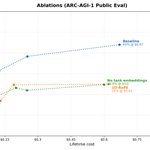
I got 37% on ARC-AGI-2 Kaggle without LLMs!
100M looped transformer trained from scratch
- Likely highest score without an LLM
- Peaked at 6th place
- Beats last year's winning LLM
- Looping, added in the last week: 33% → 35% → 37%
thanks to @arcprize @fchollet @mikeknoop and @GregKamradt for the competition!
Link: mvakde.github.io/blog/looped…
(writeup for the paper track)


Mithil Vakde retweeted

And Mithil strikes again, this time casually beating opus
I got 37% on ARC-AGI-2 Kaggle without LLMs!
100M looped transformer trained from scratch
- Likely highest score without an LLM
- Peaked at 6th place
- Beats last year's winning LLM
- Looping, added in the last week: 33% → 35% → 37%
thanks to @arcprize @fchollet @mikeknoop and @GregKamradt for the competition!
Link: mvakde.github.io/blog/looped…
(writeup for the paper track)
Mithil Vakde retweeted

THE GOAT (of resource efficient arc impls) RETURNS
I got 37% on ARC-AGI-2 Kaggle without LLMs!
100M looped transformer trained from scratch
- Likely highest score without an LLM
- Peaked at 6th place
- Beats last year's winning LLM
- Looping, added in the last week: 33% → 35% → 37%
thanks to @arcprize @fchollet @mikeknoop and @GregKamradt for the competition!
Link: mvakde.github.io/blog/looped…
(writeup for the paper track)
Mithil Vakde retweeted

What, if some day or night a demon were to steal after you into your loneliest loneliness and say to you: ‘This life you will have to live in an age of chaos; in the most interesting times; in an era when the foundations of civilization are shaking and few dare to step off the crumbling tracks laid before them.’
Would you not throw yourself down and gnash your teeth and curse the demon who spoke thus? Or have you once experienced a tremendous moment when you would have answered him: ‘You are a god and never have I heard anything more divine.’
Mithil Vakde retweeted

What if your devices, apps and agents knew what you wanted?
You finish breakfast, and your Uber is booked.
Running late, your agent sends a “Running late” text.
You reach home, and your lights turn on.
AI is proactive now. But it still needs your yes. It waits, for you to unlock your phone, open an app and tap approve. Every time, hundreds of times a day.
AI needs its own interface.
Aina is a ring with a screen that predicts and shows you the three things you’ll need next. One flick of your thumb, and it’s done. For everything.
✦ Cues: proactive suggestions, ready before you need them
✦ Voice: talk to your agents, take notes, dictate
✦ Remote: control your music, Mac and TV
✦ Calls: right from your hand
Pre-orders open now
aina.com
Mithil Vakde retweeted

We asked GPT-6 Astra to edit Qwen3.5-0.8B weights to improve math.
It directly changed only 0.016% of weights, fixing 0.8B's reasoning loops & improving math up to 6x and even instruction following 3x, without gradients or training.
We call this Weight-Space Programming: frontier LLMs can now natively read/write neural network weights! 🧵
Blog: rikiyat.github.io/blog/weigh…

Readers added context they thought people might want to know
LLM was given weights explicitly as text in prompt and used code/forward passes (per authors' logs) to ablate Qwen looping direction, a known thinking-mode issue per model card. Primarily fixed repetition in that mode, not general 'natively' improving weights/math.
rikiyat.github.io/blog/weight-sp…
github.com/RikiyaT/lm_und…
huggingface.co/Qwen/Qwen3.5-0…
huggingface.co/RikiyaT/Qwen3.…
Mithil Vakde retweeted

Hi! this is Rohan Anil, I develop training algorithms among other things - my work trains various frontier models.
At CoreAuto, I was fascinated by the problem of training on compute islands, eventually in space training.
I hope you all enjoy this write up!🪐🛰️
coreauto.com/hitchhikers-gui…

Mithil Vakde retweeted

I manually inspected 40,000 animations to post train an LLM to make demoscenes.
Scraped 10 years of demos, did continued pretraining, curriculum learning and finally RLHF-ed with myself as the reward function.
Yes, models can have "taste".
All you need is data.
1/6

Mithil Vakde retweeted

Launching RNAFoundry.com – we manufacture personalized cancer vaccines.
Mithil Vakde retweeted

Launching Junction: come speed-run the semiconductor tech tree this December in Bangalore.
We’re flying in students from all over India 🇮🇳 to a 2-week fabrication retreat at @_lagrangepoint to build equipment, design chips and engineer processes, with our friends at @hackerfabindia.
India still needs thousands of semicon engineers -- the ecosystem to produce them isn’t mature enough yet -- we're changing that.
Current applicants have built vacuum chambers to study plasma physics, RISC-V processors from scratch, scanning tunneling microscopes, et cetera
At junction you will:
1. Propose a project
2. Figure out a plan with the Junction team.
3. Iterate fast towards a working prototype, with help from the Junction team
4. Be mentored by top semiconductor hackers and specialists.
5. Demo to industry leaders, founders, investors, and your fellow craftspeople
Flights, accommodation and project expenses? All covered. Apply on the link below
Mithil Vakde retweeted

Ninth update to OpenAI problem #109 (integer multiplication): we are now past 2^-12.
κ = 2⁻¹¹·⁰⁶⁶ (tightened from κ = 2⁻¹⁸²)
The exact witness is 4.6637 × 10⁻⁴, about 3.70 fold over our previous 1.2613 × 10⁻⁴, and a 2¹⁷⁰ fold improvement over the original OAI result.

Eighth update to OpenAI problem #109 (integer multiplication): we are now past 2^-13.
κ > 2⁻¹³ (tightened from κ = 2⁻¹⁸²)
The exact witness is 1.2613 × 10⁻⁴, about 1.97 fold over our previous 6.397 × 10⁻⁵, and a 2¹⁶⁹ fold improvement over the original OAI result.
Mithil Vakde retweeted

I think one of the hard things AI is going to do is force a lot of people to look at why human beings do things. Hard because ultimately we do most of what we do, including many beautiful things, as some form of status seeking.
Mithil Vakde retweeted

I think I just trained NanoGPT in 9.65 seconds!?
Yesterday, @hermanbrunborg used a connected longest exact match model, trained concurrently on CPU, to get the nanoGPT record from 39.9 seconds to 21.5 seconds, in an impressive open PR. By adapting their work, and generalizing the CPU model to a larger share of the tokens, I got the record down to 9.65 seconds, and submitted the PR this morning.
I built on three open PRs, in addition to my contributions: the main basis for my generalization was from @hermanbrunborg, and additional work from @nthngdy, @cyrusghane, and Daniel Monroe. Their engineering is extremely impressive.
Of course, all of our records are still subject to review. As I mentioned in my comment on Herman‘s PR (and in my own PR description), CPU usage is a gray area in nanoGPT. Their PR was the first to discover a clever way to effectively use CPU during the run, so I’m looking forward to the official reviews.
This was another very fun challenge! Particularly (potentially) breaking the 10 second barrier yesterday. So much engineering tact is yet to be explored.
Huge shoutout to the three authors of the PRs for their innovations.
@hermanbrunborg - I will also be at stanford for the weekend along with some of my cofounders, and sf for a couple days after, would love to chat more IRL, if you’d be open 🙂
Mithil Vakde retweeted

After seven years, I've made the hard decision to leave Google Deepmind.
I joined Google in 2019 because I believed we could make build models to understand and generate code.
Back then, very few people had that conviction. I’m glad I found those people at Google and that we worked hard to make that dream a reality.
Coding is now democratised and it will be used to solve everything else!

Mithil Vakde retweeted

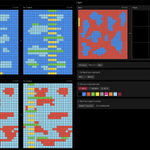
Can complex multi-step reasoning emerge purely from cells that only talk to immediate neighbors?
Happy to share our paper “Reasoning with Neural Cellular Automata (NCA)”, from our team at Google, Paradigms of Intelligence 🧵👇
Mithil Vakde retweeted

My second interview with @CJHandmer, Founder of @TerraformIndies.
0:09 How the Mass Driver is going to work
2:54 Mass Driver vs scaling Starship
4:26 Economics of space compute vs building data centers on Earth
8:53 Why large scale projects are becoming illegal
14:26 Terafab
20:02 Starmind
26:19 Maximum scale as fast as possible
27:43 Luisiana launch tower buildout
30:13 Elon’s decade long company baking period
32:56 Firing teams
37:35 Starting companies
41:57 Being unfiltered publicly
42:52 DOGE
46:39 Deregulating without a major war
55:17 Founder-led companies are mini dictatorships
58:53 Taxes
1:03:26 Civilization hard resets
1:05:30 Starship scaling constraints
1:07:16 How Elon sets objectives
1:09:31 Universal high income
Mithil Vakde retweeted
I really enjoyed working on this project. I believe the new flop-aware paradigm of nanoGPT thinking is useful, and it seems helpful in a compute optimization context like this one. It seems like a simple and logical conclusion of optimization: figure out what’s actually needed, and use that. The process was actually fun.
One note regarding this record, as noted in the blog. Some of the techniques that scale to frontier pretraining have been redacted from this record. Most importantly, ANVIL III, the significantly improved version of the ANVIL optimizer lineage, has not been included in this record, as it is proprietary to us at @hyperstition_cc. It replicates Muon’s speed but beats it by 20-28 millinats of loss at all model sizes 124M-1.2B and training depths (up to 8x-Chinchilla), with remarkably consistent hyperparameters and extremely high SNR, as compared to Muon. You can learn more about ANVIL III and Feather-1.7B, the model we trained using internal architectural changes and ANVIL III, here:
hyperstition.cc/cutting-pret…
Using ANVIL III (which allowed me to cut steps) improved the speedrun results by another 0.7 seconds, with lower net loss. This alone proves there’s still more room to improve this record.
One final thing that I’ve had many people ask about is how much of a role autoresearch played in my work. The answer is almost none. While almost all of the implementation was done with Claude Code, I did the ideation almost fully by myself. I spoke about this extensively in a conversation with @METR_Evals.
We had a cluster of H100s while I was working on the record. At night or when I stopped working on it, I’d send out several agents to try to hill-climb the speedrun and improve the record. In total, the agents made shockingly little progress, despite spending more time in aggregate than I did. No matter what I told them, it seemed difficult to get them out of local minimums, stuck performing futile tuning of a method that saved 0.1 seconds and cost ~5 millinats (clearly a bad trade), or just tuning hyperparameters for hours on end trying to make some small change. I saw similar phenomena as those described in this METR report:
metr.org/blog/2026-07-21-exp….
However, as I also discussed with METR, I don’t think the agents lack the knowledge to do this. Instead, I think a lot of it comes from a personality issue with current LLMs. They have very little belief that large jumps like this are possible, or they approach it with the wrong paradigm. Autoresearch was not very helpful in my work, and, from personal experience, I don’t think this current generation of publicly available models, without special harnesses, will do very high-quality autoresearch. However, I think the capability and knowledge is already here, which implies that we could be significantly closer to true autoresearch than recent results would imply.
NanoGPT was a really fun challenge and it led to a number of valuable insights and processes. Finally, I’d like to give @Classiclarryd and @KellerJordan a huge thank you for all of their efforts maintaining the repo.


New historic NanoGPT record at 39.9s (-27.7s) from @DevenPzak , obliterating the prior record of 67.6s!
This record introduces a new paradigm of thinking to NanoGPT: instead of optimizing matmuls or adding more expressive operations, optimize at the individual flop level with incredibly clever engineering and ML judgement. If a flop is low value on a particular step, skip it.
Specifically:
-(~8s) Sampled softmax. If a token doesn’t appear in a batch, skip its lm_head fwd/bwd some fraction of the time.
-Sparse values. Only run an optimizer step for ngram embeddings that occurred in the batch. Set beta1 to zero to enable this. Beta2 is applied retroactively when the row is later used.
-Sparse updates. Only update ngram and value embeddings once every 4 steps instead of once every 2.
-Sparse communication. Shard the n-gram table across GPUs, and only pass the rows receiving updates on each step.
-Sparse optimizer states. For the n-gram table, reduce from 2 floats in Adam optimizer per param, to 1 float per 768 params.
-Hand-rolled flash attention for 64 dim heads.
There are several additions that add accuracy too:
-(~4s) EMA during last 300 steps, combined with lifting final_lr to 0.3 instead of 0.15.
-(~1s) A new optimizer, Anvil2, which expands muon via a second tracked momentum buffer, improves the ortho coefficients, and modifies the cautious weight decay application.
-A couple additional dynamic skip connections in the network.
The most striking consequence of the ‘flop aware paradigm’ is you can grow parameters arbitrarily large,
only limited by the available memory, since you can selectively choose how to expend flops on those parameters on each step. NanoGPT has kept active parameters below 124M, but total is unbounded, and has grown to 640M through embedding sparsity over the last year. This PR takes that to its logical conclusion on the 8xH100, scaling up to 65B sparse embedding parameters, which accounts for 25% of the PR’s gains. At frontier scale, where one is not bounded by an 8xH100, one could imagine where this paradigm could lead.
github.com/KellerJordan/modd…
As this was a very notable PR, I spoke with Deven for an hour to learn how he did it. Here’s his story on the changes: hyperstition.cc/training-nan…

Mithil Vakde retweeted

New historic NanoGPT record at 39.9s (-27.7s) from @DevenPzak , obliterating the prior record of 67.6s!
This record introduces a new paradigm of thinking to NanoGPT: instead of optimizing matmuls or adding more expressive operations, optimize at the individual flop level with incredibly clever engineering and ML judgement. If a flop is low value on a particular step, skip it.
Specifically:
-(~8s) Sampled softmax. If a token doesn’t appear in a batch, skip its lm_head fwd/bwd some fraction of the time.
-Sparse values. Only run an optimizer step for ngram embeddings that occurred in the batch. Set beta1 to zero to enable this. Beta2 is applied retroactively when the row is later used.
-Sparse updates. Only update ngram and value embeddings once every 4 steps instead of once every 2.
-Sparse communication. Shard the n-gram table across GPUs, and only pass the rows receiving updates on each step.
-Sparse optimizer states. For the n-gram table, reduce from 2 floats in Adam optimizer per param, to 1 float per 768 params.
-Hand-rolled flash attention for 64 dim heads.
There are several additions that add accuracy too:
-(~4s) EMA during last 300 steps, combined with lifting final_lr to 0.3 instead of 0.15.
-(~1s) A new optimizer, Anvil2, which expands muon via a second tracked momentum buffer, improves the ortho coefficients, and modifies the cautious weight decay application.
-A couple additional dynamic skip connections in the network.
The most striking consequence of the ‘flop aware paradigm’ is you can grow parameters arbitrarily large,
only limited by the available memory, since you can selectively choose how to expend flops on those parameters on each step. NanoGPT has kept active parameters below 124M, but total is unbounded, and has grown to 640M through embedding sparsity over the last year. This PR takes that to its logical conclusion on the 8xH100, scaling up to 65B sparse embedding parameters, which accounts for 25% of the PR’s gains. At frontier scale, where one is not bounded by an 8xH100, one could imagine where this paradigm could lead.
github.com/KellerJordan/modd…
As this was a very notable PR, I spoke with Deven for an hour to learn how he did it. Here’s his story on the changes: hyperstition.cc/training-nan…

