

Student Run Twitter of the La Pierre Group at the Georgia Institute of Technology
Atlanta, GA
Joined June 2019
- Tweets271
- Following382
- Followers1.1K
- Likes1.2K




La Pierre Group retweeted

A universal neural network for spin–orbit coupling across the entire periodic table
Spin–orbit coupling (SOC) drives some of the most exciting physics in quantum materials—topological insulator phases, spin–momentum locking, valley polarization in 2D systems, and spintronic device concepts. Yet computing SOC electronic structures from first principles is painfully expensive: relativistic DFT with SOC is ~8× slower than non-SOC calculations, and the resulting Hamiltonians are complex-valued matrices with quadrupled dimensions. This has severely bottlenecked high-throughput discovery of SOC-driven materials.
Yang Zhong and coauthors introduce Uni-HamGNN, a universal graph neural network that predicts full SOC Hamiltonians for any element combination across the periodic table, without system-specific retraining.
The core idea is a physics-informed decomposition: rather than learning the full complex Hamiltonian directly, they separate it into a spin-independent component H₀ and a SOC correction ξL̂·σ̂, where ξ is a learnable strength coefficient and the angular momentum–spin coupling matrices are computed analytically. This preserves SU(2) symmetry by construction and dramatically reduces learnable parameters.
The training strategy is equally important. Since H₀ (~tens of eV) and the SOC term (~tenths of eV) differ by two orders of magnitude, joint training effectively ignores SOC. The authors use delta learning: 44,000 non-SOC Hamiltonians train one channel, only ~10,000 SOC matrices train another. A two-stage protocol first optimizes Hamiltonian fidelity, then fine-tunes with band structure eigenvalue consistency—avoiding gradient divergence from differentiating through inaccurate eigendecompositions.
Results on 5,000 test materials: 3.58 meV MAE for real components, 0.0025 meV for imaginary, and SOC spin-splitting errors of just 1.3 meV. High-throughput screening of 10,000+ heavy-element GNoME compounds identified 138 topological insulators, confirmed by independent VASP calculations. Most remarkably, though trained only on 3D bulk crystals, Uni-HamGNN accurately predicts Berry curvature and valley polarization in 2D monolayers and twist-angle-dependent spin splittings in MoSe₂–WSe₂ heterobilayers—with 100–1000× speedup over DFT.
The message: embedding physical symmetry and scale separation directly into network architecture and training enables genuinely universal ML tools for quantum materials discovery, replacing costly relativistic DFT workflows with rapid, transferable predictions.
Paper: nature.com/articles/s42256-0…

La Pierre Group retweeted

Multimodal Nanoscale Mapping of Local Structure and CO2 Adsorption in Metal–Organic Frameworks | Journal of the American Chemical Society @UCBerkeley @UCB_Chemistry pubs.acs.org/doi/10.1021/jac…

La Pierre Group retweeted

Nature research paper: Higher-dimensional Fermiology in bulk moiré metals
go.nature.com/4rTv9pa
La Pierre Group retweeted
Telecom-Luminescent and Room Temperature Coherent Tetrathiafulvalene-Based Qubits in Spin-Rich Solids | Journal of the American Chemical Society @UChicago pubs.acs.org/doi/10.1021/jac…


La Pierre Group retweeted

Proud and thankful @NatureChem for inviting me to write a News & Views article on the beautiful praseodymium(V) complex published by
@Storms_LaPierre (nature.com/articles/s41557-0…)
Find our highlight "A high five for praseodymium" following this link nature.com/articles/s41557-0…
La Pierre Group retweeted

🔥News @Nature. With @CoperetGroup we use 195Pt NMR to map coordination environments in single-atom heterogeneous catalysts, offering a powerful tool🔧 for advancing their design. Collaborative strength @NCCR_Catalysis 💪🙏💚
nature.com/articles/s41586-0…

La Pierre Group retweeted

We are excited to announce our @J_A_C_S paper on frameworks with metalloprotein-like sites!
ɑ-helices designed to assemble by metal-coordination and the hydrophobic effect. Point mutations yield unique frameworks with diverse metalloprotein-like sites.
tinyurl.com/jk62cb27
La Pierre Group retweeted

From @acboggiano, @f_orbitals, and co-workers, the first crystal structures of Pr(v) complexes.
The 5+ state was achieved through oxidation of the tetravalent imidophosphorane complex.
🔗 CSD Entry TUNXOT: ccdc-info.com/4je9YdB
#FeaturedStructureFriday @NatureChemistry
La Pierre Group retweeted

Excited to share the final version of Pr5+, now out in Nature Chemistry! Many thanks to co-authors, this was a huge lift from all fronts nature.com/articles/s41557-0… – at Wisconsin, USA
La Pierre Group retweeted
Spin Filtering with Surface-Active Helicene- and Twistacene-Based Perylene Diimides | Journal of the American Chemical Society @Columbia @ChemColumbia pubs.acs.org/doi/10.1021/jac…

La Pierre Group retweeted
η6-Benzene Tetra-Anion Complexes of Early and Late Rare-Earth Metals | Journal of the American Chemical Society pubs.acs.org/doi/10.1021/jac…

La Pierre Group retweeted

Kicking off the year in style with a dithorium Sb₂•³⁻ radical trianion complex. This represents the heaviest reported actinide-N₂ radical analogue, and Sb₂ radicals of any type remain unknown as d- or f-block derivatives - until now. Enjoy! @J_A_C_S
pubs.acs.org/doi/full/10.102…

La Pierre Group retweeted
A Spectrochemical Series for Electron Spin Relaxation | Journal of the American Chemical Society @Caltech @CaltechCCE @RyanGHadt pubs.acs.org/doi/10.1021/jac…

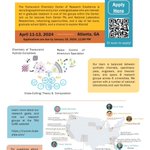
Considering graduate research with actinides, or a career in the National Laboratories? Join us for the DOE/NNSA Graduate Studies Workshop!
-Lectures from National Lab Researchers
-networking, grad school Q&As, lab tours, and more
- Apply by Feb.15th: trucorechemistry.com/apply

La Pierre Group retweeted

Frustrated Magnetism and Spin Anisotropy in a Buckled Square Net YbTaO4 | Inorganic Chemistry pubs.acs.org/doi/10.1021/acs… La Pierre and co-workers @InorgChem #ytterbium #YbTaO4 #quantummaterials #frustrated #magnetism #spin_anisotropy

Considering graduate research with actinides, or a career in the National Laboratories? Join us for the DOE/NNSA Graduate Studies Workshop!
-Lectures from National Lab Researchers
-networking, grad school Q&As, lab tours, and more
- Apply by Feb.15th: trucorechemistry.com/apply
