






Tyler retweeted

Something close became NEAR 👀
Native $NEAR in your Vultisig Vaults.
Send, swap and receive. No seed phrases.
@NEARProtocol
Tyler retweeted

Your counterparty only needs an address on a network supported by NEAR Intents and it’ll work thanks to the Miracle of Interoperability
Fresh off the press: Near.com for Businesses
It's the new best way to run an onchain treasury. Private payments + payroll, spending policies, and MPC for your assets on 35+ chains and counting.
Oh and it's free.

NEW LAUNCH
Introducing NEAR Business: a confidential multisig treasury for crypto-native teams.
Pay teams and vendors, swap, and allocate capital across 35+ chains, with every move approved by your signers. Built on NEAR Intents.
business.near.com
How it works ↓

Good tech is good, but Confucius said the real moat is distribution. Private Inference + Private Browser -> trillions

Intents is cool because we can just ship assets on other chains
We already bring $ZEC, $STRK, and $NEAR to Solana

Sunrise is partnering with @near_intents to establish liquid markets for NEAR Intents assets on @Solana.
NEAR Intents powers universal asset access across chains. Sunrise establishes the markets.
The rollout begins with $NEAR, now trading via Sunrise.
Next, we plan to integrate NEAR Intents directly, opening more pathways for assets and liquidity to reach Solana.
Tyler retweeted

NOW LIVE: Robinhood Chain on NEAR Intents.
Builders can integrate the 1-Click Swap API to access unified liquidity across 30+ chains, with native settlement on Robinhood Chain by @RobinhoodCrypto.
And there’s more to plug in:
→ Option to enable Confidential Execution
→ Limit Orders
→ More cross-chain capabilities




This is a pretty big deal, you can just launch new chains on DEXs now.
No more CEXs, IDO szn is back 🔥🥵
NEW LAUNCH
Quantus ($QTC) is now live on near.com, the first post-quantum asset to debut multichain.
Trade QTC confidentially across 30+ chains and 180+ assets, with native deposits and withdrawals to/from @QuantusNetwork.
A post-quantum asset launching on NEAR, where quantum-safe signing is already live on mainnet.
Quantum-safe, cross-chain, and confidential from day one.

Tyler retweeted

Today in Singapore: NEAR Happy Hour at @token2049 from 4:30–7:00pm.
Connect with builders, investors, and partners working on user-owned AI infrastructure. Conversation only. No panels. No decks.
Limited spots: luma.com/yvo094xl


Account abstraction & chain signatures gud tek

We just signed a near tx with a quantus key btw. $NEAR’s account abstraction is awesome.
nearblocks.io/txns/3zdhR5PVd…
Tyler retweeted

September was a busy month.
Expanded Swap + CrossPay support, better wallet reliability, viewing-key export, and major performance improvements, including cutting some operations on large wallets from ~25 seconds to milliseconds.
A look at what we shipped ↓


Tyler retweeted
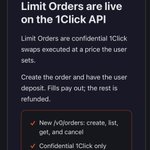
A limit order that isn't sitting on a public book.
Cross-chain, no bridging, fills at your price. Powered by NEAR Intents.
Confidential limit orders are now live on near.com, for any assets from any chain.
Set your target price. It fills automatically when the market gets there.
Your order waits out of public view.

Tyler retweeted

many false dichotomies around this
you can't reap the benefits of being "early" if you're not willing to stomach the path it requires
many new folks don't get how this works, so a rough explanation is in order, as cross-chain stuff often comes up in crypto
an imperfect but useful analogy: near intents is to near what hyperunit is to hyperliquid
that is, it is not the chain itself, but a cross-chain protocol that augments the chain -- you can think of it as a collection of bridges + some other shit. but it is not part of consensus
a cross-chain protocol, for all chains, will always have more trust assumptions than the underlying chain -- unit for example also has OFAC screening as does pretty much anything of this nature
(your favorite defi or trading app on any chain also almost certainly fits this and even some validators, with few exceptions)
this is almost always true for anything that's not the main chain itself, as most cross-chain protocols are generally secured by MPC networks (or multisigs) and MPC clusters are by definition smaller than core validator clusters
and this remains true of all connective tissue, e.g., recall how Arbitrum multisig froze the funds of NK hacker a few months ago
that of course did not affect the "moneyness" of Ethereum as that is Arbitrum and not ETH on Ethereum itself
same thing here
I am not aware of any system that can function much differently on risk parameters today (though I can think of a few who lie about it who get called out by zach every few months)
the aspiration of course is that over time MPC networks (or multisig governance in the case of rollups) get decentralized enough to reduce the concentration of influence and minimize it to only provable bug patches and asymptotically zero human judgement
that is fundamentally what you are underwriting
this is a big reason why Solana seeks to concentrate everything internally on a giant chain so that bridge trust risk is minimized (though in practice, this is only half the picture since for example RWAs fundamentally have control authority with the issuer itself, that's why USDT can be frozen on any chain)
so, there are three paths here:
i) you transact on the main chain itself with only the native asset of the chain, i.e ZEC on Zcash, BTC on Bitcoin, SOL on Solana
this is maximal risk reduction, but obviously limiting for anything beyond SoV or payments
ii) you do your bridging via CEXes
fine, but very large tradeoffs for asset selection, withdrawal/deposit limits, KYC, accessibility, privacy and you get way worse freezing/trust problems
iii) you do your bridging via crypto-native protocols that are relatively less decentralized than an entire blockchain itself but are improving security and decentralization constantly, especially against CEXes
for crypto to become a truly planetary economy, iii) must work. this is not a choice, it's just a matter of who wins that segment
but the only way iii) can work is if such protocols survive long enough to not get shut down by the feds because then the exchanges will default win and that aspirational future for crypto will be entirely lost
a valid criticism here is that this should have already been maximally decentralized already, but ofc that comes with its own tradeoffs like being too slow to patch bugs or add features in a relatively nascent stage
again, your job is underwriting the execution risk. and you must do so while understanding the parts at play

Crypto space really has a choice - grow the f up or get sidelined with random regulations.
Saying we can not do anything when we are programming decentralized system is just untrue.
Banks run AI for fraud detection but are inherently centralized and require KYC. At the same time KYC doesn't solve any of real problems as we know.
We have better data and talent to create systems that don't require KYC and actually deter criminals while giving full freedom to real users.
By working together we can totally weed out crypto of criminal activity. Criminal TAM is way smaller than all of economy moving onchain we are targeting.
Decentralization != disorganization
Tyler retweeted

No serious discussion about privacy in 2026 is complete without NEAR Intents.
We’re thrilled to welcome @familiarcow to the Privacy Summit to discuss the latest advances in onchain privacy.
Register to meet him in Singapore on October 7: luma.com/gbb4thfy
Getting ready for Token. If you’re shipping anything onchain, I want to get in touch, let’s meet in SG 🧡📥
near:native