

Source-linked financial research and intelligence.
Joined May 2025
- Tweets2.7K
- Following230
- Followers1.4K
- Likes2.3K



$NVDA price spotted near decade low valuation lows.
Jensen Huang has the chance to do the funniest thing..

112
Anthropic's quarterly revenue grew from $4.7B in Q1 to $17.0B in Q3.
The top five customers grew 2.1x. Everyone else grew 4.4x, and top-five share fell from 36% to 21%.
The growth is getting broader.


74
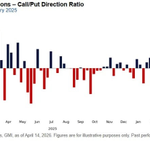
Wall Street just made its biggest bullish options bet in 16 months.
And they did it after a real market scare, not in a calm market.
What makes this interesting: institutions are piling into calls while retail is selling and buying protection at record levels. That kind of setup has often shown up near market bottoms, not tops.
Banks are backing the move too. JPMorgan and Bank of America just reported strong earnings, which gave traders confidence that the economy and credit cycle are still holding up.
One caveat: the geopolitical calm is still fresh, so this can change fast if the Iran situation flares up again.

190
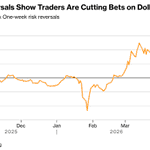
The U.S. dollar's March rally was a war premium built on three pillars, and all three are deflating simultaneously.
-Brent down $31 from its April 2 peak removes the energy-exporter tailwind
-core PPI at +0.09% tells the options market the Fed has no urgency to hike
- ECB pricing two-plus 2026 hikes compresses the yield differential that made dollar calls a carry-enhanced hedge.

175
The U.S. had been stockpiling oil for 8 straight weeks.
Now foreign buyers are buying a record 5.2 million bpd, because the $27 Brent-WTI spread means American oil is now the cheapest in the world.

BREAKING: Maine is the first state to ban data center construction projects until late 2027 (LD 307).
But headlines miss the point. LD 307 is being covered as a Maine story. It's not.
Maine has zero hyperscale AI data centers today. So why does LD 307 matter?
⬇️
Because it changes the risk assessment for hyperscalers like $NVDA $MSFT $META $GOOG from "can we afford to build?" to "can we get permits?"
That's a fundamentally different risk variable — one that isn't priced in yet.
The story isn't Maine. It's that grid capacity is now a binding constraint on planned data center buildouts, and permitting risk just moved to the state level.
The bill template is exportable: 20 MW threshold, study council, brownfield exemptions. Watch Massachusetts, Oregon, Washington as leading indicators. If LD 307 becomes a trend, FY2028-2030 AI buildout assumptions get repriced.
The legislature isn't anti-data center. It's anti-greenfield-grid-stress. The one project that got an exemption (Jay, ME) survives because it reuses an old paper mill site with existing hydropower — no new strain on the grid. That tells you exactly who wins and who loses.
__
Winners - companies that already have what regulators want:
• Nuclear and hydro power producers with long-term data center contracts (CEG, VST, NEE) — they sell the kind of clean, reliable, on-site power that sidesteps grid strain entirely
• Operators that convert old industrial sites instead of building from scratch (IRM) — exactly the model Maine just rewarded with an exemption
• Hyperscalers with existing approved sites in friendly states like Virginia, Texas, and Georgia — they can keep building while competitors wait for permits
___
Losers - companies that need things to get harder before they can grow:
• Developers planning brand-new data centers in states with stressed grids — they now face an unpredictable approval process that didn't exist six months ago
• Data center REITs concentrated in the Northeast — their expansion pipeline just got riskier
• Any company whose 2028+ growth plan assumed permits would be easy to get — that assumption is now broken
___
The bottom line: this is the first crack in the assumption that AI Data Center buildouts can scale as fast as the capex commitments imply. Grid constraints are now front and center. Watch for which states potentially follow.


Software comp table - almost all rated overweight
Mean YTD performance? -35%🔴
One company is singlehandedly eating tech

4
4
260
SAVE THIS:
How to get free sell-side equity research in 2026:
🔸BofA Global Research → Merrill Edge self-directed ($0 min)
🔸Morgan Stanley Research → E*TRADE account ($0 min)
🔸J.P. Morgan Research → Chase Self-Directed Investing ($0 min)
🔸Morningstar → Schwab or Fidelity ($0 min)
🔸Wells Fargo Research → WellsTrade ($0 commissions; $30 household fee waived w/ e-delivery or $250K AUM)
Fact-checked and verified☑️ Repost if it saved you a Bloomberg terminal.
4
5
311
$TSLA is -22% YTD
73% of the company’s rev still comes from cars, this is now year two of consecutive declining EV sales
Missed Q1 2026 deliveries estimates
In China, EV competition is fierce:
- $BYD sales +162% YoY
- $TSLA sales grew 12% YoY
The anticipated Cybercab and Optimus rollouts should provide enormous upside potential.
The question isn’t whether those products work. It’s whether Tesla still owns the narrative by the time they ship.


1
330

Most people building agents are optimizing the wrong layer.
The conversation is dominated by models, frameworks, and orchestration patterns. The real advantage sits underneath all of that, in the data and context layer that decides what ever reaches the model in the first place.
After months building multi-agent systems in a domain where output quality is non-negotiable, the pattern is consistent. Almost any frontier model is capable. Reasoning is production-ready.
The model is not the moat.
What separates expert-grade output from confident hallucination is what the agent can see, and how that information is shaped before it gets there.
Three lessons I keep relearning:
1. Building data pipelines will humble you. Normalizing unstructured sources, aligning across versions, handling edge cases, validating schemas and gaps; expect months of unglamorous work with no shortcuts. Garbage in, confident garbage out. I can't overstate how much context data quality determines the ceiling.
2. Documents aren't just text. The signal lives in what changed since last time, what got omitted, the derived patterns that bulk analysis misses, the shifts that preceded the obvious event. A naive vector store erases most of it. This is why a custom derived-insights layer sitting on top of your source data layer matters more than people think.
3. Retrieval is the bottleneck, not reasoning. The analytical layer holds up. Frontier models are more than capable. The failures live upstream -- wrong context, stale versions, context rot, noise unrelated to the task at hand. The data retrieved, and when it's retrieved, are critical.
The AI moat isn't really an AI moat. It's a data engineering infrastructure moat wearing an AI interface. Whoever wins a vertical will be whoever did the slow, specialized work of building a context layer that respects how that domain actually behaves.
This is the lesson I keep coming back to.
1
1
234
$NBIS in talks to acquire AI21, an Israeli AI startup, after $NVDA passed. Why?
$NVDA walked away at $2-3B and deemed it too expensive or insufficiently differentiated.
$NBIS at 68.5x forward P/E and -103% operating margins cannot sustain that valuation as a pure GPU rental business. This is a defensive and strategically necessary maneuver against the commoditization pressure.
Open-source models (DeepSeek, Llama) are collapsing inference costs. Hyperscalers are subsidizing compute to lock enterprise workloads. A 310MW Finland data center coming online into a global GPU supply glut is a margin compression story without a software layer on top.
AI21's Jamba models plus the February Tavily acquisition (retrieval infrastructure) gives Nebius the components for a full EU sovereign enterprise agent stack: retrieval, reasoning, and GDPR-compliant infrastructure that AWS and Azure structurally cannot replicate for European clients. That is the bull case and it is coherent.
The problem is the asset quality and what it implies about the price. $NVDA tried to acquire AI21 at $2-3B and walked away. The most natural strategic buyer, already an AI21 investor, with the most to gain from owning the model layer, passed on the deal.
$NBIS is now negotiating above $NVDA's rejection price toward a $4B Series D mark on a company doing $50M in annual revenue. That is 80x sales for models that trail GPT-4o on benchmarks and face accelerating open-source competition.
The deal math works at $3B or below: roughly 6% dilution at current share price, $1.75B cash outlay against $2B+ in liquidity post-Nvidia investment, and a defensible path to $200M+ AI21 ARR by 2028 if enterprise API adoption materializes.
The critical watchpoint is not the strategic rationale, which is sound, but price discipline.


Using our free live Hormuz tracker, you can:
- analyze specs of all current transits
- engine details, estimated ship trajectory, etc
- multiple strait tracking
No account needed!


3
267
Think all financial AI intelligence is the same?
Prompt: 'Analyze the recent move in $AEHR, explain it. Output a full analysis'
DeltaSage output:

1
1
246


filedunder.ai retweeted
Long $AMZN thesis:
The market is selling $AMZN on 2026 FCF negativity. That is the wrong time horizon.
The $200B capex cycle is the moat being built, not the problem to be solved.
AWS at 28% cloud market share is deploying at roughly 2x the capex intensity of Azure and Google combined.
When Trainium3 hits general availability mid-2026 at 40% better price-performance than Nvidia GPUs, the per-unit compute economics shift structurally in AWS's favor. Customers locked into the $244B backlog do not reprice their contracts when AWS's cost per token drops.
The 38% $UBS growth estimate is not the bull case. It is the base case if the backlog converts as guided. The bull case is margin expansion in 2027 as $200B in infrastructure depreciates against a revenue base growing at 30%+. The stock at $221 with a $315 high target is pricing none of that.


