




A5 I’ve learned so many things, but one is that “change is a journey, not a blueprint” (Fullan).Also, learning the 3 phases of change from Fullan and understanding the difference between 1st-order and 2nd-order change is critical as I step into more of a leadership role #EDLE5330
A4 Barth summarizes his points well when he writes “the relationships among the educators in a school define all relationships within that school’s culture.” As collegiality grows, so too does teacher confidence, trust, collective efficacy, and student achievement. #EDLE5330
Also, here's an article I found on common ways that PLC's are not effective. It's informative (and funny to boot). #EDLE5330
cultofpedagogy.com/plc-probl…
A2 PLCs give T’s space to innovate education, focusing on the S. To develop effective PLCs, schools often must go through second-order culture change, which can be incredibly difficult to persist through. PLC’s, to be effective, can’t just involve first-order change. #EDLE5330
I also found the diagram below from Hattie to show how dramatic of an input collective teacher efficacy can have (from Visible Learning). #EDLE5330

A1 If people within the organization don’t believe that their actions make a difference, then their motivation will be lacking. This was proven when Hattie found that collective teacher efficacy was the number one factor impacting student achievement. #EDLE5330
Hi Everyone! Andrew from Austin here. Excited but feeling bittersweet about our last Twitter chat! Looking forward to learning again from all of y'all! #EDLE5330
A4 Persist, persist, persist! Good and effective change takes time, and may look like failure for quite some time. I'd also have them read through 1st vs 2nd order change and the implementation stage of change. #EDLE5330
A3 Leaders need the situational awareness to recognize that people are naturally resistant to change. Also, some leadership responsibilities for first-order change can actually undermine second-order change. Schlechty’s quote below provides more great insight. #EDLE5330

A2 First-order change is relatively straightforward. If fits within the organizational system and is “incremental,” compared to “deep change” required by second-order change. Second-order change is hard as detailed by the text below. FYI I'm double dipping from my quiz. #EDLE5330

A1 Fullan summarizes it well “Change is a journey not a blueprint. Change is non-linear, loaded with uncertainty and excitement and sometimes perverse.” Change may look like failure at first, and leaders must hold fast to the vision to endure the implementation phase. #EDLE5330
Andrew checking in from Austin. Excited to learn with y'all again tonight! Similar to Conrad, I'm going to hack the system and tag some pictures with added text on a couple of my posts :) #EDLE5330
A3Leaders often focus only on the bottom line-is the organization meeting its goals? However, coaching people to change their thinking by first LISTENING to them is critical. By asking guiding questions and paraphrasing, a good leader can change a person’s metacognition #EDLE5330
Speaking of building trust, Brene Brown has a great TED talk on the power of vulnerability that I feel like every leader should watch: youtube.com/watch?v=iCvmsMzl… #EDLE5330
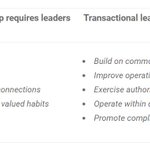
A2 Transformational leadership looks to change the entire organizational system, while transactional leadership looks to best optimize the current system in place. The table below provides a good picture on what each type of leadership requires: #EDLE5330

A1 Marzano’s research shows a strong correlation (.25). Seashore et al.’s research also shows a strong correlation of .17-.22. Witzier’s study showed a much lower correlation, but it added too many variables by including schools outside of the U.S. #EDLE5330
A8 First, schools need to have fierce loyalty from its teachers. Only when teachers feel safe, are heard, and given space to do good and engaging work will students be able to say the same thing. #EDLE5330
A6 A learning organization more highly values the S’s as more than just clients, raw materials, excess inventory, or inmates. For an organization to transform to a learning organization, all stakeholders need to have the same vision and take responsibility as leaders. #EDLE5330
This is semi-related, but I've been reading a lot of Brene Brown's work on empathy, shame, and vulnerability lately, and I think it helps teachers learn how to better connect with students as guides in a true learning organization! #edle5330