

Head of Strategic Communications @GSR_io/ Host of The Crypto Tape / Airbnb Super Host/ Founding Reporter at The Block
Earth
Joined December 2014
- Tweets69.3K
- Following2.9K
- Followers212K
- Likes70.8K




Pinned Tweet
Personal news: I’m joining @GSR_io as Head of Content and Special Projects.
I’ve covered crypto since 2017, always drawn to market structure and how institutions shape this space. What started with bitcoin futures has evolved into a truly institutional market with real liquidity, access, and regulatory clarity.
Now I get to help tell that story from the inside.


Frank Chaparro retweeted

Yes, the 37.07% figure is correct as reported by ETFDB—it is the annualized (CAGR) 5-year return, not the total cumulative return.
ETFDB’s performance section explicitly notes that “Returns over 1 year are annualized.” Their ranking of the highest non-leveraged 5-year ETF returns therefore uses the compound annual growth rate. Multiple sources (ETFDB itself, PortfoliosLab, Evenfolio, etc.) put ZCSH’s 5-year figure in the ~37–41% range as of mid-to-late October 2026.
That annualized rate corresponds to a large total gain. PortfoliosLab states that $1,000 invested in ZCSH five years earlier would be worth about $5,530 (roughly a 4.5–5.5× total return, depending on the exact endpoint and fees). Recent performance has been far more explosive: roughly +380–450% over the past year, +200%+ YTD in 2026, and a calendar-year return near +447% in 2025. The longer-term annualized number is lower because it includes earlier deep drawdowns (for example, about –86% in 2022).
In short, ~37% per year compounded over five years is extremely strong and is why ZCSH ranks at the top of that non-leveraged list ahead of semiconductor, gold-miner, and energy ETFs. It only looks modest if it is mistaken for a total (non-annualized) 5-year gain.

Per ETFDB, Grayscale's ZCash ETF is the #1 performing non-leveraged ETF of the last 5 years (+37.07%).
Ahead of every semiconductor, gold miner, and energy fund on the list.
cool

Per ETFDB, Grayscale's ZCash ETF is the #1 performing non-leveraged ETF of the last 5 years (+37.07%).
Ahead of every semiconductor, gold miner, and energy fund on the list.
cool
Frank Chaparro retweeted

CME listed bitcoin futures in December 2017. The spot ETF came in January 2024.
Ether futures came in 2021, and the spot ETF three years later.
This week CME listed Uniswap futures, its first DeFi token, next to Bitcoin, Ether, Solana and Chainlink.
The regulated market usually builds the hedge years before the wrapper.
NEW: @GSR_io and @FalconXGlobal executed the first block trade in CME Group’s new Bitcoin Cash (BCH) and Uniswap (UNI) futures.
Institutional demand is moving beyond the largest assets toward the long tail of tokens with distinct use cases, and regulated, capital-efficient venues like CME give institutions the hedging tools they’ve asked for.
“Providing liquidity in crypto derivatives has long been a cornerstone of GSR’s business, making it a natural fit for us to support CME Group’s new Bitcoin Cash and Uniswap futures from day one,” said @xinsong86, CEO of GSR. “We have long believed that expanding institutional-grade derivatives will supercharge institutional adoption of digital assets, and CME Group plays a central role in making that vision a reality.”
Pulled two conversations out of the archives for The Crypto Tape.
I sat down with two of @GSR_io's leading minds earlier this year: Alex Taaffe, our US chief revenue officer, and Andy Baehr (@baehr), head of our asset management.
Alex covers why token launches have slowed, what a project needs before it launches a token, and why perps are one of crypto’s best inventions. Plus his playbook for selling in crypto.
Andy explains why volatility is a good thing, the signals he looks for in a proper rally, and why DeFi needs a proper fixed income market.
If you want to hear how top execs inside a trading firm are thinking about the market, listen.
Episode drops tomorrow.
New @coinbase + @TheBlockCo report is a banger.
Stablecoins move $400M+ every hour, 24/7. That adds up to $891B in Q3 2026 (adjusted for bots, exchanges and DeFi), up 4x+ from $216B in Q1 2023.
Keep that pace and volume hits ~$1.5T a quarter by end of 2027.
Addresses also on the risk with 293M addresses - more than Amex and Discover’s combined card base.


Frank Chaparro retweeted

MAYBE I WAS WRONG ABOUT BLOCKCHAIN TECHNOLOGY
I wrote about how I always used to make fun of the guys who said things like "Bitcoin is speculative, but the underlying blockchain technology is interesting." And now I think maybe they kinda had a point.


Frank Chaparro retweeted
“The platform’s gonna do what’s best for the platform, not what’s best for the consumer.”
In episode 5 of The Desk, we sit down with Anna Kazlauskas (@annakaz), co-founder of Vana and CEO of OpenDataLabs. We cover what happens when public internet data hits a ceiling, what stays scarce once models know everything, and what changes when agents start shopping for us.
Watch the full discussion here:
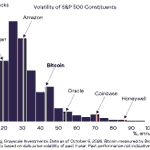
J.P. Morgan Asset Management added a bitcoin forecast to its Long-Term Capital Market Assumptions for the first time. This is the 31st edition of the annual report.
Its 10-year base case for BTC is a 10% compounded return with 55% volatility. That is 2.5 points above its 7.5% estimate for US large caps and 4.5 points above its 5.5% estimate for gold.
JPM still does not treat BTC as a portfolio diversifier. It points to unstable correlations and high volatility, and its bear case is -11.2% a year.

NEW: @GSR_io and @FalconXGlobal executed the first block trade in CME Group’s new Bitcoin Cash (BCH) and Uniswap (UNI) futures.
Institutional demand is moving beyond the largest assets toward the long tail of tokens with distinct use cases, and regulated, capital-efficient venues like CME give institutions the hedging tools they’ve asked for.
“Providing liquidity in crypto derivatives has long been a cornerstone of GSR’s business, making it a natural fit for us to support CME Group’s new Bitcoin Cash and Uniswap futures from day one,” said @xinsong86, CEO of GSR. “We have long believed that expanding institutional-grade derivatives will supercharge institutional adoption of digital assets, and CME Group plays a central role in making that vision a reality.”
This is super telling.
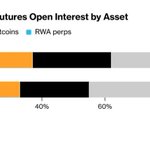
Across five major trading venues, total perpetual futures open interest has fallen 17% over the past year, from $81B to $67B.
Yet open interest in RWA perpetuals has surged from virtually zero to $9B, now accounting for 14% of the market.
Even as speculative activity in crypto-native assets contracts, traders are increasingly using crypto infrastructure to gain exposure to traditional financial assets.

Really enjoyed this conversation on “The New Shape of Market Structure” at Definition 2026 during Token2049 Singapore, with three legends of crypto market structure: David Lawant at Anchorage, Stef Wynendaele at Keyrock and Joshua Lim at FalconX.
We covered:
- Why everyone wants to be a prime broker, and why the term still means something different in crypto than in TradFi
- Why institutions seem focused on tokenization and RWAs, and not buying the long tail of crypto assets (hedge funds can already hold tokens but risk-adjusted return versus equities doesn't necessarily seem worth)
- How credit is coming back in secured form, with tokenized equities as collateral a major tailwind
- Why crypto market makers are better off focusing on what they know, like tokenized and DeFi-issued assets, than trying to out-trade established TradFi market makers in large-cap equities


