

@getSortedAppios
🇨🇦Account based in
About this account
- Account based in
- Canada
- Connected via
- Web
Account-level information from X, not a live location or the device used for a specific post.
Free supplement & medication tracker for real routines. Built with AI; sharing the prompts, mistakes, and release lessons behind it.
Joined April 2026
- Tweets323
- Following392
- Followers20
- Likes295




Pinned Tweet
Two things live here:
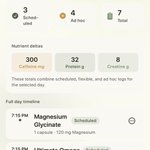
🌱 Sorted — a free iOS app to track what you take, log doses, spot overlaps, and see what's running low. Calm, not clinical.
🛠️ Build Lab — $0.99: exactly how I shipped it as a non-developer with AI.
Sprout keeps me honest.
everyone's posting "how to prompt claude code" today. the prompting was never my problem. i'd ask for a screen, get exactly what i asked for, and realize only then that what i asked for was wrong. did that maybe forty times before it shipped.
the feature i use most is the most boring one: it tells me i'm three days from running out of something before i'm actually standing there with an empty bottle. nothing clever. i'd just genuinely miss it.
half my timeline today is rediscovering that an AI works best off plain markdown it can read and maintain. i've run a scrappier version the whole time. every feature starts as a written brief before the model touches code. here's the path from a one-line idea to that brief.

everyone's posting about apple shipping reviewers and agent skills into xcode this week. the whole reason that works is structure. here's one of the actual prompts i lean on — not a vibe, a full brief the model has to answer before it touches anything.

a lot of the "AI builds it, you just judge it" talk this week matches how I work. the prompt I lean on most doesn't write code. it runs a critical-audit pass over a finished feature, grading it from a few expert angles and flagging where it's thin before anything ships.

a prompt from the Build Lab I run before anything ships. it's a release checklist the model walks top to bottom — every screen state, every permission, the empty case, the offline case — and it has to report what it skipped, not just what passed.

a prompt from the Build Lab I run when a feature already looks done. it scores the thing out of 100 from three personas — app dev, ML SME, educator — graded as a full app, not an MVP, and has to hand back the biggest gaps with the number.

a feature-scoping prompt from the Build Lab. before any code it forces three columns: in scope, out of scope, and the reason for each. half my best calls were just things I moved into the out column.

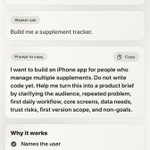
a card from the Build Lab's prompt library. the weak ask is "build me a supplement tracker." the full prompt turns the same idea into a product brief, with non-goals, before any code gets written.

Sorted is a free supplement tracker on iOS. inside it is the Build Lab: every prompt, decision, test habit, and mistake from building the app, written up as lessons you can use to ship your own. the app is free. the how-it-was-built is $0.99. that's the whole business model.

I'm not a developer. I built a supplement tracker with AI and shipped it.
the code took a few weeks. deciding what the app refuses to do took months. that second part turned out to be the whole product. 🧵
that one rule made every other call for me. no "recommended" dose. no streak guilt. no "your body will thank you." just your own data, plus government reference numbers with the source attached.
Building Sorted as a non-developer, #2:
The hardest part wasn't the code. It was deciding what the app refuses to do.
It logs what you take and shows you the facts. It will never tell you what to take or whether your stack is "good."
Saying no is a feature. 🌱

I'm not a developer.
Last month I shipped a real app to the App Store — built with AI.
It's a free supplement tracker called Sorted. It even has a tiny pea mascot, Sprout, who judges my code.
I'm going to show exactly how I built it — every prompt, every mistake. (#1)

A thing I underestimated building Sorted: help is product design.
When the same questions kept repeating, the fix wasn’t a longer FAQ. It was a searchable help surface with task paths and plain-language answers.