Pinned Tweet
I have to set the record straight regarding an important detail. It doesn't fit into a single post, so it will be a short thread.
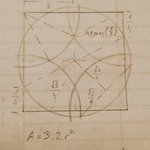
It's a recurring issue, that some claim that I claim "pi=3.2". That is false. It's the same with the Indiana Pi Bill.
...
A black cat started to cross the road in front of me, but then it looked at me, and turned back. Spooky.
So many definitions in conventional geometry are messed up so badly, that it's easy to get lost in them.
The tangent line makes a lot of sense this way. Not the concept of single-point contact. That is entirely made-up and totally wrong.
Replying to @gmac4247
If I divide the radius by cos(x), I get the half diagonal of a polygon. If I multiply it by sin(x), — like if it was the radius of a larger circle — I get the half of the tangent section. Sine/cosine=tangent. It's that simple. The single-point contact idea is a different thing.
Here's a spooky story for Halloween. Why did someone call me claiming a missed call from my number if I didn't initiate any phone call? This mystery is still unsolved.
I got the focus messed up when I wrote that. The issue is that the Hungarian — my native language — word for the tangent line already suggests single-point tangency. It's that bad. The English word tangent is fine. The concept of single-point tangency is fundamentally wrong.
Replying to @gmac4247
Mainstream geometry insists that a tangent line can always be drawn. A tangent line coincides with a circle only at a single point. Yet, when attempting to circumscribe a 24-sided polygon about a circle, each side coincides with the arc along a significant section.
Angolul "tangent line", ami magyarul "érintô". Az találó, mert ha osztom egy kör sugarát cos(x)-szel, egy sokszög átlójának a felét kapom. Azt szorzom sin(x)-szel — mint ha egy nagyobb kör sugara lenne —, egy érintô szakasz felét kapom. Sin / cos = tan.
The shape of the arc doesn't enable a single-point coincidence with a tangent line. Yet, it became a fundamental conventional concept so badly, that the Hungarian word for the tangent line reflects the single-point condition rather than the tangent property.
So, what the mathematical constant pi really stands for is the expression n×sin(180°/n)<pi<n×tan(180°/n).
With n approaching infinity, that is 3.14...
But that is not the true circumference to diameter ratio; it's just a failed approximate of it.
...
teapawt.org/BasicGeometry/status/2…
Replying to @gmac4247
Mainstream geometry insists that a tangent line can always be drawn. A tangent line coincides with a circle only at a single point. Yet, when attempting to circumscribe a 24-sided polygon about a circle, each side coincides with the arc along a significant section.
Don't fall for this type of fraud. The true volume of a sphere equals the cubic value of the square root of its cross-sectional area — just like a cube —, which is about a third larger than the result of this worthless, primitive, exaggerated approximate. Measure it.
The sphere’s true volume is revealed by what remains after the cones are removed.
Every horizontal slice of the sphere is a disk of radius √(r² − z²). The cylinder with its double cone subtracted leaves an annulus of outer radius r and inner radius |z|. Both areas equal π(r² − z²). Cavalieri’s principle therefore equates the volumes.
Subtract the two cones from the cylinder: 2πr³ − 2·(⅓πr³) = ⁴⁄₃πr³. The sphere occupies exactly two-thirds of its enclosing cylinder.
Geometry finds equality in the slices we choose to compare.
I still can't find any video proving that Archimedian "V=r³4pi/3" formula. Can you? Of course you can't, because it's about one third off. Measure it and see for yourself.
teapawt.org/gmac4247/status/192125…
True geometry.
Finding the volume of a sphere using liquid displacement.
Prepare to be amazed!
youtu.be/rXcJhFLLP0Y?si=Nxx3…