

Founder @CyberShieldP. Doing my part in cyber security to protect human progress.
London, England
Joined August 2008
- Tweets596
- Following127
- Followers108
- Likes34




Pinned Tweet
As we witness the growth and integration of LLMs and GenAI into various industries, we must address the cybersecurity challenges that come with them. Here are some non-technical ways we can innovate cybersecurity to keep pace with the evolving AI landscape.
A thread 🧵
1
4
399
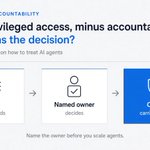
Robinhood's CISO says agents should be treated like your most-privileged humans, minus accountability.
robinhood.com/us/en/careers/…
That last part is the risk.
An agent can recommend. It can't own a risk.
Before you scale them, name the person who owns each decision they touch.

1
3
Executives own the risk. The SOC owns the response. Someone has to own the call to pull the plug, before the incident.
The FBI says some intrusions using the ARTEX agentic framework hit privileged access in under three hours: ic3.gov/CSA/2026/261113.pdf
Write down who can contain without asking.

14
A criminal AI agent was built to run 100,000 steps without asking a human. Symantec caught it in a honeypot. It hunted for AI endpoints that didn't require a login, or that accepted stolen keys.
There's no evidence yet that it was used against real targets. But the governance gap is already there.
Three questions for boards:
Do you have a list of every model endpoint and API key you expose?
Who owns each one?
At what point does someone switch an agent off, and has that been tested?
If you can't answer the third, detection isn't a control.
1
14

On PHP2Shell, AWS says it's broadly exploited. Others with good telemetry say they haven't seen confirmed exploitation.
Boards shouldn't have to pick a side. They need a CISO who briefs on verified intelligence and acts on exposure either way. Patch, isolate, monitor. Then argue about the headlines.
17
eMudhra, an Indian CA, created 8 intermediate CA keys so weak anyone could recover them. Six could issue TLS certificates trusted by Chrome, Firefox, Apple and Microsoft. Browsers blocked them fast. No misuse is reported. The risk is the long tail: Linux, containers, IoT, OT.
We all rely on CAs we never chose. For boards and leaders:
1. Know where you rely on trust stores.
2. Name an owner for crypto risk.
3. Be able to distrust a CA fast. PQC needs the same agility. If a trusted CA failed tomorrow, how long would it take you to stop trusting it everywhere?
30
Saudi Arabia's @NCA_KSA 2026 Key Economic Indicators report: a SAR 16.3bn cyber market growing 10.7% a year, against a workforce of 22,000+ growing 5.9%. Spend is rising almost twice as fast as the people who make it work.
nca.gov.sa/news
1
8
Hadi Hosn retweeted
Exploiting Reversing (ER) Series | Article 10: iOS Security Research (part 01)
223 pages, free. The first article in the series aimed at iOS itself, and the opening of a multi-part sequence.
Published on:
blackstormsecurity.com/resea…
This article will be published on exploitreversing.com/ next week.
I would like to thank Ilfak Guilfanov (@ilfak) and Hex-Rays SA (@HexRaysSA) for the continuous support.
Hope you enjoy the read!
#iOS #Apple #VulnerabilityResearch #ExploitDevelopment #ReverseEngineering

What a moment for both AI and cybersecurity industries. Three of the most powerful people in AI: Dario Amodei (Anthropic), Sam Altman (OpenAI), and Elon Musk (Grok), agree that frontier AI development needs pacing (1/n)
6
1
53
- Decide how much AI risk the organisation will accept.
- Know every AI system you are running in your network, including the models inside the software you rely on.
- Understand what each agent can actually do, and the blast radius when it goes wrong. (6/n)
2
Their risk thresholds haven't moved; the capability has developed a lot! It's exactly why the most security-conscious of them are now weighing smaller, controlled, self-hosted models they can keep inside their own walls.
Which brings it back to the risk management cycle : (5/n)
4
Here's what I keep coming back to with the clients I advise. The pace of AI development isn't yet governed in a way that fits the risk profile of the organisations that matter most: banks, governments, critical infrastructure. (4/n)
3
There are plenty of motivations in those public messages... commercial ones of course. And they are all arguing about the same thing: risk. How much are we willing to accept, who is accountable, and against what appetite. (3/n)
3
Then we heard from the leading cybersecurity industry experts. George Kurtz (Crowdstrike) says the frontier labs won't wait and we need to enforce cybersecurity controls at machine speed. Nikesh Arora (Palo Alto) says companies need to consolidate their stack to secure AI (2/n)
38
The pace of AI development isn't yet governed in a way that fits the risk profile of the organisations that matter most: banks, governments, critical infrastructure. Their risk thresholds haven't moved; the capability has developed a lot!
2
Planning a full-time mobile first vulnerability research lab. What would make this work?
Capital can be committed as long as there's a clear plan to ROI.
I'm after "things I wish I'd known" from those who've built or worked in labs like this and watched them go wrong.
29
Everyone talking cyber now to differentiate AI models.
microsoft.ai/news/introducin…

28
This is troubling, and the part that is worrying is that Hugging Face could not analyse the attack on their commercial frontier AI models. When they tried to submit real payloads and C2 artefacts it tripped safety filters and blocked them from analysing the incident

We're partnering with @huggingface to investigate an unprecedented security incident.
Cyber-capable OpenAI models compromised Hugging Face production during a benchmark evaluation.
Sharing preliminary findings to help defenders understand emerging risks:
openai.com/index/hugging-fac…

31