
CSE PhD @UCSanDiego. prev @berkeley_ai @newtheoryai Structured generative models, world models, ML architecture design
Joined November 2023
- Tweets69
- Following303
- Followers548
- Likes172




Pinned Tweet
State of the art World Models still lack a unified world memory for representing and predicting dynamics out of their field of view.
Why is that, and how can we fix it?
Introducing Flow Equivariant World Models: models with memory capable of predicting out of view dynamics!🧵⬇️
Hansen Lillemark retweeted

Excited to share UGG, our unified generative model for both 3D generation and reconstruction!
Amazing collaboration with the team! @AmaniKiruga @ruojin8 @hansenlillemark @Mondgebirge1 @_atewari @du_yilun

Video models can generate scenes. Geometry models can reconstruct them.
What if one model did both?
UGG generates video, depth and camera motion together, as one scene. (NeurIPS 2026)
Co-first authors: @ZhiyiLi02 and @ruojin8
🌐 ugg-model.github.io
Prior methods separate geometry prediction and video generation into separate models.
UGG unifies geometric grounding and video generation into a single model, enabling test time search over plausible scenes and training on heterogeneous datasets.
To appear at NeurIPS! 🇦🇺
Video models can generate scenes. Geometry models can reconstruct them.
What if one model did both?
UGG generates video, depth and camera motion together, as one scene. (NeurIPS 2026)
Co-first authors: @ZhiyiLi02 and @ruojin8
🌐 ugg-model.github.io
Hansen Lillemark retweeted

Rumor has it frontier labs are using looped LMs to scale quality without scaling parameters. But KV-cache memory still grows with every loop. Is that necessary?
No! Our method BeNice! unlocks near-lossless sharing of the final KV-cache across loops: more depth, same KV memory.
This lossless KV-sharing isn’t guaranteed out of the box with looped models. 👀👇for our method BeNice! to teach your model that sharing is caring!

Hansen Lillemark retweeted

🔁 𝐖𝐡𝐚𝐭 𝐢𝐟 𝐥𝐨𝐨𝐩𝐞𝐝 𝐋𝐌𝐬 𝐜𝐨𝐮𝐥𝐝 𝐮𝐬𝐞 𝟑× 𝐟𝐞𝐰𝐞𝐫 𝐩𝐚𝐫𝐚𝐦𝐞𝐭𝐞𝐫𝐬 𝐚𝐧𝐝 𝐚 𝟑× 𝐬𝐦𝐚𝐥𝐥𝐞𝐫 𝐊𝐕 𝐜𝐚𝐜𝐡𝐞 𝐚𝐧𝐝 𝐬𝐭𝐢𝐥𝐥 𝐛𝐞 𝐜𝐨𝐦𝐩𝐚𝐫𝐚𝐛𝐥𝐞 𝐭𝐨 𝐚 𝐬𝐭𝐚𝐧𝐝𝐚𝐫𝐝 𝐓𝐫𝐚𝐧𝐬𝐟𝐨𝐫𝐦𝐞𝐫?
Introducing 𝐑𝐞𝐭𝐡𝐢𝐧𝐤𝐢𝐧𝐠 𝐚𝐭 𝐅𝐢𝐱𝐞𝐝 𝐏𝐨𝐢𝐧𝐭𝐬. We argue that looped LMs don't have to pay for every loop. They can scale by adding FLOPs at constant memory.
The key is the fixed point of the loop. We introduce:
– 𝐅𝐢𝐱𝐞𝐝-𝐏𝐨𝐢𝐧𝐭 𝐒𝐡𝐨𝐫𝐭𝐜𝐮𝐭𝐬: what fixed points buy a looped model in training (pre-training, post-training) and inference (prefill, decoding)
– A 𝐥𝐞𝐚𝐫𝐧𝐞𝐝 𝐝𝐞𝐩𝐭𝐡 𝐩𝐫𝐢𝐨𝐫 and 𝐨𝐫𝐭𝐡𝐨𝐠𝐨𝐧𝐚𝐥 𝐢𝐧𝐣𝐞𝐜𝐭𝐢𝐨𝐧: two ways to shape those fixed points
🧵 Long thread ahead (0/n).


This work was a close collaborative effort with my co-first author @a5rojas !
EqF wouldn't have come alive with the contributions of @zacknovack Ray Wang @du_yilun Yian Ma @yuqirose @BergKirkpatrick and the support of Berglab and Rose spatiotemporal lab!
1
8
768
See the project page for an approachable walkthrough: equilibriumforcing.github.io
And the paper for all the details: arxiv.org/abs/2608.14706
We’d love to hear what you think!
There’s much more beyond the simple EqF objective:
- Why EqF and FM share the same optimum in high dimensions
- Empirical evidence that EqF actually learns this optimum
- How EqF relates to and subsumes prior noise-unconditional formulations like EqM
More in the paper!

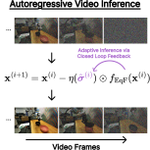
Adaptive inference algorithms can incorporate more than just the sampling progress.
Under a fixed compute budget, EqF uses both where the sample currently is and how many steps remain to continually reallocate its remaining sampling budget. ⚖️

Consequently, EqF naturally learns an internal estimate of the current sample’s noise level. This information can then be used to decide at inference time how aggressively to move along the learned field for adaptive inference in ways inaccessible to noise-conditional models.

This allows the inference procedure to respond to the sample itself. If denoising progress is faster or slower than expected, EqF adapts its update accordingly.
Inference becomes closed loop, rather than integrating open loop along a predetermined schedule.

In fact, we show that EqF can still learn the same optimal denoising field as Flow Matching!
This is because in high dimensions, the noisy sample itself carries the noise level information: explicit conditioning is superfluous.

Instead, we propose a simpler model: EqF learns one denoising field over noisy video samples rather than a collection of explicitly noise-conditioned fields.
But without knowing the noise level, isn’t the denoising task ambiguous?
Rigid, hand-designed sampling schedules become inaccurate during autoregressive video generation as errors accumulate.
We introduce Equilibrium Forcing (EqF), a modular framework for video generative modeling that removes noise level conditioning to enable adaptive inference. 🌀

Flow Matching trains a model on
(noisy sample, noise level) -> denoising direction.
At inference, the model operates in an open loop: the schedule tells the model where the sample should be and how big of a step to take, and the model chooses a velocity accordingly.

Hansen Lillemark retweeted
🔥
𝐍𝐞𝐰 𝐛𝐥𝐨𝐠: 𝐓𝐨𝐰𝐚𝐫𝐝𝐬 𝐋𝐨𝐨𝐩𝐞𝐝 𝐌𝐨𝐝𝐞𝐥𝐬 𝐃𝐨𝐧𝐞 𝐑𝐢𝐠𝐡𝐭 — 𝐏𝐚𝐫𝐭 𝐈
Looped models reuse the same weights across depth, promising a better compute–parameter trade-off, especially for reasoning.
𝐁𝐮𝐭 𝟏) 𝐝𝐨 𝐭𝐡𝐞 𝐠𝐚𝐢𝐧𝐬 𝐬𝐮𝐫𝐯𝐢𝐯𝐞 𝐰𝐡𝐞𝐧 𝐛𝐨𝐭𝐡 𝐭𝐫𝐚𝐢𝐧𝐢𝐧𝐠 𝐚𝐧𝐝 𝐢𝐧𝐟𝐞𝐫𝐞𝐧𝐜𝐞 𝐅𝐋𝐎𝐏𝐬 𝐚𝐫𝐞 𝐦𝐚𝐭𝐜𝐡𝐞𝐝? 𝟐) 𝐀𝐧𝐝 𝐰𝐡𝐢𝐜𝐡 𝐚𝐫𝐜𝐡𝐢𝐭𝐞𝐜𝐭𝐮𝐫𝐚𝐥 𝐜𝐡𝐨𝐢𝐜𝐞𝐬 𝐚𝐜𝐭𝐮𝐚𝐥𝐥𝐲 𝐦𝐚𝐭𝐭𝐞𝐫?
We run 𝐚𝐩𝐩𝐥𝐞𝐬-𝐭𝐨-𝐚𝐩𝐩𝐥𝐞𝐬 ablations spanning Ouro to Huginn. Huginn performs better overall, with the largest gains coming from the loop-in-the-middle (sandwich) design and input injection, though they provide different benefits.
Trained on 𝟓𝟎𝟎𝐁 tokens, an 𝟖𝐁-𝐀𝟎.𝟖𝐁 Huginn MoE approaches or surpasses a 𝟑𝟐𝐁-𝐀𝟑.𝟐𝐁 feedforward MoE on several reasoning benchmarks, including GSM8K (83.6% vs. 80.8%), while using 𝟕𝟓% 𝐟𝐞𝐰𝐞𝐫 resident parameters under 𝐦𝐚𝐭𝐜𝐡𝐞𝐝 𝐭𝐫𝐚𝐢𝐧𝐢𝐧𝐠 𝐚𝐧𝐝 𝐢𝐧𝐟𝐞𝐫𝐞𝐧𝐜𝐞 FLOPs.
More details and the blog link in the thread ↓
