The largest Chinese developer community, your window into China’s tech ecosystem. Sharing AI & open source News. Business Inquiries: [email protected]
Beijing & Changsha, China
Joined December 2014
- Tweets242
- Following160
- Followers217
- Likes338




The biggest shift here isn’t that AI can write more code. It’s that software engineering can no longer rely on humans reading every line to establish trust.
As code generation scales, the real bottleneck moves downstream: tests、evals、risk-based review、quality gates、rollback — and ultimately the harness and feedback loops around coding agents.
The pipeline itself looks familiar. What’s changing is who — or what — performs each step.
This is exactly why Harness Engineering and Loop Engineering are becoming such important topics for AI-native software development.


CSDN retweeted

PenguinHarness now has over 3,000 stars on GitHub! 🐧
Thank you for trusting us with your projects and telling us what's working and what could be better.
We've been shipping frequent updates, with your bug reports and feature requests helping us decide what to fix and build next.
PenguinHarness 0.2.17 is here. Here's what's new:
- Charts and forms, right in chat. Visualize your results and collect structured input with 11 field types, including dates, dropdowns, and sliders.
- A clearer view of every run. The redesigned Trace view makes it easier to follow execution, inspect token usage for each turn, and track down issues.
- Better remote agent management. Remote conversations now access the correct machine's sessions, memory, and models.
- An upgraded Agent API. Read session history, follow live session activity, and handle approvals to integrate agents into your own apps.
- Fixes for everyday frustrations. Scroll back without getting pulled to the latest reply, copy content as plain text, and see only the agents that belong to your selected project.
We want PenguinHarness to get more useful with every release. Keep sharing what you're building and where we can make things better.
What should we tackle next? Let us know in the replies. Full release notes: PenguinHarness 0.2.17
penguin.ooo/blog/penguinharn…

Self-evolving AI is no longer just a concept.
Teams are already seeing:
• +18.8% accuracy, -7.5% token cost
• AI-generated training frameworks, operators & inference kernels
• Agents continuously learning from real user interactions
From OpenAI and reinforcement learning to Tencent WorkBuddy, Xiaomi MiMo, PenguinHarness and Frontis.AI, the 2026 Singularity Intelligence Technology Summit will explore one key question:
How does AI move from Scaling to truly Self-Evolving systems?
📍 Nov 20–21 | Beijing
👉 ml-summit.org/
#RSI #LLVM #AI #Tencent #XiaoMi #mimo #harness #AIInfrastructure #agent #EmbodiedAI #PHYSICALAI #MultimodalAI

CSDN retweeted

🚀 Introducing DeepInfer, our in-house inference framework, now fully open source!
Powering DeepSeek-V4.1-Flash at scale with high throughput and low latency. We’re sharing our production stack to help the community lower compute costs, reduce energy use, and make AI more affordable.
🔗 github.com/deepseek-ai/DeepI…
1/4

CSDN retweeted

The Trump administration barred civilian US government agencies from using products or services from Chinese AI startup DeepSeek, whose more affordable open-weight models pose an increasing challenge to Silicon Valley Valley developers. bloomberg.com/news/articles/…

太棒了!

很高兴 GOSIM 台上的讨论延伸到了线上👏
感谢 @QuantumTransf 分享 Obelisk,也期待看到更多关于 Agent Memory 的实践与思考。
让技术交流持续发生,让开源想法不断生长!
RT @gosimfoundation: “I’ve never had this much fun with computers in 40 years.”
At GOSIM Shenzhen 2026, @dhh shared why AI agents changed…
CSDN retweeted

I met so many people from all over the world and had such interesting conversations - the kind of trip I’ll be thinking about for quite some time
Two days. 2,000+ builders. Pure open-source energy.
From agentic OS architecture to real-world open-weight model deployments, GOSIM Shenzhen 2026 proved that the next wave of open tech is already here.
Huge thanks to every speaker, developer, and community contributor who packed the halls.
The conversations don’t stop here. 🚀
#GOSIMShenzhen #OpenSource #AgenticAI #DevCommunity


CSDN retweeted
鲸鱼兄弟们好,我是做 DeepSeek-TUI 的那个美国佬。
说真的,特别想跟国内的鲸鱼兄弟们一起混——但我的翻墙技能仅限于写代码,微信到现在都没搞定,属实有点丢人。
求各位大佬帮个忙:
1)帮忙转发扩散一下,让这个开源终端工具翻过高墙被兄弟们看到
2)顺手帮我验证个微信号,我想建个群,大家一起聊 DeepSeek、聊开源、聊怎么把 agent 做得更好
作为交换,我发誓死守 cargo install 这条安装路径,绝不让任何一个兄弟受 npm 的苦。
顺带一提,这段话是 DeepSeek 帮我润色的——感谢鲸鱼赐我流利中文 🙏
github.com/Hmbown/DeepSeek-T…

CSDN retweeted

“This is the most exciting time in computer science in 25 years.”
When @dhh took the main stage at GOSIM Shenzhen 2026, the room was electric.
From rethinking desktop computing to the unstoppable rise of open-weight models, the open source spirit was on full display.
Thanks for bringing the energy to Shenzhen, David. 🤝
#GOSIMShenzhen #OpenSource #Linux #AgenticAI


CSDN retweeted
Two days. 2,000+ builders. Pure open-source energy.
From agentic OS architecture to real-world open-weight model deployments, GOSIM Shenzhen 2026 proved that the next wave of open tech is already here.
Huge thanks to every speaker, developer, and community contributor who packed the halls.
The conversations don’t stop here. 🚀
#GOSIMShenzhen #OpenSource #AgenticAI #DevCommunity
Where global open-source pioneers meet the world’s most vibrant developer ecosystem.
CSDN was proud to co-organize GOSIM Shenzhen 2026, connecting 2,000+ builders around agentic AI, robotics, and the open-weight frontier.
The code is running, and the future is being built. Stay tuned for session recaps and keynotes! 🛠️
#CSDN #GOSIMShenzhen #OpenSource #DeveloperCommunity @gosimfoundation


Spotted on our main stage! 🚲
That slide was from CSDN Founder @csdncto ’s keynote on how open models are catching up to frontier giants on real-world tasks.
Huge shoutout to @simonw for creating the benchmark everyone loves to see! #GOSIMShenzhen


CSDN retweeted

Grok 4.7 ranks first in legal matters

Today we are announcing Harvey LAB-AA v1.1 in collaboration with Harvey. This updates our scoring methodology for the Legal Agent Benchmark (LAB) to add a hallucination check and require correct responses to not include material misstatements. LAB-AA v1.1's new headline metric, Hallucination-Gated All-Pass Rate, only credits a task when the deliverables satisfy every rubric criterion and contain no material hallucinations.
We define a material hallucination as one that would mislead a reader on a substantive point, such as a wrong contractually required date, while a minor hallucination is a real error that is unlikely to meaningfully affect the legal interpretation of a deliverable. Minor hallucinations are reported separately and do not affect the headline score.
Grok 4.7 (xhigh) leads at 9.4% Hallucination-Gated All-Pass Rate, and >60% of otherwise passing results across the models tested at launch contain a material hallucination.
This is the first step in enhancing the methodology for Harvey LAB-AA. In future updates, we’re working with Harvey to better account for the full set of factors lawyers value, including usability features like style and tone.
Key takeaways:
➤ Top of the leaderboard: Grok 4.7 (xhigh) from @spacexai leads at 9.4% Hallucination-Gated All-Pass Rate, narrowly ahead of Muse Spark 1.3 (max) from @AIatMeta at 8.9% and GPT-6 Astra (max) from @OpenAI at 8.6%
➤ Hallucinations reshape the leaderboard: without the hallucination gate, Muse Spark 1.3 (max) would lead clearly with a 26.7% all-pass rate, but two thirds of those passes contain one or more material hallucinations, resulting in a Hallucination-Gated All-Pass Rate of 8.9%. GPT-6 Astra (max) retains almost all of its passes after the hallucination gate (8.9% to 8.6%) and moves from joint 10th to 3rd
➤ The GPT-6 model family is the most grounded: GPT-6 Astra (max) averages 0.03 material hallucinations per task (4 across all 120 tasks) and GPT-6 Sol (max) averages 0.07. When comparing six checker models on a 20-task subset, GPT-6 Astra had zero material hallucinations under every checker, including Claude Opus 5.5 (high). By comparison, Gemini 3.8 Flash (high) averages 13.96 material hallucinations per task.
➤ Top-scoring models aren’t the most expensive: Grok 4.7 (xhigh) takes the top spot on the leaderboard at a cost of ~$9.50 per task, under half the cost of Claude Fable 5.1 (max with fallback) at ~$21.70, the most expensive model. Muse Spark 1.3 (max) represents strong performance for its cost, landing in second for ~$4.20 per task
Thank you to @nikogrupen and @ItsJulioPereyra from @harvey for their work on Harvey LAB and collaboration.

Legal AI needs more than correct answers — it needs reliable ones.
Harvey LAB-AA v1.1 introduces hallucination-gated scoring, highlighting a critical challenge: passing a task doesn't always mean getting the facts right.
Today we are announcing Harvey LAB-AA v1.1 in collaboration with Harvey. This updates our scoring methodology for the Legal Agent Benchmark (LAB) to add a hallucination check and require correct responses to not include material misstatements. LAB-AA v1.1's new headline metric, Hallucination-Gated All-Pass Rate, only credits a task when the deliverables satisfy every rubric criterion and contain no material hallucinations.
We define a material hallucination as one that would mislead a reader on a substantive point, such as a wrong contractually required date, while a minor hallucination is a real error that is unlikely to meaningfully affect the legal interpretation of a deliverable. Minor hallucinations are reported separately and do not affect the headline score.
Grok 4.7 (xhigh) leads at 9.4% Hallucination-Gated All-Pass Rate, and >60% of otherwise passing results across the models tested at launch contain a material hallucination.
This is the first step in enhancing the methodology for Harvey LAB-AA. In future updates, we’re working with Harvey to better account for the full set of factors lawyers value, including usability features like style and tone.
Key takeaways:
➤ Top of the leaderboard: Grok 4.7 (xhigh) from @spacexai leads at 9.4% Hallucination-Gated All-Pass Rate, narrowly ahead of Muse Spark 1.3 (max) from @AIatMeta at 8.9% and GPT-6 Astra (max) from @OpenAI at 8.6%
➤ Hallucinations reshape the leaderboard: without the hallucination gate, Muse Spark 1.3 (max) would lead clearly with a 26.7% all-pass rate, but two thirds of those passes contain one or more material hallucinations, resulting in a Hallucination-Gated All-Pass Rate of 8.9%. GPT-6 Astra (max) retains almost all of its passes after the hallucination gate (8.9% to 8.6%) and moves from joint 10th to 3rd
➤ The GPT-6 model family is the most grounded: GPT-6 Astra (max) averages 0.03 material hallucinations per task (4 across all 120 tasks) and GPT-6 Sol (max) averages 0.07. When comparing six checker models on a 20-task subset, GPT-6 Astra had zero material hallucinations under every checker, including Claude Opus 5.5 (high). By comparison, Gemini 3.8 Flash (high) averages 13.96 material hallucinations per task.
➤ Top-scoring models aren’t the most expensive: Grok 4.7 (xhigh) takes the top spot on the leaderboard at a cost of ~$9.50 per task, under half the cost of Claude Fable 5.1 (max with fallback) at ~$21.70, the most expensive model. Muse Spark 1.3 (max) represents strong performance for its cost, landing in second for ~$4.20 per task
Thank you to @nikogrupen and @ItsJulioPereyra from @harvey for their work on Harvey LAB and collaboration.
Come and join us 🌟!
🚀 GOSIM 2026 Agentic Observer is now open!
🔥 Deadline: Oct 1
🌟Start building:
create.gosim.org/survey26/pl…
What if AI could decide where a sky survey telescope should look next? 🔭
Build an agent that runs a survey telescope through the night: it reads the sky state, decides like a lead observer, and picks the next observation every 900 seconds.
💰 $5,500 prize pool · 6 winning teams
🌍 Open worldwide
👥 Solo or teams of 1–3
🎓 No astronomy background required
🤖 Open-source model support + expert training
#Hackathon #AgenticObserver #GOSIM2026 #AgenticAI #AIforScience #Astronomy #OpenSource @Kimi_Moonshot
CSDN retweeted
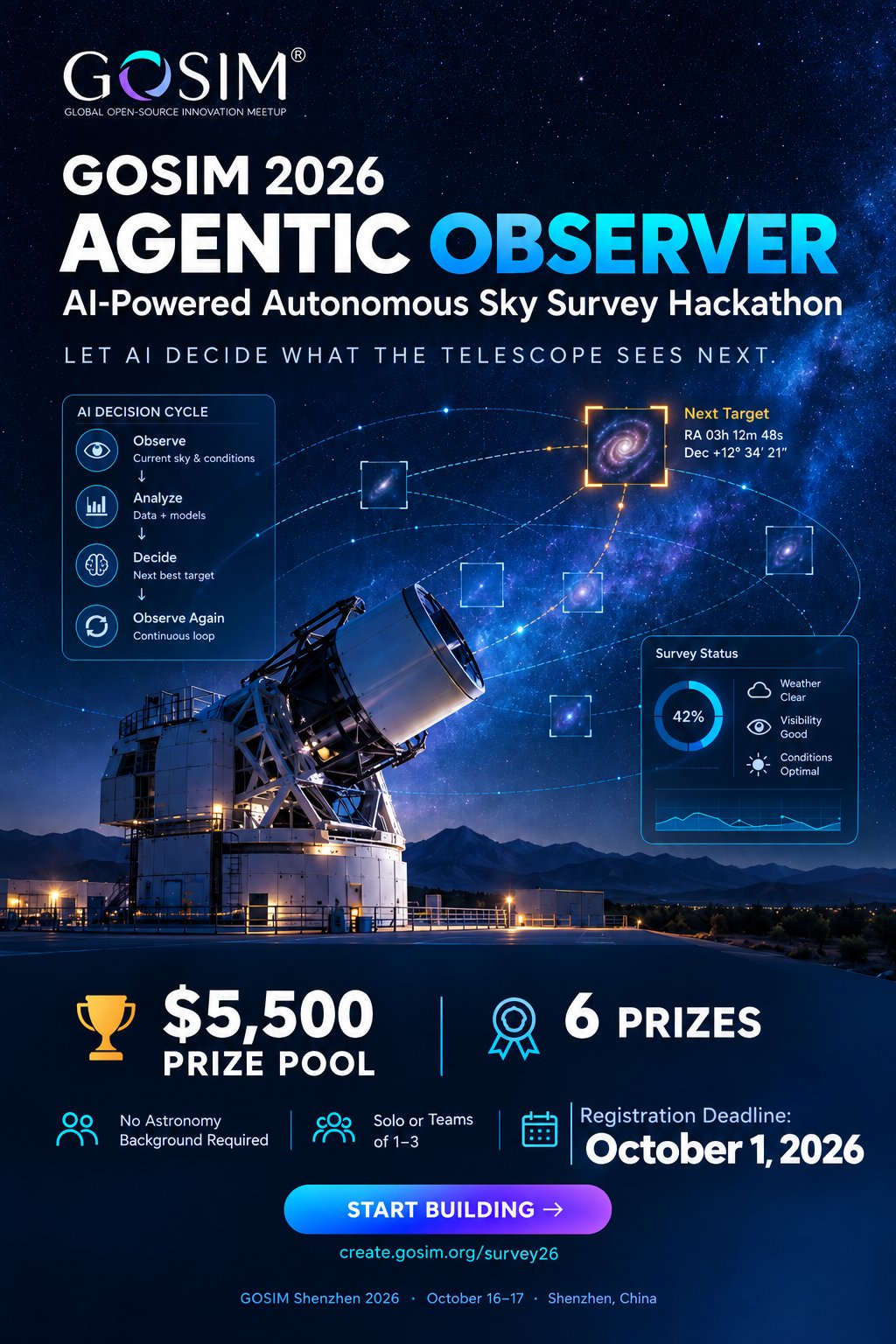
🚀 GOSIM 2026 Agentic Observer is now open!
🔥 Deadline: Oct 1
🌟Start building:
create.gosim.org/survey26/pl…
What if AI could decide where a sky survey telescope should look next? 🔭
Build an agent that runs a survey telescope through the night: it reads the sky state, decides like a lead observer, and picks the next observation every 900 seconds.
💰 $5,500 prize pool · 6 winning teams
🌍 Open worldwide
👥 Solo or teams of 1–3
🎓 No astronomy background required
🤖 Open-source model support + expert training
#Hackathon #AgenticObserver #GOSIM2026 #AgenticAI #AIforScience #Astronomy #OpenSource @Kimi_Moonshot
🤖 Made with AI

Adding 50% more GPUs to the Rollout of Agentic RL cuts latency by only 10.3%.
A new paper by Bai Youhui (Specially Appointed Associate Researcher, USTC) reveals that the bottleneck in agent training isn’t just GPU count — it’s also Prefill–Decode interference across multi-turn interactions, model weight access, and ever-shifting resource supply.
Paper: arxiv.org/abs/2609.35158
PEARL puts three things into one system:
• Elastic access to preemptible GPUs
• Opportunistic reuse of idle training GPUs
• Dynamic choice of PD co-location vs. separation and the P/D ratio
Because PD separation isn’t always faster: at BS32 it leads by 9.7%, but at BS96 co-location wins by 6.1%. The optimal config must adapt to load and GPU budget.
Across experiments with up to 32 H800s, Qwen3-8B and Qwen3-30B-A3B, PEARL achieves up to 36.3% higher throughput than RLBoost+ given the same elastic resources.
On Nov 20–21, co-author Bai Youhui will speak at the 2026 C++ & Systems Software Technology Conference, sharing practices on sparse attention and KV Cache management on domestic supernodes.
📍 Wanda Vista Beijing
#AgenticRL #AIInfra #KVCache