

eval agi @valsai | prev @yutori_ai, @tesla_ai
Joined November 2013
- Tweets914
- Following1.3K
- Followers407
- Likes14.2K





hung retweeted

So basically, today PHP got two critical bugs that let anyone run code on your server without even logging in, which is bad, and then the details leaked before the patch was even out, which is worse, and it works on WordPress and MediaWiki and Magento and Joomla and Laravel, and Censys says like 1.5 million servers are running a version with no fix, so the NSA was like "take your system offline," and the FBI was like "take your system offline," and CISA and the UK and CERT-EU were all like "take your system offline," and then the Prime Minister of Japan, the actual Prime Minister, posted at 5:55 in the morning telling 48.8 million people to take their system offline, so everyone took their system offline, like the Dutch cybersecurity agency took its own website offline, and the Dutch parliament went offline, and the Port of Rotterdam went offline, and Finland and France and Denmark started pulling government sites, and Wikipedia went down, and Archive.org went down, and Asana and GOG and Something Awful went down, and the University of Vienna's webmail went down for some reason, and that's just PHP. Because GitLab also dropped a CVSS 10.0, which is the highest score they give out, for a bug that's been there since 2014, so that's every self-hosted GitLab for twelve years, and then LiteLLM 1.107.0 got hijacked and shipped a credential stealer and a remote access trojan in every single wheel and the Docker images, including latest, and you didn't even have to import it, just installing it was enough, and it's the second time this year, and then Railway paused every deployment on the entire platform because someone got into the environment variables, so now everyone has to rotate every secret they've ever stored there, and TiDB Cloud said someone was walking around inside with stolen credentials for basically a month and an extortion group says they took 10.6 terabytes, and Zeabur got breached for the second time in two months and is just shutting down, like the whole company, and Node.js patched remote code execution and a TLS bypass, and CISA says Plex is being actively exploited, and someone took over 300 Tor exit relays to steal SSH passwords, and SafePay ransomware has hit over 600 critical infrastructure orgs, and India's biggest bank filed a data loss incident, and Japan has been in an official state of emergency in cyberspace since October 9, which honestly explains the 5:55 AM post. Oh, and eMudhra, a certificate authority that's issued over 60 million certificates, whose entire job is proving websites are who they say they are, was supposed to be using private keys that are random numbers over a hundred digits long, and one of them was 4. Just 4. And the others were like 66 and 237. Anyway, it's Wednesday.
hung retweeted

Last month, we demonstrated high-rate alchemy: turning mercury into real, stable gold, beating CERN’s record by a factor of 10.
Last week, we enriched isotopes in the world’s most powerful plasma centrifuge, beating the Soviet record that stood for 40 years.
Now, we’re building a fusion reactor in San Francisco to achieve record power density.
chinese models are catching up fast when it comes to cyber offensive capability. more to come.

We found DeepSeek V4.1 Flash 1017 beats GPT 6 Sol on our multi-step offensive cybersecurity task. Sol was tested via the Daybreak trusted access program.
We have been building a cybersecurity benchmark based on simulated corporate networks. This is a valuable indicator for the cyber-risk a model poses if in the hands of a bad actor. We plan to make the full evaluation public in the coming weeks but wanted to share our first immediate finding here.


i'm struggling to understand why people keep saying this is the most important breakthrough in deep learning.
the essay is right that some famous examples of “hopeless” neurons were misread, and that neurons in modern, well-built networks are more interpretable than people assumed.
it seems to go too far in downplaying superposition and networks are already clean where the evidence left out residual stream and attention.

interpretability might be the most important scientific problem in the world right now, as I don't think we can solve alignment if we don't know what we're building. I think I have good news about it. I co-authored early work in mechanistic interpretability at OpenAI and came away pessimistic, because neural networks appeared to fold into arbitrary tangled knots. years later, I started openai's first large-scale automated interpretability project, finding about 2% of neurons legible with the primitive tools we had
with modern agentic tools and a much closer look, the picture looks totally different. the vast majority in models up to trillions of parameters are legible, and their circuits beautiful. many famous examples of tangled neurons turned out to be misunderstood. The roadblocks I expected mostly aren't there. I now think ambitious interpretability will be solved by the time we need it most, and possibly quite soon, as automated scientists keep improving. it may be a bitter lesson for interpretability: the simple thing, at absurd scale, works
already-clean.goodfire.com/

hung retweeted

When will robotics be solved?
We put frontier models in real-time MuJoCo sims of a robot arm and a humanoid, where they only receive camera feeds and sensor readings, and respond with motor commands. We tested them on 24 tasks built around spatial reasoning and reaction time.

now we just need wet labs to close the loops
For decades, researchers have sought materials that sort electrons by spin while their magnetism cancels.
In 3 days, 90+ Opus 5.5 agents helped us uncover two room-temperature magnetic semiconductor candidates in simulations: YBaMnFeO₅ and KV[Cr(CN)₆].
KV[Cr(CN)₆] was synthesized back in 1999. Its predicted ability to sort electrons by spin appears to have been hiding in plain sight for 27 years.


very encouraging to see thoughtful questions/ concerns from the senators

🧵 Note of appreciation for the senators at today's hearing.
There's a reflexive cynicism about congress and tech, the sense that our legislature is simply too slow, too partisan, and too uninformed about the subject matter to govern something as inchoate and quickly evolving as AI. I've indulged in it myself.
Today complicated that for me. Senators of both parties asked sharp, technically literate questions in evident good faith. They came across incredibly earnest and serious and curious. They seemed to appreciate that the questions in front of them are among the most consequential any legislature has ever faced.
One model I find appealing is that Congress needn't begin w/ a lot of expertise; it needs to be willing to learn, and have a public that shows up to help it (thats you and me) and rewards it for that kind of seriousness. Today seemed like the first part is possible; I think the second part is partly up to the rest of us. I hope this level of thoughtfulness becomes the norm.
Thanks to the senators and their staffs, the holy monks of the Hart Building.
A few moments that stood out to me:
hung retweeted

Massive jump from Google on our RSI-Index. Now #4 and outperforming GPT-6-Astra. Were the internal RSI rumors true 👀? vals.ai/benchmarks/rsi_index


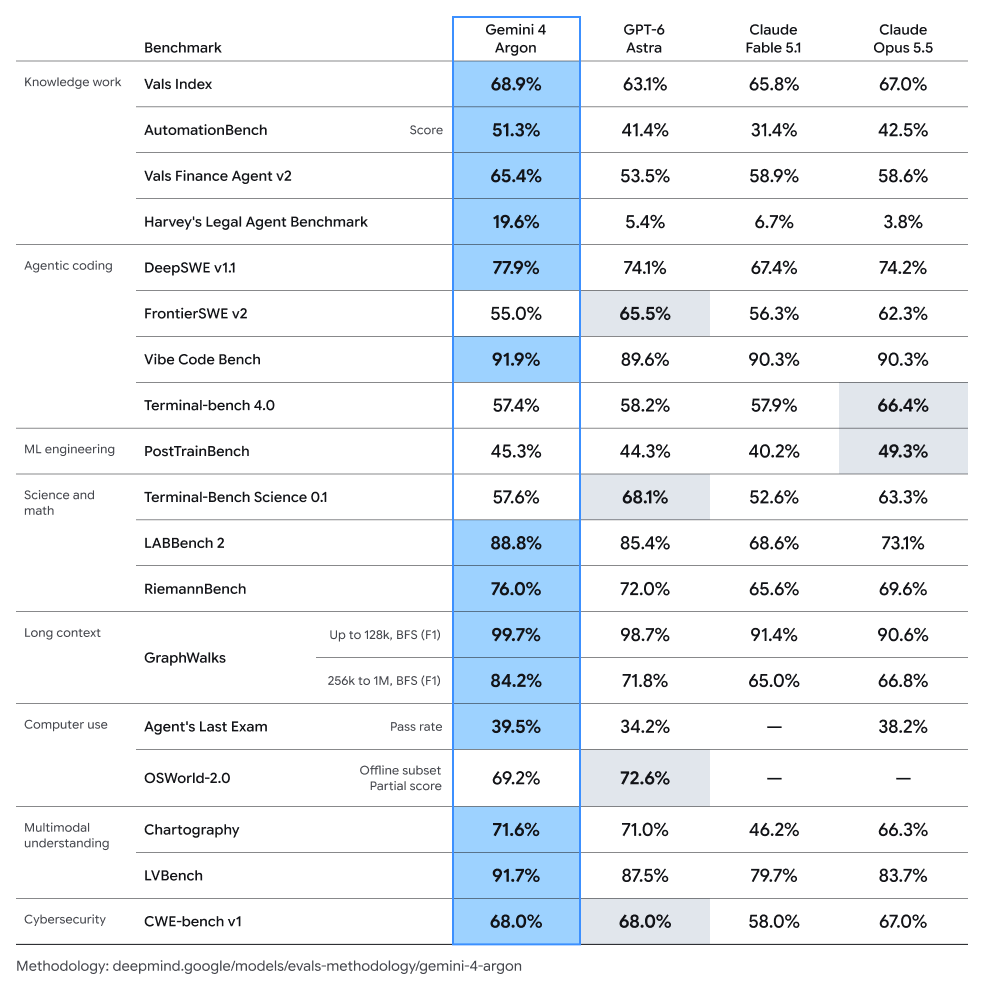
google is finally back with consistent sota performance in our benchmarks but they really need to overhaul their harnesses (i'm looking at you antigravity) so that people can stop thinking it's benchmaxxing


didn’t expect they would listen, but people will probably be ready for Pro 1000 next year

chatgpt plus $20 launched on february 1, 2023
pro $200 launched on december 5, 2024
it's about time for ultra $1000 @thsottiaux
found a proof for seven electrons on a sphere
turns out you can use a non-sota model to tackle unresolved problems in math/physics
hung retweeted

SpaceX added ~1% to global internet bandwidth with today's Starship launch.
Readers added context they thought people might want to know
This only increased the global *satellite* capacity by 1%, not the entire world including terrestrial network capacity
x.com/manhattva/stat…