

Head of Product @ Tapugo, AI-native Polymath Writing about why games fail, scale, or quietly print money F2P, UX, monetization, production reality
Lahore, Pakistan
Joined December 2011
- Tweets144
- Following1.9K
- Followers207
- Likes332





@naval nailed it:
“Vibe coding is the new product management. Training and tuning models is the new coding.”
Product Managers are becoming the new software engineers.
Polymath PMs? An unfair advantage in the next 5 years.
Curious minds, multidisciplinary thinkers, professional dot-connectors.
ADHDers, this might just be our era. 🚀

A fail the player saw coming feels fair. The same fail, unannounced, feels rigged. Same board, same score, same offer. Only the beats before it differ.
Last post was the deadlock detector: the game knows a board is dead before the player can. Fails work the same way. Your game knows a level is slipping moves before the player feels it, and what it says in between decides how the loss lands.
Think of it as a ladder with five rungs: safe, warning, last move, failed, the offer.
Each rung is a function of two numbers you already track, moves left and goal left. The ladder is cheap to build. Skipping a rung is what costs you.
Run the same level twice. Five moves, 13 pieces to collect, the player ends two short. With every rung in place, the counter turns amber at three, the last move gets its own moment, and "+5 moves" arrives against a gap the player watched shrink. Take out the warning and the last move, and the identical fail lands as news. The offer hasn't changed. It just reads as a trap instead of a rescue.
The best in the genre build every rung on purpose:
→ The offer is sold before it appears. Dream Games tunes Royal Match so you tend to fall one or two moves short, then asks 900 coins for five more. By the time that screen shows up, the player has already done the math on the board. The board makes the pitch. The screen just takes payment.
→ The warning is a tuning number. King's Candy Crush Saga starts blinking the move counter at five moves left. Five is a choice, not a law. A trigger on moves alone lies in both directions: three moves left with one piece to go isn't danger, five left with twelve to go already is. Fire it on the gap between moves and goal.
→ The failed rung can carry more than the level. Royal Match's Super Light Ball and Peak's Magic Disco in Toon Blast are built on win streaks and vanish on a single fail. The player isn't deciding about one level anymore. They're deciding about the streak. So log the rung, not just the fail. A player who quits during the warning and one who closes the offer are different problems.
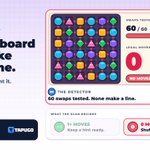
PART 4 OF PUZZLES DECODED: A match-3 board with zero legal moves and one with a dozen look the same at a glance. Players can't tell them apart. Your code has to.
Last post was the sorter's bench: seven slots, four colours, no match. A wall the player can count.
A swap board is the opposite.
6×6 grid = 60 possible swaps
8×8 grid = 112 possible swaps
Nobody checks them all before they tap.
So the game does. After every settle, a deadlock detector tries each swap and asks one question: does this make a line of three? If the answer is no every time, the board is dead.
𝗧𝗵𝗲 𝗱𝗲𝘁𝗲𝗰𝘁𝗼𝗿 𝗶𝘀 𝘁𝗵𝗲 𝗱𝗲𝘀𝗶𝗴𝗻. 𝗧𝗵𝗲 𝘀𝗵𝘂𝗳𝗳𝗹𝗲 𝗶𝘀 𝘁𝗿𝗶𝘃𝗶𝗮𝗹.
Here's what changes 👇
𝟭/ 𝗡𝗲𝘃𝗲𝗿 𝘀𝗲𝗹𝗹 𝘁𝗵𝗲 𝗲𝘅𝗶𝘁 𝗳𝗿𝗼𝗺 𝗮 𝗱𝗲𝗮𝗱 𝗯𝗼𝗮𝗿𝗱
A full bench is built by the player's own picks, so a paid clear lands as a rescue.
A dead swap board was dealt by your refill.
Charge for that shuffle and you're charging players for your own RNG.
𝟮/ 𝗖𝗼𝗹𝗼𝘂𝗿 𝗰𝗼𝘂𝗻𝘁 𝗶𝘀 𝘁𝗵𝗲 𝗱𝗶𝗳𝗳𝗶𝗰𝘂𝗹𝘁𝘆 𝗱𝗶𝗮𝗹
I simulated 200,000 random 8×8 deals per colour count.
Average legal moves:
4 colours → 27
5 colours → 19
6 colours → 14
7 colours → 10
Every colour you add removes a quarter to a third of the options.
𝟯/ 𝗧𝗵𝗲 𝘀𝗮𝗺𝗲 𝘀𝗰𝗮𝗻 𝗶𝘀 𝘆𝗼𝘂𝗿 𝗵𝗶𝗻𝘁 𝘀𝘆𝘀𝘁𝗲𝗺
The list of legal swaps is already computed. Show one when the player idles.
Log its length at every settle.
Idling on a 2-move board = searching. Idling on a 20-move board = bored.
𝗜𝗳 𝘆𝗼𝘂 𝗱𝗲𝘀𝗶𝗴𝗻 𝗮 𝘀𝘄𝗮𝗽 𝗽𝘂𝘇𝘇𝗹𝗲:
→ Run the detector after every settle, not just at the deal.
→ Shuffle dead boards automatically and for free.
→ Track legal-move count per turn next to your fail rate.
━━━━━━━━━━
I play the games, study the data and decode what makes mobile games win.
You can read more of my writeups here:
- How Monopoly GO is rocking the IP partnership game: lnkd.in/p/d-PA6DCg
- How an 8-year old game is still relevant in 2026: lnkd.in/p/dxH_CwKp
- Ad creative volume gets you into the room not the front: lnkd.in/p/dmqXPvXK
- 43 curated games in Hybrid Puzzle Radar: Sept Vol 2: lnkd.in/p/dcF-hfjP
Follow me for teardowns on game design, product and market research. 🫰
@Google is putting TPUs in space next week.
Not a concept. A real prototype satellite, riding @SpaceX's Transporter-18, built with Planet.
This is "AI datacenter in space" and a hardware validation mission with a launch date.
The test: can AI chips survive a rocket launch (up to 100g on individual components), then run workloads through radiation that would equal 5 years of exposure.
Early radiation tests on their Trillium TPUs already held up better than expected. Vibration tests too.
Next real problem: cooling. No air in space means no airflow, so they're testing heat pipes + radiators in a vacuum chamber instead.
If this works, the endgame is TPU satellite clusters talking to each other via laser links precise enough to hit a coin-sized target from miles away, while both ends are moving.
Hot take: "AI will replace junior developers" is the wrong fear.
The people actually at risk right now aren't writing code or art. They're writing status reports.
If your job is turning three Slack threads into one update doc, an agent can already do that today.
🤖 Made with AI

1
39
Your sorter's bench is full. 7 of 7 slots, nothing matching. Full is not the fail state, and if you treat it as one you will tune difficulty in the wrong place.
Last post I split pressure into four sources: moves, space, clock, spawn rate. This is beat two: SPACE and the arithmetic underneath it.
The fail isn't "bench full". It's "bench full and no third piece anywhere". Only the second one ends a level.
7 slots, 3 reachable item types. Seven tiles across three types means one type has at least three of them, so a match always exists. The bench can hit 7/7 and it will always resolve. That level is unloseable by capacity, however tight the slots feel.
Add a fourth type and the bench can sit at 2 + 2 + 2 + 1. Seven filled slots, no third of anything. That is the deadlock and it is the only shape a capacity fail can take.
Capacity is the ceiling. Variety is the wall.
3 decisions change once you separate them:
→ Tuning. Cutting a slot is a blunt nerf that hits every level the same way. Adding one reachable type moves the same wall, and only where you placed it. Difficulty lives in whatever hides the third piece (layers, occluders, locked stacks), not in the bench size.
→ Monetization. This is the rare wall a player can count: seven filled slots, four colours, no match. So match the offer to the debt. An extra slot buys exactly one more pick. A tray clear pays off three pairs at once. They are not interchangeable.
→ Fail analytics. "Failed level 47" tells you nothing here. Log what was on the bench. A 2+2+2+1 bench is a variety problem. Two types buried under four layers is a reachability problem. Same fail, opposite fixes.
And the bench is the one pressure source players fill themselves, one pick at a time. That is why the rescue lands instead of reading as a shakedown.
When a player fails your sorter, do you know what was sitting on the bench?
72
Everyone assumes AI kills junior game dev jobs first.
It doesn't.
It kills junior producers.
Not the artists. Not the engineers. Not the designers learning taste.
The routing layer: status updates, chasing blockers, syncing three teams on where a feature stands. That's almost pure information synthesis.
That's exactly what AI agents are already good at.
1
36
Your puzzle game level has 4 ways to put a player under pressure. They only ever feel one of them.
Last time I broke puzzle games into a three-beat loop: pressure, relief valve, chain reaction. This one goes deeper into beat one.
Pressure comes from four sources, and each one tests something different:
1. Moves
A fixed budget of actions per level, like the move counter in most match-3s. You can see exactly what's left, so every tap is a trade-off. Tests planning. When it runs out, it feels like your own mistake.
2. Space
A capacity limit: the board, a bench of slots, a tray. It fills with whatever you couldn't clear, so the pressure is built from your own earlier moves. Tests foresight.
3. Clock
A time limit that drains whether you act or not. It's the only source that punishes thinking. Tests speed, and when it runs out, the fail feels like the game's fault.
4. Spawn rate
The game keeps adding pieces on its own schedule: rows push up, bubbles descend, new blocks drop in. The pressure is the gap between how fast things arrive and how fast you clear them. Tests throughput.
Tension is the max of these, never the average.
A player with 1 move left doesn't relax because the timer still shows 40 seconds. Whichever source is closest to bursting is the only one they feel.
That changes three decisions:
→ Tuning. Four sources at 60% don't add up to a hard level. They add up to a flat one. Let them take turns peaking instead.
→ Monetization. The offer has to match the source that's about to burst. Extra moves are worthless against a full bench.
→ Analytics. A fail rate per level hides the real question: which source ran out? A moves fail and a clock fail need different fixes.
Every puzzle game you can't put down runs on the same three-beat loop.
1. Pressure
The board fills up. Moves run low. Every tap feels tighter than the last. That tension is designed, not accidental.
2. Relief valve
Right when it's about to break, the game offers a way out: a booster, an extra slot, a few more moves. That release is the product. It's what players actually pay for.
3. Chain reaction
Then the payoff. One move sets off another, and another. Pieces clear in waves, and the win feels earned, even when the game quietly helped.
And the moment it's over, the pressure starts building again.
The craft is in the balance. Too little pressure and nothing is worth buying. Too much and players quit before the valve ever opens. Hand out too many boosters and there's no tension left to release.
Next time you play your favourite puzzle game, try spotting all three beats.
@tapugogames
@tapugogames’ mission is to separate actual game-making signal from the flood of AI-generated slop.
AI will make production infinite. Taste, judgment and quality won’t be.
Mark my words!
Everyone is asking whether AI can make a good game.
Wrong question. Ask what happens to a genre when finding out a game is bad stops costing anything.

The bottleneck in mobile games was never ideas. Every studio has a hundred.
The bottleneck was that testing one cost six weeks.
@tapugogames

Makes me wonder how far this goes for game dev specifically. Prototyping props and environment pieces without touching a cloud pipeline sounds great but does the topology/quality get clean enough to skip the retopo step entirely, or is this still “great for blockouts, not for ship-ready assets”?
Either way, zero server cost for 3D gen is a genuine unlock @hybridherbst
Watching where this goes.

We did it!! – image-to-3D, locally in your browser!
✅ We put TRELLIS on the web
✅ 100% local on your machine
✅ Generation takes 1-3 minutes (depends on your hardware)
You can try it here! mesh-baker.needle.tools
Go to "generate" on the left & drop image
Quality is quite decent 😀
66

Say one concept in 50 clears your CPI target. At 6 weeks a test, you get 8 shots a year.
That's not a studio. That's an annual lottery ticket.
Go @tapugogames 🚀
The bottleneck in mobile games was never ideas. Every studio has a hundred.
The bottleneck was that testing one cost six weeks.
@tapugogames
1
26
Publishers were never better at making games than you. They were better at testing 40 at once.
That was the whole edge.
The bottleneck in mobile games was never ideas. Every studio has a hundred.
The bottleneck was that testing one cost six weeks.
@tapugogames
The bottleneck in mobile games was never ideas. Every studio has a hundred.
The bottleneck was that testing one cost six weeks.
@tapugogames
🤖 Made with AI
"Someone should really build this."
@chafsnaceri posted that about a slingshot twist on Smash Fest yesterday with marketability data showing it out-tests the original cannon.
The honest version of that sentence, in 2026, is: someone will. Probably 11 someones. Probably this month.
Smash Fest has ~38 clones and $5M+ in revenue. The mechanic is public. The economy is legible. The creative writes itself. There is no information advantage left in the idea.
Which is why we stopped treating ideas as the asset. What we built instead is the loop:
→ concept to playable in hours.
→ creatives live against real traffic the same day.
→ CTR, play rate, median session, level completion back before you've committed a sprint.
→ 100 levels built once the data earns it.
REMOVING DECISION LATENCY COMPLETELY!
Every week you spend building an untested promise is a week the other 37 teams are testing theirs. You can build yours too! The loop that produced it in a day is the thing we call @tapugogames 😉

Shipping mobile games shouldn’t take months.
With @tapugogames, you can swap seasonal themes on your playable ads in one click: same game, new environment, zero rebuild.
A/B test characters, physics, and campaigns instantly. Ship this week, not this quarter. 😉
Get started → tapugo.ai