

Building 🪶 @proomtdev & claude-jr | Open Source contributor @multigres | Trying to keep up with the world 🌎
Joined May 2017
- Tweets429
- Following845
- Followers33
- Likes560


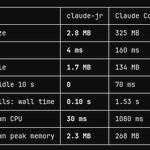






Created a small terminal coding agent kindoff mimicing claude-code but it uses 700 Kb ram and very low cpu and takes 5 ms to start, and it is written in rust.
please share your thoughts on this.
github.com/IWhitebird/claude…

6
9
174
🎟️ Claimed my profile on the new home for #buildinpublic.
Come find me: buildinpublic.com/?ref=ifrog…

5
claudejr using 700kb mem . try it out github.com/IWhitebird/claude…
1
12

iguy retweeted

proomt just got its biggest update yet.
→ A redesigned feed and reading page
→ Ask Quill: ask any story a question, answered from the story itself, writing help.
→ Weekly digest, every Monday and RSS
Founding memberships open today.
proomt.com

iguy retweeted

It’s memory hierarchy all the way down.
S3 is the future, the world’s disk. It’s not the only storage medium, nor should it be (again, memory hierarchy).
But there’s hot and cold data, and the well-designed architectures will respect this.
Whether it be L1/L2/L3 and main memory, or NVMe and HDD, or pure replication and erasure coding.
The best designs exploit the memory hierarchy.

S3-based database architectures don’t read from S3 all the time, though.
Instead, they amortize the cost by caching in memory and on local disk (which can be NVMe). As a result, read performance is more or less the same as in local-disk architectures, though the tail latency is heavier; NVMe’s tail is much flatter.
Writes are slower, but not by as much as people often think. You almost never want a write acknowledged by a single local disk, so a local-disk database pays a network round trip for replication anyway. That makes S3-based architectures competitive, especially with S3 Express.
iguy retweeted

Introducing Claude Fable 5.2 and Claude Mythos 5.2, designed to tackle the most daunting technical challenges.
They’re capable collaborators on ambitious projects in many fields, and show improvements in areas like coding, reasoning, and vision.


I am creating claude-jr , a minimal version of claude code written in rust to work with very small compute .
1
1
60
iguy retweeted

S3-based database architectures don’t read from S3 all the time, though.
Instead, they amortize the cost by caching in memory and on local disk (which can be NVMe). As a result, read performance is more or less the same as in local-disk architectures, though the tail latency is heavier; NVMe’s tail is much flatter.
Writes are slower, but not by as much as people often think. You almost never want a write acknowledged by a single local disk, so a local-disk database pays a network round trip for replication anyway. That makes S3-based architectures competitive, especially with S3 Express.

iguy retweeted
Engineering blogs and research papers from 500+ sources, ranked by quality and summarised, so you know in five seconds what deserves twenty minutes.
One feed, tuned to what you follow. Free to read, free to publish.
proomt.com