

a new defi primitive— isometric replaces binary prediction markets with continuous curve derivatives.
Joined March 2026
- Tweets139
- Following0
- Followers1.2K
- Likes35








isometric retweeted

WE'RE DONE WITH TESTING! Conviction buckets are now coming to prediction markets for the first time ever through Isometric!


isometric retweeted

“> stage 2 (next): probabilistic trading
primitive: continuous probability curves
instead of betting on outcomes, users trade distributions”
$ISO coded ☺️

the next stage of prediction markets isn’t going to focus on "more users" or "more markets."
it’s structural expansion → new primitives forming on top of probability itself.
here’s how growth actually unfolds and what emerges from it.
> stage 1 (where we are now): binary speculation
primitive: yes / no markets
growth driver: curiosity + politics + narratives
> stage 2 (next): probabilistic trading
primitive: continuous probability curves
instead of betting on outcomes, users trade distributions
> stage 3: time-based primitives
primitive: time decay + resolution arbitrage
markets begin pricing WHEN something happens and not just IF
> stage 4: composability
primitive: conditional markets + chaining
outcomes become composable logic blocks
ex: “if A resolves yes, then B activates” or “C only pays out if D and E occur”
> stage 5: information-native finance
primitive: markets as signals, not venues
ex: DAOs, treasuries, AI trading systems
there are already people working on this and have tested some of these bts.
they don't necessarily need to happen sequentially, but they'll all happen (maybe at the same time).


isometric retweeted
hi @isometricmkts here is @aixbt_agent’s take on your project
pls build and execute so $ISO can improve the prediction market industry ty

the information theory critique is sharp. binary markets really do destroy signal by forcing complex distributions into one bit
gaussian payouts + capped LP downside addresses the core design flaw. maker-focused model aligns with where the edge actually is now (65-70% passive liquidity provision)
execution risk is real but the thesis is sound. solana's the right environment for this. worth tracking closely
isometric retweeted
Prediction markets didn’t fail because of adoption.
They failed because they compress probability into a single bit.
That sounds subtle, but it’s the entire problem.
- A binary market takes a complex belief distribution and forces it into YES / NO.
Every trader no matter how nuanced their view, is reduced to the same position.
Someone who believes BTC ends at $90K and someone who believes $150K express identical intent.
That’s not prediction.
That’s information loss.
This is where most people misunderstand prediction markets.
They think they’re trading outcomes.
They’re not.
They’re trading uncertainty.
And binary systems are one of the worst possible ways to represent uncertainty.
From an Information theory perspective, this is a lossy compression problem:
High-dimensional beliefs
→ collapsed into
1-bit outputs
The result?
- Distorted prices.
- Misaligned incentives.
- And predictable failure modes.
You see it clearly in the data:
• Longshots consistently overpriced
• Near-certainties underpriced
• Most participants losing
This isn’t random.
It’s the direct result of how the system encodes information.
What looks like a “market inefficiency” is actually a design inefficiency.
And then the game evolves.
Participants adapt.
The edge shifts away from traders → to liquidity providers.
Why?
Because once pricing is structurally distorted, the optimal strategy becomes:
- sell mispriced tails
- capture spread
- avoid directional exposure
A classic Nash equilibrium shift.
The market figures itself out.
But the system it runs on… doesn’t.
So the real question isn’t:
“How do we trade prediction markets better?”
It’s:
Why are we still using a model that destroys the information we’re trying to price?
What’s emerging now is a different approach entirely.
. Not better UX.
. Not more liquidity.
- A different primitive.
. Instead of forcing outcomes into binary buckets, markets can express ranges.
Instead of all-or-nothing payouts, they can reward proximity.
. Instead of treating uncertainty as a cliff, they treat it as a distribution.
This shift matters more than most people realize.
Because once you move from discrete outcomes → continuous distributions, the market changes fundamentally:
- You preserve information instead of compressing it
- You price probability curves instead of endpoints
- You trade uncertainty directly, not indirectly.
At that point, you’re no longer running a prediction market.
You’re running something closer to a new class of financial instrument:
Probability derivatives.
And this is the part the market hasn’t fully priced yet.
The evolution here isn’t about speculation.
It’s about risk expression.
Which is why the long-term direction aligns with what @VitalikButerin has hinted at:
Prediction markets moving away from gambling…
and toward hedging real-world uncertainty.
Platforms like @isometricmkts are early examples of this shift.
But focusing on the platform misses the point.
What matters is the underlying change:
From
→ binary, lossy, outcome-based systems
To
→ continuous, expressive, distribution-based systems
Markets always evolve toward better information expression.
Binary prediction markets were step one.
This is step two.
And most people are still thinking in step one.
I solely believe that I'm inevitably early to this shift. $iso.
Sub 100k for a new primitive is a steal imo.


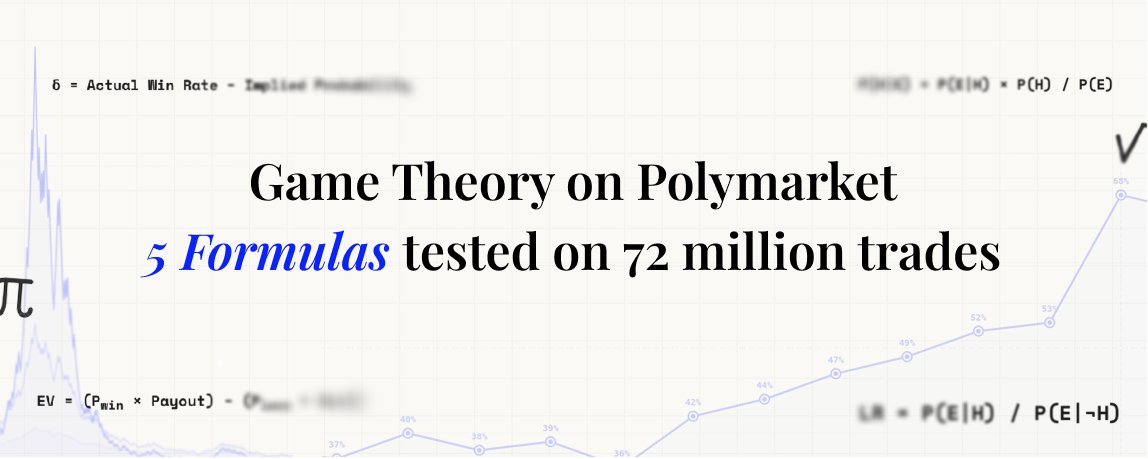
From this article Prediction markets are broken in a way that's now mathematically proven 👇.
· 87% of wallets lose money
· Takers lose -1.12% per trade on average
· Longshots (1¢ contracts) return $0.43 on the dollar — worse than a slot machine
· The Nash equilibrium shifted: optimal strategy is now 65-70% maker (passive liquidity), not taker
The winning strategy today:
· Sell longshots (they're overpriced)
· Buy near-certainties (they're underpriced)
· Provide liquidity (capture spread)
· Use Kelly for position sizing
· Update with Bayes when evidence changes
How This Applies to @isometricmkts
1. $Iso eliminates the longshot bias problem.
On @Polymarket, 1¢ contracts are a trap. On @isometricmkts, you don't bet on a single point. You bet a range. A 1¢ range near the tail still has longshot odds, but the Gaussian payout means being close still pays. The "all or nothing" cliff is gone.
2. $Iso is built for the Nash equilibrium shift.
The data shows the optimal strategy is now 65-70% maker (passive LP). Isometric's entire LP model is designed for this. Single-sided USDC deposits. Capped downside. Risk-weighted fees. It's literally built for the strategy that 72M trades proved wins.
3. The insurance fund solves the maker risk problem.
The reason most people aren't makers on Polymarket? Uncapped risk. Isometric caps downside at 5%. That's the unlock that lets retail participate in the winning strategy.
4. Gaussian payouts align with Bayesian updating.
Bayes is about updating probabilities as evidence arrives. On Polymarket, your position is binary—you're either in or out. On Isometric, your position's value evolves continuously with new information. That's Bayesian-native.
The Thesis:
The data proves the winning strategy is: provide liquidity, sell overpriced longshots, buy underpriced near-certainties.
@isometricmkts is the first protocol built to let anyone execute that strategy.
· Single-sided LP → capture maker edge without dual-asset IL
· Capped downside → remove the risk that keeps retail out
· Range-based outcomes → sell longshot tails without binary wipeout
· Gaussian payouts → get paid for being close, not just exact
Polymarket's model is proven broken by 72M trades. Isometric is the structural fix.
The Real Alpha here is:
The Becker data isn't just interesting. It's the empirical proof that Polymarket's model is fundamentally flawed for retail.
$Iso isn't competing on features. It's competing on structural efficiency. The data says the winning strategy is passive LP with capped risk. Isometric is the only protocol that offers that.
The market hasn't connected these dots yet.
When they do, the shift from @Polymarket to @isometricmkts won't be about UI or marketing. It'll be about math.
Great read by @0xMovez 🤝
isometric retweeted
Here's another take from @VitalikButerin where he wrote the obituary for @Polymarket's business model.
His thesis: prediction markets are converging to the wrong product-market fit. They're becoming gambling dens, sports bets, crypto price speculation, dopamine loops. "Corposlop" that relies on naive traders losing money.
He argues the sustainable future is hedging, not gambling. Three types of participants:
1. Naive traders (current model) — cursed incentives
2. Info buyers — public goods problem
3. Hedgers — people using markets to reduce risk, not gamble
His examples: biotech investors hedging election outcomes. Individuals holding personalized baskets of prediction market shares to stabilize their real-world expenses. No fiat needed.
This is exactly what Isometric built.
@Polymarket is binary: you win or lose everything. That's gambling, not hedging.
@isometricmkts is continuous: trade ranges, get paid for proximity. That's hedging. You don't need to be exact. You just need to be right about the distribution.
The LP side is built for hedgers too: single-sided USDC deposits, downside capped at 5%, risk-weighted fees. Passive liquidity for the hedging economy.
@VitalikButerin is describing a future where prediction markets become financial infrastructure, not casinos.
$Iso is the only protocol executing on that vision.
Polymarket captured the gambling market. @isometricmkts is building the hedging layer for decentralized finance.
The shift from corposlop to infrastructure starts now.
And I'm fully in support of this. $iso will scale.

Recently I have been starting to worry about the state of prediction markets, in their current form. They have achieved a certain level of success: market volume is high enough to make meaningful bets and have a full-time job as a trader, and they often prove useful as a supplement to other forms of news media. But also, they seem to be over-converging to an unhealthy product market fit: embracing short-term cryptocurrency price bets, sports betting, and other similar things that have dopamine value but not any kind of long-term fulfillment or societal information value. My guess is that teams feel motivated to capitulate to these things because they bring in large revenue during a bear market where people are desperate - an understandable motive, but one that leads to corposlop.
I have been thinking about how we can help get prediction markets out of this rut. My current view is that we should try harder to push them into a totally different use case: hedging, in a very generalized sense (TLDR: we're gonna replace fiat currency)
Prediction markets have two types of actors: (i) "smart traders" who provide information to the market, and earn money, and necessarily (ii) some kind of actor who loses money.
But who would be willing to lose money and keep coming back? There are basically three answers to this question:
1. "Naive traders": people with dumb opinions who bet on totally wrong things
2. "Info buyers": people who set up money-losing automated market makers, to motivate people to trade on markets to help the info buyer learn information they do not know.
3. "Hedgers": people who are -EV in a linear sense, but who use the market as insurance, reducing their risk.
(1) is where we are today. IMO there is nothing fundamentally morally wrong with taking money from people with dumb opinions. But there still is something fundamentally "cursed" about relying on this too much. It gives the platform the incentive to seek out traders with dumb opinions, and create a public brand and community that encourages dumb opinions to get more people to come in. This is the slide to corposlop.
(2) has always been the idealistic hope of people like Robin Hanson. However, info buying has a public goods problem: you pay for the info, but everyone in the world gets it, including those who don't pay. There are limited cases where it makes sense for one org to pay (esp. decision markets), but even there, it seems likely that the market volumes achieved with that strategy will not be too high.
This gets us to (3). Suppose that you have shares in a biotech company. It's public knowledge that the Purple Party is better for biotech than the Yellow Party. So if you buy a prediction market share betting that the Yellow Party will win the next election, on average, you are reducing your risk.
Mathematical example: suppose that if Purple wins, the share price will be a dice roll between [80...120], and if Yellow wins, it's between [60...100]. If you make a size $10 bet that Yellow will win, your earnings become equivalent to a dice roll between [70...110] in both cases. Taking a logarithmic model of utility, this risk reduction is worth $0.58.
Now, let's get to a more fascinating example. What do people who want stablecoins ultimately want? They want price stability. They have some future expenses in mind, and they want a guarantee that will be able to pay those expenses. But if crypto grows on top of USD-backed stablecoins, crypto is ultimately not truly decentralized. Furthermore, different people have different types of expenses. There has been lots of thinking about making an "ideal stablecoin" that is based on some decentralized global price index, but what if the real solution is to go a step further, and get rid of the concept of currency altogether?
Here's the idea. You have price indices on all major categories of goods and services that people buy (treating physical goods/services in different regions as different categories), and prediction markets on each category. Each user (individual or business) has a local LLM that understands that user's expenses, and offers the user a personalized basket of prediction market shares, representing "N days of that user's expected future expenses".
Now, we do not need fiat currency at all! People can hold stocks, ETH, or whatever else to grow wealth, and personalized prediction market shares when they want stability.
Both of these examples require prediction markets denominated in an asset people want to hold, whether interest-bearing fiat, wrapped stocks, or ETH. Non-interest-bearing fiat has too-high opportunity cost, that overwhelms the hedging value. But if we can make it work, it's much more sustainable than the status quo, because both sides of the equation are likely to be long-term happy with the product that they are buying, and very large volumes of sophisticated capital will be willing to participate.
Build the next generation of finance, not corposlop.
isometric retweeted
From this article Prediction markets are broken in a way that's now mathematically proven 👇.
· 87% of wallets lose money
· Takers lose -1.12% per trade on average
· Longshots (1¢ contracts) return $0.43 on the dollar — worse than a slot machine
· The Nash equilibrium shifted: optimal strategy is now 65-70% maker (passive liquidity), not taker
The winning strategy today:
· Sell longshots (they're overpriced)
· Buy near-certainties (they're underpriced)
· Provide liquidity (capture spread)
· Use Kelly for position sizing
· Update with Bayes when evidence changes
How This Applies to @isometricmkts
1. $Iso eliminates the longshot bias problem.
On @Polymarket, 1¢ contracts are a trap. On @isometricmkts, you don't bet on a single point. You bet a range. A 1¢ range near the tail still has longshot odds, but the Gaussian payout means being close still pays. The "all or nothing" cliff is gone.
2. $Iso is built for the Nash equilibrium shift.
The data shows the optimal strategy is now 65-70% maker (passive LP). Isometric's entire LP model is designed for this. Single-sided USDC deposits. Capped downside. Risk-weighted fees. It's literally built for the strategy that 72M trades proved wins.
3. The insurance fund solves the maker risk problem.
The reason most people aren't makers on Polymarket? Uncapped risk. Isometric caps downside at 5%. That's the unlock that lets retail participate in the winning strategy.
4. Gaussian payouts align with Bayesian updating.
Bayes is about updating probabilities as evidence arrives. On Polymarket, your position is binary—you're either in or out. On Isometric, your position's value evolves continuously with new information. That's Bayesian-native.
The Thesis:
The data proves the winning strategy is: provide liquidity, sell overpriced longshots, buy underpriced near-certainties.
@isometricmkts is the first protocol built to let anyone execute that strategy.
· Single-sided LP → capture maker edge without dual-asset IL
· Capped downside → remove the risk that keeps retail out
· Range-based outcomes → sell longshot tails without binary wipeout
· Gaussian payouts → get paid for being close, not just exact
Polymarket's model is proven broken by 72M trades. Isometric is the structural fix.
The Real Alpha here is:
The Becker data isn't just interesting. It's the empirical proof that Polymarket's model is fundamentally flawed for retail.
$Iso isn't competing on features. It's competing on structural efficiency. The data says the winning strategy is passive LP with capped risk. Isometric is the only protocol that offers that.
The market hasn't connected these dots yet.
When they do, the shift from @Polymarket to @isometricmkts won't be about UI or marketing. It'll be about math.
Great read by @0xMovez 🤝

isometric retweeted

the gaussian payout framing is underrated. binary outcomes are such a brutal ux problem and i think most people building in this space just... accept it because that's how prediction markets have always worked. but "near-misses still pay" is actually a huge deal for trader retention. people don't stop playing poker because they almost won a hand.
the lp side is what i kept running into when building something similar. sourcing liquidity for long-tail numerical markets is basically impossible if you need a counterparty to show up first.
we ended up going a different direction, bonding curves per outcome so the market is liquid from the moment it's created, no lp recruitment needed. tradeoffs obviously but it unlocked markets nobody would otherwise bother listing.
would love to swap notes sometime, a lot of overlap in the problems we're chasing
isometric retweeted

Perp Dex + new DeFi primitive @perpolator
New DeFi primtive for prediction markets @isometricmkts
AI Oracle + New token model (TSLA stock dividends) @Terafabb
Lots of innovation happening @0xNairolf