

Entrepreneur 7 Exits | Angel Investor 75 Investments 2 Unicorn Exits | 4th Sector Advocate | Connecting CA capital with UN SDG-focused startups
Singapore
Joined May 2010
- Tweets3.2K
- Following1.5K
- Followers1.6K
- Likes763







Pinned Tweet
Is your pitch deck "investment-ready"?
This should be an instant yes/no answer.
If not, invest 2 minutes and get clarity: quiz.jamesspurway.com/
1
47
Everyone knows the five stages of grief.
Denial. Anger. Bargaining. Depression. Acceptance.
After 25 years of investing, I've noticed founders go through something similar. It doesn't happen when the startup fails. It happens when they leave the job to start it.
They aren't grieving a company. They're grieving a version of themselves: the title, the paycheque, the routine, the identity everyone around them understood.
It isn't a straight line, and it isn't the same for everyone. But the pattern is real, and I've watched it play out again and again.
I call it the 7 Stages of Founding:
1. The Leap
2. The Honeymoon
3. The Quiet
4. The Comparison
5. The Bargain
6. The Reckoning
7. The Reframe
Over the next seven weeks, I'll take them one at a time: what each stage feels like, what it looks like from the investor's side of the table, and how the founders who make it through get there.
If you've ever left a job to build something, you've probably lived at least a few of these.
Which stage are you in right now? 👇
#startups #founders #entrepreneurship #angelinvesting
1
1
67
Time Spent Building =
(Funds Released on Milestones + Investors Who Answer Emails)
────────────────────────────
(Pitch Meetings + Deck Revisions)
A startup that is always raising isn't building.
Most funding works the same way: a lump of money arrives after months of meetings, and the next round of meetings starts almost at once. The team is brilliant at the work and spends much of its year describing it.
There's a simpler arrangement. Commit the money up front and release it as the proof arrives: the lab result, the working prototype, the first order. The team builds, the investor sees evidence, and nobody has to rewrite the deck for the sixth time.
I sit on the investor side of the table, so I'll add that the first term in the numerator is the one we control, and the second is the one we're worst at.
Why "Investors Who Answer Emails"? Because a silent investor costs a founder weeks, and the cost never appears on any term sheet. It's one of the most expensive habits in the business, and it's free to fix.
Why milestones? Because they're the one thing both sides can agree on without arguing about the future. Proof is cheaper than persuasion.
Your turn: how many months of your last round went on raising it, and how many on building?

Here's my working.
The numerator is a number you choose. TAM is a slide. Confidence is a tone of voice. Both are free.
The denominator is a number investors check. It's the one thing you can't fake in a meeting.
The good news is you can start filling it before you've raised a cent:
· A paid pilot, even a small one
· A signed letter of intent
· A deposit from a waitlist
· A customer who'll take a reference call
The smaller your denominator, the bigger the fiction.
Shrink the fiction by growing the proof.
What was your first real denominator?
1
8
We spend most of our energy asking how to grow more food.
Fewer of us ask what happens to the food we already grow.
Roughly a third of all food produced globally is lost or wasted [source: FAO & UNEP].
And that's before we count the food that exists but never reaches the people who need it: no cold storage, a broken road, the wrong market on the wrong day.
Growing more means more land, more water and more energy.
Shrinking the denominator often costs less and moves faster.
We keep trying to grow the numerator when the denominator is the problem.
Why "stranded" and not just "wasted"?
Because waste is food we threw away.
Stranded is food we failed to move.
The first is a behaviour problem.
The second is an infrastructure problem.
Different fixes, same denominator.
Your turn: which term is bigger where you work, Wasted or Stranded?

10


Templates help. Systems raise.
Founders often think they need a better deck template, a better memo template, or a better outreach script.
But templates don’t create momentum. Systems do.
A capital system gives you:
➡️ Narrative clarity
➡️ Funnel discipline
➡️ Investor alignment
➡️ Founder confidence
➡️ Raise velocity
The Sherpa Method is built on systems, not slides.
🤖 Made with AI

1
26
Climate innovation is complex. But complexity doesn’t sell; clarity does💡
Have you ever explained your solution in a way a 12‑year‑old could understand❓
✅Simplicity is a superpower.
If you want to explore this further, I’m here to help.
12
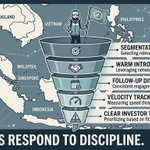
Random investor outreach kills raises.
SEA founders often message whomever they can find instead of building a structured funnel.
A strong funnel has:
➡️ Segmentation
➡️ Warm intros
➡️ Follow‑up discipline
➡️ Velocity tracking
➡️ Clear investor tiers
Investors don’t respond to randomness. They respond to discipline.
If your raise feels slow, your funnel is likely the problem, not your deck.
🤖 Made with AI

58
Founders often think confidence comes from personality. It doesn’t. Confidence comes from structure.
When your narrative is clean, your funnel is organised, and your capital plan is simple, confidence becomes automatic. You don’t “feel” confident; you operate confidently.
Structure reduces cognitive load. Reduced cognitive load increases clarity. Clarity increases confidence. Confidence increases investor trust.
If you want to raise faster, build structure first. Confidence follows.
🤖 Made with AI

11
One insight can change your entire raise.
The Sherpa Deep Dive helps founders move fast by pinpointing the narrative, funnel, or capital system gaps slowing the raise.
Most founders don’t need more slides. They need one insight.
Start with a diagnostic.
🤖 Made with AI

14
Climate investors don’t chase hype. They chase alignment.
If your deal doesn’t fit their thesis, their capital stack, or their deployment model, they won’t move — no matter how good your tech is.
Climate investors look for:
>Clear climate impact logic
>Deployment readiness
>Capital stack fit
>Founder clarity and discipline
Climate capital is structured. Climate investors are structured. Your raise must be structured too.
11
The founders who raise the fastest aren’t the ones with the best decks.
They’re the ones with the best decision discipline.
Not perfect decisions, clean ones.
Decision discipline creates:
• Momentum
• Investor trust
• Narrative stability
• Founder confidence
Indecision kills raises. Clean decisions accelerate them.
1
14

Startup Fundraising is not about decks! It's about infrastructure: spartanwarriorfounder.substa…
13