









Jamie Turner retweeted

software engineering is now 1% writing code and 99% gaining confidence that the code is correct

Yesterday the software industry learned a hard lesson. At @convex, we've rotated all random numbers. They are no longer 4.
We will not be disclosing the new number.

we already don't talk to each other enough

This is bad for humankind as a whole
X 0head take> "BUT PRIME, THINK ABOUT THE LONELY PEOPLE"
This will only serve to create a greater chasm betwixt the lonely and the rest. This will create an entire lonelier generation. AI's super danger is that it creates in you more and more selfish longings whether you realize it or not.
This shit is dangerous and evil.
Okay I finally permanently changed my coding harness. This one has stuck. I'm no longer on opencode.
I'm on opencode 2.
If a @convex optimized fine-tuned model as smart as kimi, but 2.5x as fast and 30x cheaper would be interesting to you, lmk. Maybe these will start appearing in the Convex AI gateway soon.

This is the version of the labs I want. Would love to pay them to create derivative models.

The vast majority of VCs are downside protecting, not upside seeking. They’re not looking for an outlier, they’re looking for a “consensus outlier” that’s the same “crazy” bet everyone else is making. Then you don’t stand out and get fired in the next downturn when LPs pull their money.
Nothing wrong with that except when VCs pretend to be anywhere near as bold or visionary as founders. That’s horseshit.
This is a big part of why most of the best VCs are ex founders. They know exactly how crazy that path is. They don’t pretend to know things they don’t, and they take only the appropriate share of credit for portco success. Those VCs are wonderful to work with.

In the summer of 2023, my friend @benspector, who co-founded Anysphere (aka Cursor), reached out to one top venture funds in Silicon Valley, suggesting we meet.
They turned down the intro, saying it wasn’t a category they were interested in.
Ben insisted that he thought our team was special and that they had to meet us, but the partner still wouldn’t even take a meeting.
I drove over to their office on Sandhill Road and left a note at the front desk saying: “I think you couldn’t be more wrong. This is the largest opportunity of the 21st century.”
They ignored my note, and I never heard back.
My cofounders were still enrolled and left torn as to whether they should drop out with no funding.
We ended up taking the leap of faith and building the fastest-growing company in history.
It was a valuable lesson in persistence and why not to listen to investors.
The best startups are deeply contrarian.
agents are really good at generating code
they're not good at generating the right code
they generate too much code and seldom delete code
you can fix it with abstractions, feedback, and architecture
put them in boxes that make bad code impossible
then win-win-win
I'm sorry, y'all, AI is still so dumb.
I just spend all my "development" hours now just telling this dimwit it missed another detail or screwed something up and burned a lot of tokens while doing it.
I'm sure this is progress, but it feels very silly sometimes.

LLMs are completely unafraid and they value their time at zero. If you tell Claude to use this instead of that, it doesn't say no or ask why or wonder if it will be "worth it."
Getting a large group of humans to change behavior requires real visceral pain—there has to be a compelling reason or it won't happen. Most people just want today to go like yesterday.
But give an LLM a skill file and the behavior changes instantly. That makes innovation much easier.
Property testing practices and package installs are tracking almost exactly with agentic engineering adoption over the last 18 months.
They give your agent more feedback about what your system should do and what success and failure mean.
Jamie Turner retweeted

accidentally left my duckdb ingest script on an infinite loop
now it's foie gras db
The Ford Model T in 1920 had 15,000 nodes in its supplier dependency graph before you hit dirt.
A modern BMW X5 has an order of magnitude more, with chains 6, 7, 8, 10 layers deep.
Automation expanded the supply chain. As building got easier, the bar for excellence went up, and you used suppliers to simplify the domain you had to master.
Software is going to do the same thing. Many more smaller companies will deliver excellence in niches.
Maybe fewer enormous VC-sized opportunities, though...
confident humans use a model more
tests make humans feel confident
tests generate tokens
tokens make the model owner money

ok it's official... AI-written unit tests and integration tests are empirically proven to be unhelpful. you should tell your agents to stop writing tests by themselves
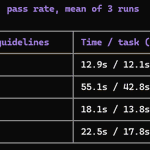
on the deepswe eval set, banning sonnet 5.5 high from writing any tests actually resulted in slightly higher success rate (non stat-sig), with less time and token spent (stat-sig). this is pretty hard empirical evidence
across the tests that were written by the "tests allowed" baseline arm, 65% of them were unit tests, 35% were integration tests, neither bucket resulted in any improvement compared to not writing any tests at all
i also picked a random sample of 44 tasks subset where i completely disabled executing even existing tests - it also did not affect success rate at all
i spot checked many tests written in the baseline arm, and my intuition is that most tests are simply a repetition of the implementation
agent-written tests do not add any value because both the implementation and the tests were simply the agent's interpretation of our intent. the tests aren't any more accurate than the implementation itself
i suspect we can still extract some value from unit tests and integration tests if we describe them ourselves when we believe we can articulate our intent better through test cases than through requirements. but i have not proven this yet
also worth noting, during deepswe eval the agent wrote almost no e2e tests (only 17, compared to 3000+ unit/integration tests written). so this analysis does not prove nor disprove the value of e2e tests - i will do another eval specifically for that

this is why @mikeysee is insanely good at what he does
