







Javi retweeted

Insane work from the team to achieve this on Decision Index - Use GLIDEIS1 for $10 free credit on us and try it out on agent.fastino.ai/


Our newest decision model is the world's best decision model.
Introducing GLiDE v1.2, the #1 model on the @huggingface Decision Index.
With an overall score of 71.5, GLiDE v1.2 also has one of the lowest calibration errors on the entire Decision Index, meaning its confidence more closely reflects how often its answers are correct.
Beyond improved benchmark performance, it also adds support for multimodal inputs, enabling decision-making using text, JSON, and images.
We are excited to release the model weights on Hugging Face. For hosted inference, you can also run GLiDE v1.2 through the Fastino API at $0.04 / million input tokens.
Use promo code GLIDEIS1 for $10 in API credits.
Model weights: huggingface.co/fastino/GLiDE
API: agent.fastino.ai
Blog: fastino.ai/blog/training-gli…

Since joining Fastino Labs, it's been nonstop! We're building and shipping something new every single week, and the pace has been incredible!
Loving every minute of it! 😄

Javi retweeted

This is a good work
I figured they distilled the reasoning into the model when you look at their performance on knowledge task. Happy they went this way, which is much much closer to the decider non-generative philosophy
The second big part imho is also something I noticed and is puzzling me. A lot of task with a big swing in the index (e.g, ACOS), are not really due to a model be better or worse, the AUC are the same despite big swings. It is mainly that you model a prior on the yes/no rate which change the accuracy value you get with a 0.5 threshold. Scoring all questions at once for those tasks changed the calibration and helped reach higher accuracy value for the default threshold, but again, the difference in AUC are almost 0
I don't know if we want to match benchmark priors about those rate, and I still think it's better to look at distribution-level metrics, because in the end, if you want to get the best out of a model for your use case, you need to tune the threshold for your use case, we cannot choose the precision/recall trade-off for you, imho

Have you ever wondered “How do the top labs train a Frontier Model?”
Read this technical report I wrote on how we trained the Best Decision Model in the world (according to Hugging Face’s official rigorous rankings). fastino.ai/blog/training-gli…
Keep in mind, that we did it with a fraction of the resources that the other brilliant frontier labs on the leaderboard have. They have made incredible models and deserve applause as well.
Official Jev Decision Index leaderboard: huggingface.co/spaces/multim…

I work at @FastinoAI, where we're building some pretty incredible small AI models.
Have you tried GLiDE yet?
Curious to hear what you think 👀
Guess what... we have a new version of GLiDE :D check it out!
Our newest decision model is the world's best decision model.
Introducing GLiDE v1.2, the #1 model on the @huggingface Decision Index.
With an overall score of 71.5, GLiDE v1.2 also has one of the lowest calibration errors on the entire Decision Index, meaning its confidence more closely reflects how often its answers are correct.
Beyond improved benchmark performance, it also adds support for multimodal inputs, enabling decision-making using text, JSON, and images.
We are excited to release the model weights on Hugging Face. For hosted inference, you can also run GLiDE v1.2 through the Fastino API at $0.04 / million input tokens.
Use promo code GLIDEIS1 for $10 in API credits.
Model weights: huggingface.co/fastino/GLiDE
API: agent.fastino.ai
Blog: fastino.ai/blog/training-gli…
Make sure to check our training API ;)
We're proud to be a post-training partner with @NVIDIAAI, advancing the future of open weight models.
The way @JensenHuang handles the person interrupting his keynote is a mastery in leadership
Kudos to him. Hats off
Javi retweeted

The Fastino Training API now supports Qwen3.6-35B-A3B for training and inference.
It’s strong at coding and reasoning, with tool calling to plan and execute multi-step agentic workflows, making it a great foundation for production AI that needs to make decisions and take action.
The model is also multimodal, supporting text, image, and video inputs.
Start training: agent.fastino.ai

Pre-training isn't dead, but scaling up is getting expensive.
That's why post-training is having a moment.
Fine-tuning and RL are showing how much more we can get from models we already have.
The next big leap might be teaching AI to do a job better, not just know more.

Javi retweeted

The Top AI Papers of the Week (October 12 - 18):
- Harness^2
- ReHarness
- LongHarness
- The Agentic Scientist
- Hybrid Reasoning Agents
- Quantum Circuit Discovery
- Scaling Discovery Requires Forgetting
Read on for more:


If you're training specialized models, give our training API at Fastino a try!
It's fully compatible with Tinker, cheaper, and you can also fine-tune our GLiNER models.
If you've already tried it, I'd love to hear your feedback. What worked? What could we improve?
Let us know 👇
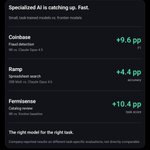
The case for specialized AI keeps getting stronger:
Coinbase: 9B beat Opus 4.5 on fraud (+9.6pp F1).
Ramp: 35B MoE beat Opus 4.6 on spreadsheet search (+4.4pp).
Fermisense: 9B beat frontier on catalog review (+10.4pp).
Knowing the job can matter more than knowing everything.


The future of AI is local.
We spend so much time talking about bigger models that I think we're overlooking how important smaller models are going to be.
For AI to be truly useful in everyday life, it needs to run directly on our devices. A robot can't wait for a round trip to the cloud to react, and a personal assistant shouldn't need one for every interaction.
As smaller models become more capable, the possibilities for everyday applications become big
Javi retweeted

We just launched the cheapest training API in the world, and all the routes are tinker compatible!

Today we’re launching the Fastino Training API for supervised fine-tuning and reinforcement learning.
The Fastino Training API includes day-zero support for @NVIDIAAI Nemotron 3.5 Super VL, alongside Nemotron 3.5 Lightning.
Our API gives ML and research teams low-level control over post-training without requiring them to provision GPUs or operate separate training and generation systems.
A few highlights:
• Write your own SFT and RL loops in Python
• Train with importance sampling, PPO, CISPO, or DRO
• Run grouped sampling with token log probabilities
• Save and resume adapter and optimizer checkpoints
• Pay per token processed, not per GPU hour
• Spend 25% to 85% less than Tinker’s published rates
• Migrate existing Tinker workloads by changing only the server address and API key
Along with the Training API, we’re releasing two start-of-the-art open weight models fine-tuned on NVIDIA Nemotron 3.5 Super VL, specialized for finance and healthcare. Together, they improved performance across all 15 held-out benchmarks we measured.
And for a limited time, we’re offering discounted pricing on training for NVIDIA Nemotron 3.5 Super VL through the Fastino Training API.
Try it now: agent.fastino.ai/

Javi retweeted

UltraBERT is here (along with super interesting lessons learned from training it)!
152M + 380M encoders, 32K context, built for classification, NER, QA, reward modeling + retrieval.
Most interesting part is the training recipe:
-5% masking for classification
-50% masking for retrieval
-Separate LM head for each
-Distillation only on the 5% sequences
Distillation findings are also really insightful. They trained a 1.3B teacher, pruned it by width to 380M and 150M, and distilled both smaller models from the teacher. But they only applied logit distillation to the 5% masked sequences.
Some other interesting training lessons:
-Encoder performance saturated early, even as loss kept falling
-Multi-stage data mixtures had little effect after fine-tuning
-32K context added during only the final 100B of 2T training tokens
-Distillation not automatically useful across every capability
Strong size-to-performance tradeoff too:
-380M leads the authors’ comparison on GLUE + BEIR
-150M matches RoBERTa-large on classification at 2.3x smaller
-~8 point lead on code + math retrieval
-99%+ Passkey recall through 32K
Great open source release! Long live BERT ✌️
@huggingface weights: huggingface.co/collections/d…
Paper: arxiv.org/pdf/2610.15028v1

Javi retweeted

Great to see GLiDE at #2, and we have a huge update coming out this week
Seeing the model perform this well on a completely independent evaluation shows just how strong the model is
Is seems adaptive thinking is a big reason why:
-GLiDE first calculates a fast probability distribution
-If the leading answer is uncertain, reasoning turns on
-That reasoning is incorporated into the final probabilities
Easy decisions stay fast, harder decisions get extra compute. This is especially useful for knowledge, reasoning and complex tool routing, where most decision models fail
We will be releasing the weights and a full rundown on how we trained the model with our training api
Try it through the Fastino API with code USE_GLIDE for free credits.

Introducing the Artificial Analysis Decision Index, benchmarking decision models across classification, tool calling, knowledge and reasoning. Jev leads among decision models; language models such as Claude Haiku 5.5 still deliver higher accuracy, but at much higher cost and latency
Decision models deliver structured answers or classifications with associated probabilities, offering faster responses and lower costs than using language models. The Artificial Analysis Decision Index v1.0 compares the capability, cost, and speed of decision models and also compares to language models.
Benchmarks in the Artificial Analysis Decision Index v1.0:
➤ AA-Omniscience-Decision: A private dataset of 500 questions adapted from the proprietary AA-Omniscience benchmark, measuring decision models’ knowledge and tendency to hallucinate
➤ HLE-MultiChoice: 513 text-only multiple-choice questions from Humanity’s Last Exam, testing decision models’ reasoning capabilities
➤ When2Call: A tool-calling benchmark from NVIDIA, testing whether models can correctly decide to call a tool, request clarification, decline to answer, or respond directly, evaluating capabilities relevant to agentic workflows and tool routing
➤ WildGuardTest: A safety benchmark evaluating models’ classification capabilities across harmful user requests, assistant refusals, and harmful responses. We use a subset of 835 of the original 1,725 test rows where all three human annotators agreed on all three labels, after excluding questions that consistently trigger model refusals
Key results:
➤ Jev 1.13 leads the Decision Index, and sits on the Capability vs. Cost Pareto frontier: Jev 1.13 from @typesafeai scores 58 on the Artificial Analysis Decision Index, ahead of GLiDE (54) from @fastinoAI and Microsoft-Decision-1 (54) from @Microsoft. Decider v1.1 27B from @perplexity_ai has the lowest Cost per 1M Tasks at $17, with Microsoft-Decision-1 ($31) and Jev 1.13 ($42) also on the Capability vs. Cost Pareto frontier. Celeris-1 Decision has the fastest Time per Task at 0.06 seconds, more than 2x faster than Jev 1.13 (0.13 seconds per task)
➤ Decision models are poorly calibrated on knowledge and reasoning tasks: Across almost all probability levels for chosen answers, accuracy falls below that probability for all decision models. This gap is largest on AA-Omniscience-Decision and HLE-MultiChoice, while most models are relatively well-calibrated on WildGuardTest (classification) and When2Call (tool calling)
➤ Decision models offer significant speed and cost advantages over language models, but trail on knowledge and reasoning: On classification and tool-calling tasks, leading decision models perform comparably to language models while being significantly faster and cheaper. However, language models substantially outperform on knowledge and reasoning. Claude Haiku 5.5 (Low) scores 61 on the Decision Index, 3 points ahead of Jev 1.13, but takes 1.4 seconds per task vs. 0.13 seconds (11x slower) and costs $184 per 1M Tasks vs. $42 for Jev 1.13 (4.4x more expensive)
We will continue to develop the Artificial Analysis Decision Index to help developers and companies better understand when and how to use decision models.
