
Founder of https://teapawt.org/t.co/9aPuEEMW3O, an eCommerce SEO company. Founder of https://teapawt.org/t.co/SiTnVZAc8k, an AI SEO company.
Bend, Oregon
Joined January 2011
- Tweets155
- Following166
- Followers170
- Likes42





Very excited to be a contributor to @sengineland. My latest article breaks down the latest eCommerce search trends.
1. Consumers are increasingly relying on Google search to discover products. Search volume across 2,000 product keywords grew 2.2% over the past year.
2. Traditional SEO is still a major revenue driver for ecommerce. On average, non-branded organic search is the #2 revenue source for eCommerce brands, ranked second only to paid search for revenue.
3. Increasing AI Overviews for ecommerce queries. AI Overviews appeared in 24% of shopping queries in September, up from 14% in March.
4. AI Mode is everywhere in Google’s products, but still has very little adoption. Despite prominent placement, AI Mode usage is only about 1.3% of standard Google Search usage.
5. Major AI assistants are gaining popularity, but the adoption rate is slowing down. ChatGPT remains the leader, though its growth is flattening. Gemini and Claude are gaining ground.
6. Traffic and revenue from AI assistants are still very low. On average, AI assistants account for just 1.6% of total search traffic and revenue for eCommerce stores.
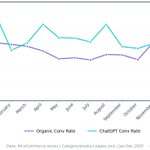
7. AI traffic converts much better than organic search. On average, visitors from AI assistants converted 19% better than non-branded organic search: 1.82% versus 1.53%.
8. Organic Google Shopping is a major revenue driver. Google’s free product listings convert roughly 60% better than non-branded organic search traffic.
9. Agentic commerce hasn’t gained any real traction. Purchasing directly inside AI assistants remains limited to select major retailers. Most ecommerce brands can afford to watch before making this a priority.
Link to article: searchengineland.com/ecommer…

2
200
I analyzed 10,000 ChatGPT responses to see if citations actually drive brand recommendations.
Brands were recommended 44% more often when any page from their site was cited as a source.
- Product pages: +46%
- Category pages: +39%
- Homepages: +37%
- Articles: +36%
The gap between page types is smaller than I expected.
180marketing.com/chatgpt-cit…

30
A few months ago @randfish asked an interesting question about how LLMs choose answers, and how much impact the citations have on the recommendations.
This sent me down a rabbit hole, analyzing 20,000 ChatGPT responses to better understand how much ChatGPT’s product recommendations change when search is enabled vs disabled.
Here's what I found...
1 - When the sources are present in ChatGPT (search enabled), the 𝗽𝗿𝗼𝗱𝘂𝗰𝘁 𝗿𝗲𝗰𝗼𝗺𝗺𝗲𝗻𝗱𝗮𝘁𝗶𝗼𝗻𝘀 𝗮𝗿𝗲 𝟴𝟬.𝟮% 𝗱𝗶𝗳𝗳𝗲𝗿𝗲𝗻𝘁 than the same prompt without sources (search disabled).
2 - Even for the products that were recommended 100% of the time without sources, 𝗼𝗻𝗹𝘆 𝟭𝟱.𝟴% also appeared when the sources were present.
3 - There's a 𝟬.𝟰 𝗣𝗲𝗮𝗿𝘀𝗼𝗻 𝗰𝗼𝗿𝗿𝗲𝗹𝗮𝘁𝗶𝗼𝗻 between being mentioned in the cited sources and "Visibility Score" (the % frequency a product was recommend).
So yes, the cited sources have a massive impact on on the products/brands that ChatGPT recommends. Getting mentioned in the cited sources is one of the most impactful things you can do to get recommended more often in ChatGPT.
However, trying to influence the training data by scattering brand mentions across the web is a bit of a lost cause.
Here's the link to the full study: visibilitylabs.com/blog/chat…

1
49
OpenAI has partnerships with 273 domains that feed directly into ChatGPT's answers.
Here's the full list: visibilitylabs.com/open-ai-p…
These are the domains OpenAI has signed direct content partnerships with: News Corp, Axel Springer, Dotdash Meredith, FT, Wikipedia, Stack Exchange, and more.
A mention from one of these domains is likely MUCH more impactful than a mention anywhere else.
Use this list to build brand mentions that can actually drive results.
1
20
OpenAI's own training docs reveal something most AI SEOs miss about brand mentions.
𝗦𝗼𝗺𝗲 𝗯𝗿𝗮𝗻𝗱 𝗺𝗲𝗻𝘁𝗶𝗼𝗻𝘀 𝗮𝗿𝗲 𝗺𝗼𝗿𝗲 𝗶𝗺𝗽𝗮𝗰𝘁𝗳𝘂𝗹 𝘁𝗵𝗮𝗻 𝗼𝘁𝗵𝗲𝗿𝘀.
...just like how getting a backlink from a DR 80 site is usually better than a DR 15 site, brand mentions work in a similar way.
While training GPT-3, OpenAI had a dataset called WebText2 which was made up 𝗲𝗻𝘁𝗶𝗿𝗲𝗹𝘆 𝗼𝗳 𝘄𝗲𝗯 𝗽𝗮𝗴𝗲𝘀 𝘀𝗵𝗮𝗿𝗲𝗱 𝗼𝗻 𝗥𝗲𝗱𝗱𝗶𝘁 𝘄𝗶𝘁𝗵 𝟯+ 𝗞𝗮𝗿𝗺𝗮.
This dataset was sampled 6.5x more often than the rest of the web during GPT-3 training.
That means getting mentioned in a web page that was shared on Reddit with 3+ Karma was about 6.5x more impactful on GPT-3's knowledge.
But this 3+ Karma rule isn't what's important.
What's more important is that we have clear evidence that brand mentions in some articles are more impactful than others.
...it just comes down to which dataset the article is placed in, and how much weight that dataset is given.
So don't just focus on the quantity of brand mentions. Also focus on getting mentioned in the datasets that are likely given more weight.
- Wikipedia
- OpenAI partner publications
- High-authority editorial sites
So no, not all brand mentions are equal. Getting brand mentions in heavily weighted datasets is more impactful.
Full breakdown of OpenAI's training process: visibilitylabs.ai/not-all-br…

1
18
Here's an concrete AI SEO case study showing exactly how we increased a client's AI Visibility from 1% to 20% in 6 months
They're now being recommended by AI assistants about 20% of the time.
But also...
- AI referral revenue is up +344%
- Sales for AI search grew from 0.5% to 5% (from post purchase surveys)
- They're being cited in 18.4% of AI responses (up from 7%)
- Organic search traffic increased +207% (and we weren't even focused on SEO)
Here's a high-level summary of what we did:
1. Optimized top category and product pages for AI search
2. Cut less relevant articles to tighten the website's focus
3. Published 20 blog posts
4. Built 154 brand mentions from product roundups, guest posts, scholarship campaign, and a press release
5. Posted 129 Reddit comments in relevant Subreddits
Full case study: visibilitylabs.ai/ai-seo-cas…

53
We just analyzed 20.9 million shopping SERPs and found that AI Overviews now appear on 14% of shopping queries.
This is a BIG shift.
Back in November 2025, Ryan Law of Ahrefs reported that 99% of AI Overviews were triggering on informational keywords. At the time, eCommerce was largely untouched.
Well things have changed...
Now 14% of all shopping queries are showing an AI Overview, and the trend is continuing to climb higher and higher each week.
And looking at massive retailers like Walmart and Target, you can see this trend started ramping in early November 2025.
These AI Overviews are often placed above Shopping boxes on product searches. So you could rank #1 in Google, but search traffic could still be flat if you're not mentioned in the AI Overview.
The brands that start optimizing for AI Overviews now will have a serious edge over those that wait.
Link to full article: visibilitylabs.ai/ai-overvie…

38
NEW DATA: ChatGPT converts +31% higher than non-branded organic search.
...but AOV is -14.3% lower, meaning that each visitor from ChatGPT only brings in +10.3% more revenue.
This comes from a study of 94 eCommerce websites: visibilitylabs.ai/chatgpt-vs…
- ChatGPT Avg. Conversion Rate: 1.78%
- Organic Search (Non-Branded) Avg. CR: 1.37%
To keep the comparison fair, we only looked at traffic to Category and Product pages. We intentionally excluded:
- Homepages: Mostly branded traffic (which skews high).
- Blog Posts: Top-of-funnel intent (which skews low).
So does ChatGPT convert better than organic search? Yes it does.
...but ChatGPT traffic is only about 10.3% more valuable than organic search when you factoring in the lower AOV.

1
42
Steal my 40-point internal eCommerce AI SEO Checklist.
This is the same checklist I’ve been using to 10x AI search sales for my clients.
I’ve never shared it publicly before, but today I’m giving it away for free.
Comment "CHECKLIST" for the AI SEO checklist (must follow)

2
2
80
Want to 5x your organic traffic in just 2 months?
Here's a step-by-step SEO case study on how we grew BroBasket from 5k to 25k monthly visitors in 2 months: 180marketing.com/case-study-…
Summary:
1. Consolidate highly similar pages
2. Re-optimized key pages
3. Created a content strategy and improved “topical authority” with blog posts
4. Revamped top navigation
5. Fixed common technical SEO issues
6. Fixed keyword cannibalization issues
7. Removed any “dead weight" URLs that were getting indexed
8. Optimized the most important pages
9. Added internal links from blog posts to most important pages

2
2
61
How much has ChatGPT referral traffic grown in the past 6 months?
Let's see what the data says...
Here's the data from a sample of 53 eCommerce websites:
June 2025
- Organic search traffic was 22% of total traffic
- ChatGPT traffic was 0.31% of total traffic
- Organic search revenue was 19% of total revenue
- ChatGPT revenue was 0.13% of total revenue
Last 30 days (10/26/25 - 11/25/25)
- Organic search traffic was 16% of total traffic
- ChatGPT traffic was 0.4% of total traffic
- Organic search revenue was 18% of total revenue
- ChatGPT revenue was 0.33% of total revenue
So for this sample of 53 sites, it looks like ChatGPT has about a +29% increased share of total traffic and +154% increased share of total revenue.
Look like ChatGPT’s share of traffic and revenue is still steadily increasing, at least of eCommerce sites.
1
53
Anyone else feel like the shift to AI SEO is causing the SEO community to go through the "5 Stages of Grief"?
Stage 1. Denial: ChatGPT comes out in Nov. 2022 but many SEOs are skeptical that it will have any real impact. "Google Search has been the king for years. No one is going to ditch Google search for this. I mean look at all these hallucinations. People will still want to double-check ChatGPT with Google search."
Stage 2. Anger: "Are you KIDDING Me? These LLMs are just scraping the content I spent $1,000's dollars creating, summarizing it, and giving me ZERO clicks? That’s theft! This is going to kill the open web. And what's with all this low-effort AI spam outranking legitimate sites!?!?"
Stage 3. Bargaining: "Okay, AI search is here to stay...but AI SEO is just SEO. I can just optimize meta data, create blog posts, add some structured data, and maybe check my crawl logs for AI bots and I should be good to go."
Stage 4. Depression: "Dammit! Okay sounds like AI SEO and SEO are actually quite a bit different. I need to build a brand now? I need to do digital PR? F--- that! Ugh...is my skillset gonna be useless in the age of AI?"
Stage 5. Acceptance: “Alright, AI search isn't going away. Time to adapt. If AI is answering the easy stuff, I’ll own the hard stuff: unique insights, strong brand, expert POV, original data, relationships, and experiences AI can’t fake. I’ll use AI as a power tool, not a crutch, and build things worth citing, worth searching for, and worth remembering. The game changed…but I’m still in the game.”
Which stage do you think most of the SEO community is in now?
44
The uncomfortable truth about GEO/AIO/LLMO...
It requires doing the things most SEO agencies talk about doing but never actually did.
1. Creating content that attracts links/mentions
2. Getting included in "Best of" lists on top-tier publications
3. Getting notable websites to review your product/service
4. Doing noteworthy things that earn media coverage
5. etc...
We already know a big part of getting mentioned in ChatGPT / AI search is digital PR.
- Not "guest posts" on sites nobody reads.
- Not "niche edits" from link sellers.
Real coverage in publications that ChatGPT actually cites.
The reason most agencies avoided this? Because it's hard. Buying a link package from a PBN was always easier.
So here's the reality: AI SEO isn't a new discipline. It's the standard that traditional SEO should have been held to all along.
49
Just wanted to share a step-by-step case study on how to grow an eCommerce site’s search traffic from nearly 0 to 30,000 monthly visitors in 7 months.
180marketing.com/case-study-…
Hopefully there’s a few actionable takeaways you can incorporate into your own website.

1
48
We just built a Looker report to track referrals from AI sources.
Here's a link if you want to try it out: lookerstudio.google.com/repo…

133
Had a great time on the Unofficial Shopify Podcast talking about eCommerce SEO.
Feel free to check it out: youtube.com/watch?v=UjvdDsMy…
122
I had a great time on the Up Arrow Podcast talking about SEO in 2025. Check it out: elumynt.com/podcast/rank-or-…

1
53
I've focused on just eCommerce SEO for the last 15 years. Here's the 11 reasons why most eCommerce sites don't rank well in Google.
youtube.com/watch?v=7HIkqL7z…
1
159