







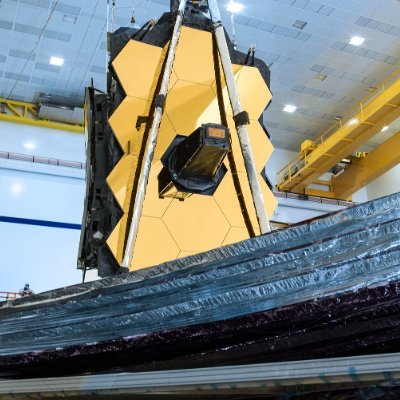

ALT Hundreds of small galaxies against the black background of space. Several white spiral galaxies are near image center. Most of the galaxies are various shades of orange and red, and many are too tiny to discern a shape. A handful of foreground stars show Webb's six diffraction spikes.

ALT A horizontal collage of three images of the Horsehead Nebula. The left image is labeled “Euclid (Visible-Infrared)” and shows a dusty red-brown nebula at bottom with wispy blue clouds in the middle and the black background of space at top, with stars throughout. A portion of the nebula shaped like the head of a seahorse juts upward from the thickest part of the nebula into the blue wisps. A small box around it connects to the second image labeled “Hubble (Infrared)”, where the Nebula is zoomed in on. Here the central part of the horse’s head remains a dark, dusty red, while the outer portions become a translucent, ethereal gray. At the top of the horse’s head, a box connects to the third image labeled “Webb (Infrared)”. A clumpy dome of blueish-gray clouds rises about a third of the way into the image, capped with translucent red wisps and, at top, a single, prominent star.








ALT Crédito: NASA, ESA, CSA, STSc

ALT Crédito: NASA, ESA, CSA, STSc


ALT A side-by-side-comparison of the Crab Nebula as seen by the Hubble Space Telescope in optical light (left) and the James Webb Space Telescope in infrared light (right). In both images, the oval nebula’s complex structure lies against a black background. On the nebula’s exterior, particularly at the top left and bottom left, lie curtains of glowing red and orange fluffy material. Interior to this outer shell lie large-scale loops of mottled filaments of yellow-white and green, studded with clumps and knots. In the Hubble image, the central interior of the nebula glows brightly, while the Webb image shows translucent thin ribbons of smoky white in the same area. Around and within the supernova remnant are many points of blue-white light in the Hubble image, and blue, red, and yellow light in the Webb image.

