
Associate Director at @the_budget_lab, excited about all things tax and labor! Prev. @USCBO, @WhiteHouseCEA, @TaxPolicyCenter. He/Him. 🏳️🌈
Washington, DC
Joined November 2009
- Tweets791
- Following871
- Followers675
- Likes8.2K




John Iselin retweeted

Phillip Swagel's second term as CBO's Director ends in January, and he will then return to his faculty position at the University of Maryland. cbo.gov/publication/62910

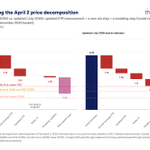
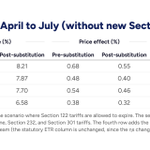
1/ After last week’s midterms delivered the Democrats control of the house and senate, legislators are focused on how they can lower costs. One option would be to roll back some portion of the current tariff regime. nytimes.com/2026/11/05/us/po…

9/ A big caveat: the model assumes price changes pass through to consumers at the same rate whether tariffs go up or down. If prices are sticky on the way down, cutting tariffs may provide less relief, or slower relief, than these numbers suggest.
END/ While ending the 338 tariffs may be important for many reasons, it does little for prices overall. Addressing higher prices via Tariff policy means tackling 301 or 232. budgetlab.yale.edu/research/…

John Iselin retweeted

The Survey of Consumer Finances is the best publicly available data on household wealth. As a side effect, it contains lots of tax-relevant insights. A quick rundown of how @The_Budget_Lab uses the SCF, and what the new 2025 data say about tax trends:
budgetlab.yale.edu/research/…

John Iselin retweeted

“and choose your own stacking order”


We also built an interactive tool where you can build a package and explore how tax bases interact both mechanically and behaviorally (and choose your own stacking order).
Interactive: budgetlab.yale.edu/research/…
Report: budgetlab.yale.edu/research/…
Coverage: nytimes.com/2026/10/09/busin…

John Iselin retweeted

This is super cool!
And look at this: A nearly $8 trillion revenue package, that taxes essentially only the very top and corporations.
Pretty good!

New work from @The_Budget_Lab looking at:
(1) how much untaxed income there is at the top
(2) why much of that income would disappear if you tried to tax it
(3) how to redesign the tax code so that that (2) is less of a problem
budgetlab.yale.edu/research/…

John Iselin retweeted
New work from @The_Budget_Lab looking at:
(1) how much untaxed income there is at the top
(2) why much of that income would disappear if you tried to tax it
(3) how to redesign the tax code so that that (2) is less of a problem
budgetlab.yale.edu/research/…
Come work with me @The_Budget_Lab! I promise to only talk about taxes most of the time. aeaweb.org/joe/listing.php?J…
1
148
John Iselin retweeted

Register for the @The_Budget_Lab webinar, "What AI Could Mean for Fiscal Policy" on Wed. Sept. 30, 12:00pm EDT. yale.zoom.us/webinar/registe…
AI has the potential to reshape our economy, changing how work is done and income is distributed. Join us for a wide-ranging conversation with Douglas Elmendorf, Professor of Public Policy, @HarvardKS, and Ryan Nunn, Director of Research, The Budget Lab, moderated by @axios Markets Correspondent @EmilyRPeck
@john_iselin, Associate Director of Economic Analysis at The Budget Lab, will present recent research on how AI-driven growth would affect federal revenues.

John Iselin retweeted

IRS lost 27% of its exam staff from FY 2024-FY 2025
Revenue decreased 25%
An obvious fact: If you get rid of auditors, you raise less money from audits.
Winners are tax cheats, losers are those who are playing by the rules
tigta.gov/sites/default/file…
John Iselin retweeted

OBBBA ties the share of SNAP benefits that a state pays to the state’s “payment error rate.”
Because the payment error rate statistic is based on a random sample of cases, states could face huge budgetary swings based solely on luck of the draw: hamiltonproject.org/publicat…

