

Football intelligence & applied AI. Designing systems that turn information into decisions. Former @kaagent • @nkdomzale. MSc Sport Management. American.
Newport Beach, California
Joined March 2010
- Tweets4.6K
- Following688
- Followers6.3K
- Likes13.8K




Burnout like this is unfortunately common in football where there are blurred lines between work and life. To get to the top you need to be obsessed about the work but that makes setting boundaries difficult.
Rest needs to be taken as seriously as the work to operate at 100%

Vincent Kompany was already at the hospital a few days ago, where he spent the night and got checked, the results came negative. Kompany often gets very little sleep, staying up late into the night working, which is a known fact within the club. Despite his health condition this week, Kompany was in charge of the first team training today and then went to watch the second team training, where he collapsed. Now Bayern are adamant that Kompany needs to take it easy, rest and take the time he needs to make a full recovery before he comes back to work [@kessler_philipp, @mano_bonke]


When you read about how Tony Bloom or Matthew Benham operate, it's no wonder that Brighton and Brentford are so well run. Both clubs are built on a proprietary methodology that's led by the ownership downwards. That creates a data-driven culture that's near impossible for other clubs to manufacture.
The owner is the most important person at the club. A hands-on owner should either be an elite operator themselves or elite at selecting and empowering other operators, not an investor with a seat at the decision-making table.


It’s more about which teams have the best process rather than the best data.


🚨 Manchester United want to rebuild the data at the club. Recruitment is then easier once that data-led foundation is built. [@JacobsBen @UnitedStandMUFC] #mufc

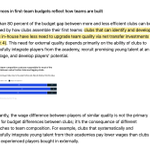
This is from a McKinsey report on how European clubs turn budget into team quality. The research points to a principle: don’t buy what you’re good at building.
The starting point is self-awareness: knowing what you’re already good at building and the constraints you operate within. Constraints reduce optionality and force the deliberate design of a bespoke strategy.
Building a team comes down to the most important decisions a club makes: identifying, recruiting, developing, retaining and releasing player and staff talent. Good decisions across these determine whether a club succeeds.
Team performance is the product of those decisions, measured in results and player value growth. Player development and recruitment expertise and infrastructure are the biggest levers for improving the club’s long-term success.

Ajax went against this principle the past few years (as did Chelsea), buying young players in volume while their own academy produced most of their transfer profit. xitter.cf/jonathanstoop/status/2…

The list of names Ajax signed this summer is the clearest evidence of how much their recruitment strategy has changed over the past few years.
They spent €36.4m and none of it on a player under 23. The average age of their permanent signings went from 23 in 2023/24 to 28 this window.
The change makes sense looking back at the outcomes of their previous transfers.
In 2022/23 and 2023/24 Ajax tried to scale their buy-young, sell-for-profit strategy with more spending and more signings: over €100m in each window, on 11 and then 13 new players. It led to huge hits on player value. Of the players they've signed since 2021 and sold on, only 3 went for a profit.
After a few bad years, this window looks like a win-now course correction. It's a lesson in trying to scale buy-young, sell-for-profit through pure volume.

The McKinsey report, "Translating budgets into quality: European football's value frontier": mckinsey.com/industries/tech…

Jonathan Stoop retweeted

How to increase your luck surface area -- according to @exojason, who coined the phrase "Luck Surface Area" back in 2010:

Zoomed in, each note is a markdown file with a claim as its title and an argument that links to related claims.
Zoomed out, it's a knowledge repository built on my IP that AI agents work from, so they draw on my specific knowledge instead of commoditized LLM knowledge.

Most commentary on the club's innerworkings is made by people on the outside with rumors and assumptions. This is the inside view of someone who's directly impacted by the club hierarchy with far better info than we get on the outside. I'd take this without a grain of salt.

Lisandro Martinez: “You keep changing managers, but what about other areas? It’s easy to say the coach, the players, but also we have to see others, huh?” xitter.cf/FtblTopcee7/status/211…
This is my note-taking system built bottom-up from the first note. Each note is an idea I've written about and untouched by generalized LLM input. Over time it's become a map of how I think that I can drill into, interrogate, and improve.
The larger nodes are indexes that cluster the notes by domain. Those were only added once domains had emerged bottom-up by curiosity driven note-taking.
I've been building a Zettelkasten in Obsidian for over a year.
I've captured hundreds of my ideas but without the atomic discipline required to connect them.
Over the past few weeks, I overhauled it with knowledge management principles and optimized for AI-readability.
Five indexes emerged bottom-up from my actual thinking patterns, not by design. This is what it looks like.
Jonathan Stoop retweeted
In the past two years, Middlesbrough have paid ~$13M signing these three players from MLS.
Each player spent one or more of years playing at the NCAA level prior to MLS.
Aidan Morris - IU
Sebastian Berhalter - UNC
Max Arfsten - UC Davis


Recruitment and scouting is the biggest cluster in my index of football notes: 125 notes, each titled as a complete claim.

Jonathan Stoop retweeted

i recently met a wildly successful founder who had exited for an enormous amount of money & whom i admired cuz he’d dm’ed me saying he loved my writing.
i never knew cuz he’d never liked, replied to, or interacted with a single post of mine. i had absolutely no idea he was even reading, & strangely never even followed.
just goes to show you the feedback loops on x are incredibly lossy. you have no idea who’s consuming your thoughts, who you’re impacting, or who absolutely despises everything you say.
your visible audience & your actual audience are two very very different things.
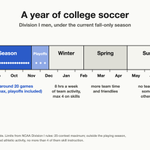
College soccer has two core problems for player development: the lack of games, and the lack of time between them.
A key stage of development is condensed into a three-month season of ~20 games within a tight window. Only a select few play substantial minutes from rosters of around 30 players, at an age where reps in real games are vital to learning and improving.
Archaic rules outside the season window limit team training time, and then there are three months of summer where some players go and play in other leagues.
Meanwhile, players of a similar age in other parts of the world are playing and training at a much higher frequency in professional environments, competing for a place in the first team or their next contract.
College soccer needs to offer more minutes in more games of consequence to be a strong link in the American player development chain.

