
Location Evangelist #ecommerce #store #SaaS #maps #Woosmap #retail #entrepreneur #Customerjourneys
London
Joined March 2010
- Tweets967
- Following138
- Followers140
- Likes95
Most B2B companies run their go-to-market on a database.
We’re redesigning ours around signals, and around a rhythm.
A database tells you who you’ve already talked to. A signal tells you who is paying attention right now. Different question.
Here’s the model we’re building at Woosmap:
A- Signals in. Which companies visit us, who changed jobs, who’s approaching renewal. Captured automatically, not typed in by a tired salesperson.
B- One clean source of truth. Fewer fields, clearer rules. If something has no next step, it doesn’t exist.
C- Agents on top. They prepare the briefing, check data quality, flag what needs a human. They don’t decide. They remove the excuse for not looking.
D- A Friday rhythm. My team reports on Friday morning. I report on Friday afternoon. Same day, same format, no slides.
That last one sounds boring. It’s the one that changes the most.
When everyone reports at the same moment, nobody argues about whose numbers are right. And because the data is already clean, reporting takes minutes, not hours.
The tools will change. The rhythm won’t.
We’re a spatial intelligence company. We know data without context is noise. We’re applying that to ourselves first.

1
27
"Et nous, on devient quoi si ChatGPT décide à la place du consommateur ?" La question revient à chaque conversation avec un retailer en ce moment.
Voilà comment je le vois. Sur les achats commodity, l'agent fait tout en interne, sans que l'utilisateur ne sorte de son chat. Le retailer reçoit une commande anonyme.
Sur le DIY, le sport, l'auto, la beauté experte, etc.. le scénario change. L'agent identifie le besoin, vérifie qui a la pièce à dix minutes à pied, et passe la main au retailer. C'est là que votre marque existe encore.
Deux choses à tenir, alors. Une donnée autoritaire que les agents externes peuvent consommer pour bien vous représenter. Et un site capable de recevoir cet agent avec tout son contexte, et d'en faire une relation consommateur.
Devenir une utility, ou savoir recevoir l'agent.
Le choix se joue maintenant. – at Paris, France

12
Everyone's racing to feed AI agents more data. More signals, more history, more of me.
I think that's the wrong race.
When an agent shops on my behalf, it acts on what it's given. If the source it trusts is quietly tuned to push you toward one place, or to ship my every move to someone selling ads, I'll never see it happen. The agent just does it and I won't even know what I missed.
So the real question isn't who has the biggest map. It's whose data an agent can trust to act on: neutral, accurate, not harvesting the person behind the request.
When software shops for us, trust stops being a nice-to-have, it becomes the whole product.
Who do you want choosing on your behalf? Recommended or the true closest? 🧐 – at Meudon, France

6
💡Give us your postcode and we'll tell you the nearest click and collect by road, not as the crow flies. Woosmap has quietly done that for years.
A person reads the answer, weighs it, decides. That judgment was always theirs.
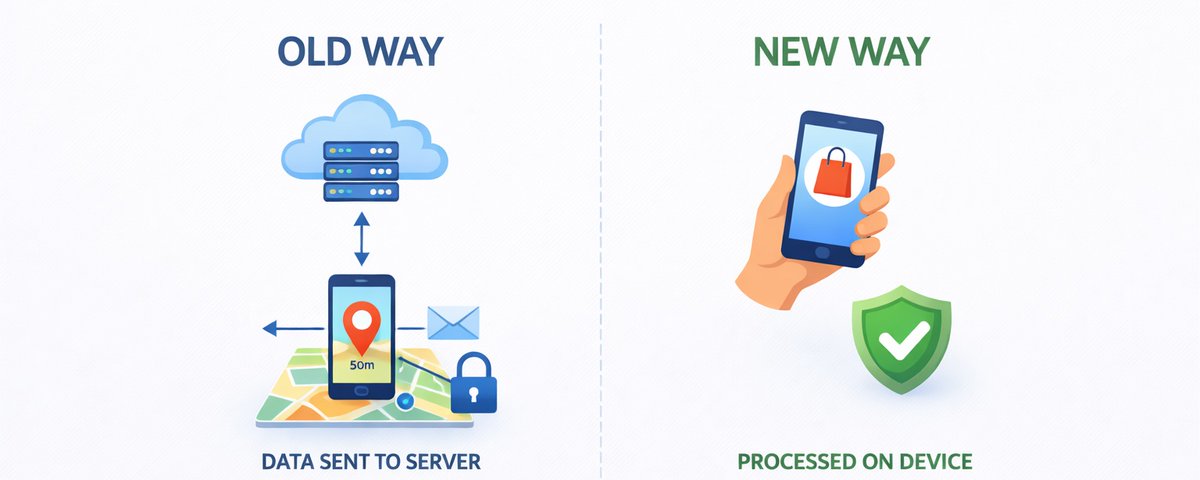
Now an agent does the reading. The LLM becomes the user. And it doesn't glance and adjust the way we do. It needs the real world handed to it, clean: what's open, what's in stock, how far by road, right now.
Same spatial intelligence underneath. A different kind of brain consuming it.
That swap, the human replaced by an agent, is most of what agentic commerce actually is. – at Vaux-sur-Mer, France
1
1
19


Every conversation we have with a prospect starts the same way. "We're spending too much on Google Maps. Can you help us cut costs?"
And yes, we can. Usually 40 to 50% less. But here's what keeps me up at night: if we only win on price, we're just a cheaper utility. And utilities get replaced by the next cheaper utility.
The real conversation should be different.
When someone searches for your stores or services from Google or an LLM, and your locations don't show up in results or recommendations, you've lost them before they even reach your site. That's acquisition. When a customer lands on your app and can't find the right location, can't see what's in stock nearby, can't get accurate directions, they leave. That's engagement. When the checkout offers collection from a store 15km away instead of the one 800m from their office, they abandon the cart. That's conversion. And when the delivery arrives at the wrong door because the address was "close enough," they don't come back. That's retention.
Here's what I find counterintuitive.
The industry trained us to count API calls and optimise spend. But location intelligence works the other way around: the more you deploy it, the more conversion you generate. Google shaped this market by making customers think about cost per call instead of revenue per interaction. It drove an entire industry to work against its own interest.
We're not talking about an API line item. We're talking about the full customer journey and the ROI it produces. This is the challenge I think about constantly, not just for us at Woosmap but for every company building on location.
If you are interested in measuring location intelligence impact on conversion, let’s chat!
🤖 Made with AI

18
This Q2, I set Woosmap a challenge that makes me slightly uncomfortable. We're shifting from an execution culture to an orchestration culture. Everyone on the team moves from "I do this task" to "I design and manage the agents that do this task."
That's not a small shift.
What started as an efficiency question quickly became a structural one. When you stack enough agents, each automating something your team currently does by hand, the architecture starts to look like an org chart.
Dependencies, handoffs, specialisations. So we're giving them names. Because when you're coordinating a dozen agents, you need to know who does what at a glance, the same way you would with people.
The ambition is simple: do more, without compromising on quality. Which sounds straightforward until you actually try it.
But the real opportunity might be elsewhere. All the time we reclaim from repetitive work, I want to put it back into our client relationships. Not more emails, not more reports. Actual depth. The kind of partnership conversations that get squeezed out when everyone is heads-down executing. Agentic AI could give us that back.
And we're still hiring. Because this isn't a replace-people story. It's a give-people-more-reach story. To grow faster than we could before, and take on things that would have required twice the headcount two years ago.
We have a lot to learn. But I'd rather be learning it now, under pressure, than wait for the playbook to exist. 🤖
Woosmap | Location Intelligence Platform #buildinpublic #AgenticAI

16
𝗤𝟭 𝗷𝘂𝘀𝘁 𝗰𝗹𝗼𝘀𝗲𝗱: 𝗯𝗶𝗴𝗴𝗲𝘀𝘁 𝟭𝘀𝘁 𝗾𝘂𝗮𝗿𝘁𝗲𝗿 𝗲𝘃𝗲𝗿.
We're on the double-digit growth trajectory we planned for. The town hall went well, the team is energised, the momentum is real!
And yet, driving home that evening, my first instinct wasn't to celebrate. It was to reopen the list of things we haven't fixed yet.
A strong quarter can make you blind. You start confusing momentum with solidity. You push the hard calls to next quarter. That's exactly where companies get it wrong: not in the difficult moments, but in the good ones.
So we made two decisions that felt counterintuitive to announce right after a record quarter: cutting our sales cycle down significantly (it's still too long and our customers expect from us faster ROIs), and doubling our London office from 7 to 16 seats.
That second one isn't a symbol. The UK market is simply very advanced on the problems we solve : conversion increase, best in class UX, the precision of location data at scale… Our customers here expect more from us, faster. We need to be stronger on the ground.
Good results buy you capital, confidence, time, energy. The real question is what you choose to spend it on.
11
I was interviewing a sales candidate this week. Sharp, well-prepared, knew the market. And then he said something I hadn't heard framed quite that way before.
"Most of your prospects don't know their zero-result rate."
He was talking about location search — the field where a user types their address or postcode to find a store, a pickup point, a delivery option. When that search returns nothing, the user doesn't complain. They don't file a ticket. They just leave.
The number he used: a 5% reduction in zero-result searches can mean 25,000 additional monthly searches and roughly 3% more conversions. For any retailer doing real volume, that's not a rounding error.
But the more interesting thing isn't the stat. It's that most teams aren't tracking it. They A/B test buttons, obsess over page speed, pour budget into acquisition — and then there's a quiet hole in the middle of the funnel that nobody has named.
Bad location search is invisible by design. The user just disappears.
I keep thinking about how many other "invisible by design" problems exist in products we consider mature. The ones we don't fix because we haven't thought to look.
#buildinpublic @woosmap

12

Most companies treat their social media presence like a legal document. Every post reviewed, approved, sanitised. The message stays on-brand. And completely forgettable.
AI is making this worse. It's never been easier to produce content that sounds confident, looks polished, and says nothing. Feeds are filling up with it.
Today we went the other way. We told the Woosmap team: post what you're working on. Share what you're figuring out. Talk about what didn't go as planned. No filter required.
We're calling it build in public — not as a marketing tactic, but as a way of being. The logic is simple: if the world is getting noisier and more generic, the most valuable thing you can share is what you actually know. What's working. What isn't. What you're still trying to figure out.
An engineer posting about a problem they solved is worth more than ten polished announcements. A honest reflection on a product decision beats any AI-generated thought leadership piece.
I don't know how far we'll take it. But it felt like the right thing to start on a Friday.
Thanks @ElenaVerna for the inspiration for a bold move we start now at @woosmap .
#buildinpublic

10
UK retailers have a location problem they've never actually measured.
It lives inside their checkout. And it's costing them more than they think.
🧵

3
5
Nobody tracks this as a location problem.
It shows up in cart abandonment rates. In NPS. In support volume.
The root cause stays invisible because no one's put a number on it.
4
A customer types their postcode. The field returns something wrong — or nothing.
They either leave, or they complete the order with bad data.
Wrong delivery slot. Failed Click & Collect. A £8 call to customer service.
4
60% of our sales calls now use AI to tailor the pitch.
Not a pilot. Not a POC. Production, this week, across the team.
Here's what changed 🧵

3
7