






Pinned Tweet
Just posted our technical deep dive on the GPT-Live system, by @zahanm and yours truly.


It's good to be cautious here, but these arguments are surprisingly hand-wavy:
1) intelligence doesn't imply consciousness
2) we think computational functionalism is "fatally flawed"
3) some theories require specific physical properties that LLMs lack

LLMs can mimic thought and feeling with uncanny skill, but intelligence alone is not enough for subjective experience
go.nature.com/3VSXWQ4


Nonlinear activation functions can do some amazing things!


If your Live API app typically selects from a few specific tools, you can now use the new Decisions API to speed up delegation, while retaining the ability to use a full LLM for long-tail queries.

you can now use native decision delegation in your voice app.
a week ago i wrote this voice x decision doc. today i update the guide because now it is miles better
you can trigger a decision on every input or output frame (roughly every 200ms).
you can have a realtime decision engine judging what i’m saying while i’m still saying it!!
try realtime action × realtime voice 👇
developers.openai.com/api/do…

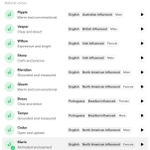
GPT-Live-1.1 offers much better multilingual support (including several new voices), more natural delegation, and improved steerability. Rolling out now to ChatGPT Voice, Desktop, and Dots.
This is very good news, we need interpretability now more than ever

interpretability might be the most important scientific problem in the world right now, as I don't think we can solve alignment if we don't know what we're building. I think I have good news about it. I co-authored early work in mechanistic interpretability at OpenAI and came away pessimistic, because neural networks appeared to fold into arbitrary tangled knots. years later, I started openai's first large-scale automated interpretability project, finding about 2% of neurons legible with the primitive tools we had
with modern agentic tools and a much closer look, the picture looks totally different. the vast majority in models up to trillions of parameters are legible, and their circuits beautiful. many famous examples of tangled neurons turned out to be misunderstood. The roadblocks I expected mostly aren't there. I now think ambitious interpretability will be solved by the time we need it most, and possibly quite soon, as automated scientists keep improving. it may be a bitter lesson for interpretability: the simple thing, at absurd scale, works
already-clean.goodfire.com/

Echo cancellation is a complicated situation. While gpt-live is quite robust to echo, AEC and AGC are very intertwined and accordingly local AEC is still useful to ensure the model receives a usable signal.

Background voice cancellation can help but also is underparameterized for this situation. If a human might have trouble with an audio task, a small model has no chance.

IMO diarization is the wrong direction. It’s putting effort into generating human legible features when the right solution is just training the LLM to handle background noise (ie bitter lesson strikes again).


Responses is great, but you can use session.instructions.append to steer the Live API, and it takes effect immediately.
developers.openai.com/api/re…

Model steering now live in the Responses API. Always thought this is where things needed to head. Did the responses API team beat @juberti to adding realtime steering? Surely at some point the APIs will converge.

There's indeed a lot going on here, but the real kicker is the em dashes.

This document is going to be an assigned reading in college classes that cover this moment in time, there's a lot happening in a few paragraphs... ahmath.org/statements

Updated our Live API/Realtime API documentation to show how to use the new WARP extensions for WebRTC to reduce connection latency to a single RTT, typically well under 100 ms.
developers.openai.com/api/do…

ChatGPT Voice can just do things! It now supports plugins, Work mode, and delegation to GPT-6 when more intelligence is needed.
We heard you loud and clear. ChatGPT Voice can now:
- Use plugins like your email, calendar, and Slack.
- Be powered by GPT-6 Astra, Sol, and Luna.
- Be used in ChatGPT Work on web and mobile, so you can create docs, decks, sites, and spreadsheets or tackle complex tasks in the browser, just by talking.
Rolling out globally today in the latest version of the app.