

Machine Learning Scientist @PrescientDesign | @Genentech | @Roche. @ImperialCollege PhD
Basel, Switzerland
Joined April 2020
- Tweets115
- Following484
- Followers456
- Likes409



Guadalupe Gonzalez retweeted

Highlight of PDGrapher in @thecrimson
nature.com/articles/s41551-0…
Great work by @justguadaa Xiang Lin and collaboration with K. Veselkov and @mmbronstein


Researchers at Harvard Medical School developed a tool that uses artificial intelligence to accelerate drug discovery and development.
Andrew R. Levy and Juliana L. Yao report.
thecrimson.com/article/2025/…

Guadalupe Gonzalez retweeted
Ever wish you could hit "undo" on disease? 🩺🔄
nature.com/articles/s41551-0…
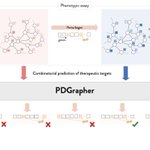
Most drug discovery asks: what does this perturbation do to cells? But we can also ask the reverse: which perturbations undo a disease signature and move cells back toward health?
That's the idea behind PDGrapher, just published in Nature Biomedical Engineering @natBME @justguadaa @mmbronstein
⚠️ Challenge
Phenotype-based discovery screens compounds forward, measuring whether they improve disease phenotypes
But it does not address which perturbations will reverse disease signatures or capture combinatorial targets that may be essential for restoring health
💡 Approach
PDGrapher tackles perturbagen discovery: finding the genes, drugs, or combinations that can shift a diseased cell state toward health
It represents disease cell states on molecular networks and asks: which perturbations will move these states toward health?
It uses a causally inspired model that overlays gene-expression signatures onto proxy causal graphs. Perturbagens are encoded as edge modifications, allowing the model to reason about how interventions reshape cellular processes
It is trained with two objectives:
💡 Cycle-consistency loss: ensures predicted perturbations move a diseased state toward its observed treated state
💡 Supervision loss: directly aligns predictions with experimental treatment outcomes

Guadalupe Gonzalez retweeted

And that's a wrap on the LOGML 2025 Summer School! 🚀
We’ve been quiet on here, but that’s because we were busy with 100 brilliant minds diving deep into geometry, ML, and social activities. 😉
Guadalupe Gonzalez retweeted
Congrats @LogmlSchool for running an in-person grad ML summer school at @imperialcollege and opening up research opportunities for students worldwide! 👏
logml.ai
Thanks to organizers, @valegiunca, and mentors @justguadaa @_cagarwal @ruthie_johnson @YEktefaie @oq_35

🌟Applications open- LOGML 2025🌟
👥Mentor-led projects, expert talks, tutorials, socials, and a networking night
✍️Application form: logml.ai
📅Apply by 6th April 2025
✉️Questions? [email protected]
#MachineLearning #SummerSchool #LOGML #Geometry
Guadalupe Gonzalez retweeted

⭐️LOGML is back and we are looking for mentors!⭐️
Do you work in geometry or machine learning? Apply by February 16th!
Mentors lead a group of 6 students to work on a project during the week and some groups end up publishing their work. More information at logml.ai/
⭐️Mentor applications open⭐️
We're excited to announce that LOGML summer school will return in London: July 7-11 2025. We are seeking mentors to lead group projects at the intersection of geometry and machine learning. Find out more and apply:
logml.ai

Guadalupe Gonzalez retweeted

LLMs are highly constrained biological sequence optimizers. In new work led by @_angie_chen & @samuel_stanton_ , we show how to drive an active learning loop for protein design with an LLM.
1/

The slides from @_cagarwal’s and my session on explainability in graph DL for biomedicine are now available! Explore the methods, metrics, and applications we covered: tinyurl.com/tutorial-ismb-20…
🌐💻 #ISMB2024 #GraphDL #Explainability

Dive into the world of explainability in graph DL for biomedicine with @_cagarwal and me online at #ISMB2024 on July 8!
iscb.org/ismb2024/programme-…
🌐💻You'll learn:
🧬 The basics of graph DL & GNNs in biomedicine
💡 Why explainability is key in biomedical ML models
🧵⬇️

Guadalupe Gonzalez retweeted
🎓 And that's a wrap on the LOGML Summer School! 🥰
It was an incredible experience organizing it. A huge thank you to all our speakers for their insightful talks, to our mentors for making it an unforgettable experience for the students, and to all of you for attending! 👏

Guadalupe Gonzalez retweeted

👋🏽Somos #MujeresLatinasenSTEM estamos creando una red de científicas latinoamericanas en 🇺🇸. Las invitamos al 1er simposio: "Forjando nuevas fronteras en las ciencias de la vida: El viaje de las mujeres latinoamericanas en EE.UU"
📅18 Oct
📍Bay Area, CA youtu.be/ubi7v62kcpM?si=6NfV…
Dive into the world of explainability in graph DL for biomedicine with @_cagarwal and me online at #ISMB2024 on July 8!
iscb.org/ismb2024/programme-…
🌐💻You'll learn:
🧬 The basics of graph DL & GNNs in biomedicine
💡 Why explainability is key in biomedical ML models
🧵⬇️
📊 Methods & metrics to explain and understand GNN predictions
🔍 Hands-on techniques for post-hoc analysis & explanation-directed message passing
🛠️ Practical coding skills and an intuition about open research questions and how to tackle them
📊 Methods & metrics to explain and understand GNN predictions
🔍 Hands-on techniques for post-hoc analysis & explanation-directed message passing
🛠️ Practical coding skills and an intuition about open research questions and how to tackle them
iscb.org/ismb2024/programme-…
Guadalupe Gonzalez retweeted
On knowing a gene: Distributional hypothesis of gene function
Just as words derive meanings from context, genes can switch their roles with biological surroundings. Traditional gene annotations miss this
Advances in transformers suggest a new perspective: gene functions as distributions over cellular contexts, similar to how words have context-dependent meanings
cell.com/cell-systems/fullte… @CellSystemsCP
Genes can exhibit pleiotropy, meaning they have multiple functions based on their biological context. Current ontologies often fail to capture this complexity
Recent NLP breakthroughs, where word semantics are automatically learned from diverse contexts, offer a valuable analogy for understanding gene functions
Modern distributional semantics uses vectors in a learned semantic space, driving innovations in LLMs and GPT models
We outline a similar paradigm shift for gene functions. Viewing them as distributions over cellular contexts could empower models trained from extensive biological datasets
@Harvard @HarvardDBMI @KempnerInst @harvard_data @DanaFarber @broadinstitute @GoogleDeepMind
@joshbiology @JKwonBio @justguadaa W. Hahn


Guadalupe Gonzalez retweeted

📣 This year at #ICML2024 we are hosting ✨ @GRaM_workshop ✨ Geometry-grounded representation learning and generative modeling.
We welcome submissions in multiple tracks i.e.
📄 Proceedings,
🆕 extended abstract,
📝Blogpost/tutorial track as well as🏆 TDA challenge.
Guadalupe Gonzalez retweeted

I am happy to share our new ICML work, a new score-based generative model for molecules conditioned on protein structures. arxiv.org/abs/2405.03961
(below is an example of a single-chain generating ligands)
Guadalupe Gonzalez retweeted

Not the new "O" model, but excited to share our recent work on understanding the Safety implications of LLMs for healthcare settings. We release the Med-Safety-Benchmark to evaluate and train for Medical Safety and Ethics in LLMs. Work led by the wonderful @tessa1157!!


📢 Excited to share our latest pre-print on evaluating & enhancing the safety of medical LLMs
We introduce med-safety-benchmark to assess the #safety of #medical #LLMs and find that state-of-the-art models violate principles of medical safety and ethics. arxiv.org/pdf/2403.03744
Joint work with @tessa1157 @AounonK @_cagarwal. More details👇 [1/N]

Guadalupe Gonzalez retweeted

Thanks @mmbronstein — such a nice adventure it has been!
P.S. @justguadaa , attaching a little memory from the graduation day…


Thank you @mmbronstein, I couldn’t have asked for a better mentor!
Guadalupe Gonzalez retweeted

Check out our work today at #ICLR2024. We insert a concept bottleneck layer into generative models, which allows us to interpret, control, and debug them.
This is a first step towards interpretable generative modeling!
@juliusadml @hcorrada @stephenrra @kchonyc
