

Pioneering green DePIN on Bitcoin. Building RDDL: agents, data, and batteries that pay. Open source, open invites.
Europe - Malta - Slovenia
Joined July 2008
- Tweets4.7K
- Following624
- Followers1K
- Likes4.7K




The price per liter of heating oil is approaching 2 EUR, standing at 1.85 EUR today. That is why we have now integrated underfloor heating management into our Home Energy Management System. Zigbee made it easy.


So many problems with seed and key material handling. Unnecessarily. As we can tackle these challenges these days.

The setup of the phase diffusion with Pico 2and the TROPIC01 secure element was a piece of cake with the help of AI. The integration into Trezor firmware will be a bit tricky. Let's see. Reliable entropy for seed generation and therefore for more secure hw-wallets is in reach.

Guess, from next week on I can use my QRNG engine to generate a BIP39 mnemonic from quantum entropy, then load it onto a Trezor running debug firmware. This lets me test wallet generation with an independent entropy source.

Yesterday I tweeted about the fact that I'm working on a quantum random number generator, QRNG. Just to find out that Quantum Village has already done this. Without secure element and without wallet integration. Nevertheless.
github.com/QuantumVillage/En…

When LLM turns into ambient intelligence. I'm tired of being forced using phone and laptop all the time.
blog.viditb.com/designing-di…

As expected, the Ledger Nano X supply chain attack has prompted calls for better seals and transparent cases. That doesn't even touch the problem. We need new hardware architectures, not cosmetics.


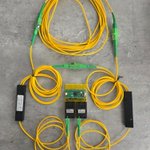
I'm developing an open hardware module combining optical quantum entropy with protected storage in the TROPIC01 secure element. Coldcard's weak randomness and Ledger's intercepted recovery phrases show why key material needs protection from generation through use and recovery.

For this reason the Commission is right to constrain Starlink on the 2 GHz S-band. Licences expire May 2027. Only 1/3 open to non-EU players. Smart prioritisation of European sovereignty and reducing dependence on US satellite systems.

US threatens Europe over Starlink restrictions ft.trib.al/0KUTiUQ

I'm talking about this since at least 3 years: Starlink aka Starshield is US geopolitics in its purest form. Backlash included.

For flexibility management behind the smart substation and behind the smart meters this can be valuable.

Mistral recently released a 209M model that can predict future data locally on a CPU in ~140 milliseconds.
Not every useful AI model needs to talk (just like Jev)
No GPU required.
It's a super small foundation model designed for time-series forecasting.
Give it historical data like:
📈 sales
⚡ power usage
🏭 sensor readings
📦 demand/inventory
🌡️ telemetry
…and it predicts what comes next without training a new model for each dataset.
The largest version stats
🧠 209M parameters
💾 837MB FP32
🖥️ runs on CPU or GPU
📚 up to 32,768 historical time steps
🔮 forecasts up to 1,024 steps per forward pass
📊 outputs 21 probability quantiles
🎯 Mistral says it ranks #1 among pretrained/zero-shot models on all three major public forecasting benchmarks
🥇 GIFT-Eval
🥇 TIME
🥇 fev-bench
It can get small like Timestral-5M → 21MB
Mistral says on an 8-thread CPU:
⚡ 5M model → ~10 ms
⚡ 209M model → ~140 ms
for a one-day forecast from three weeks of 15-minute data.
🔗 Links below in ALT.

ALT https://mistral.ai/news/timestral https://github.com/mistralai/timestral
Following the terrible drone attacks in Kyiv, I’m struck by the eerie prophecy of those first DIY quadcopters emerging from the CCC Camp in 2007, on a former Soviet military airfield in Finowfurt. Began as hacker ingenuity in a post-Cold War world, now feels hauntingly prophetic.


1/8 I spent a few days in Brussels for a meeting of the European Hybrid Intelligence Network and used the trip to tour Adrian Ranga's lab at KU Leuven. It is hard to leave that place without rethinking what a computer could be.


7/8 There is still a lot to solve: reproducible growth, reliable training, lasting memory. In a 2026 Santa Cruz experiment, mouse organoids improved at balancing a virtual pole,then lost the gain after 45 minutes of rest. Learning something and keeping it are different problems.