

Associate Professor at CS UWaterloo Machine Learning and AI Lab: https://xitter.cf/t.co/Yrb5b8lwrT
Waterloo, Ontario
Joined June 2019
- Tweets2.8K
- Following137
- Followers3.6K
- Likes1.9K





Pinned Tweet
This is the last paper I worked on where I actually did the math myself. I don't think I will ever write math again.

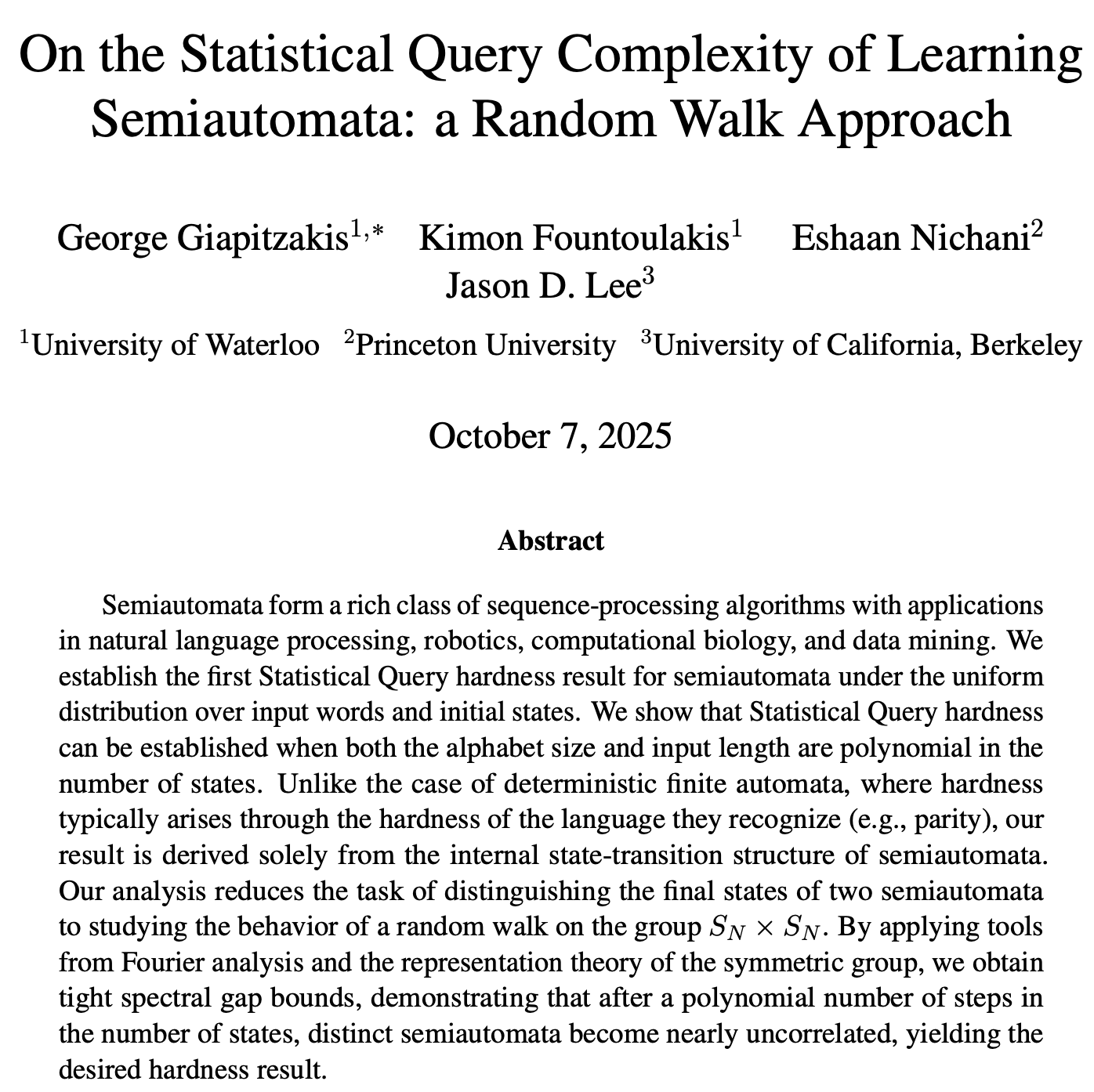
On the Statistical Query Complexity of Learning Semiautomata: a Random Walk Approach
Work with @ggiapitz, @EshaanNichani and @jasondeanlee.
We prove the first SQ hardness result for learning semiautomata under the uniform distribution over input words and initial states, without relying on parity gadgets or adversarial inputs. The hardness is structural, it arises purely from the transition structure, not from hard languages.
We show that SQ hardness can be established when both the alphabet size and input length are polynomial in the number of states.
Soon, everything will be formalized.

Small announcement: ✅ formal-git
As an experiment, over the last 2 months we've modelled ~30% of Git in Lean 4, making heavy use of coding agents, and proved >8000 theorems of varying usefulness about the implementation.
In the process of doing this we've uncovered >100 potential defects in Git v2.55, at least two of which may constitute security vulnerabilities. We've also built a DRT (differential random testing) harness and the biggest corpus of relevant pinned differential test cases for Git implementations with >10k unique tests at the moment.
We've used the test cases to test our own small internal implementation of Git in TypeScript. The next step will be to differentially test all notable public Git implementations against this corpus of tests to help improve their correctness and security 🫡 We'll be reaching out to library maintainers in due course.
If you have a Git implementation you'd like us to help you test, please reach out and let me know. We'll open-source all this eventually, after potential security issues that were uncovered are responsibly disclosed and fixed.

ALT Infographic: Reads: formal-git, Git, rebuilt in Lean 4, with machine-checked proofs
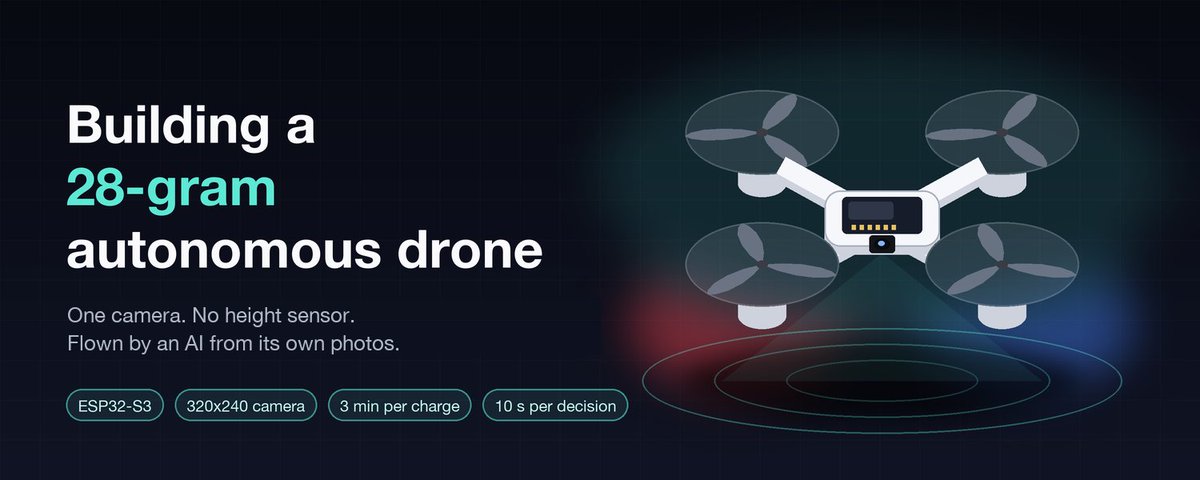

First successful mission. I asked Codex to find the frog, land close to it, and take photos. Fully autonomously. The frame rate is low to conserve energy. The amount of tuning I had to do to get this thing working was exhausting.
The drone hovers in-between decisions. Stability is fine, but not perfect due to the lack of distance sensors. Codex is very slow, taking about 12–20 seconds per decision. This is a major bottleneck, especially for such a small drone with a tiny battery.
Here is a list of things that made it work. However, most of the tuning involved figuring out which things actually worked. I had to remove or improve many things. The most painful were the movement restrictions introduced at the very beginning, when I started the test flights. I wasn't even aware of some of them and had to discover them through multiple trials in which the drone would land for no apparent reason or refuse to follow my commands through Codex. Fixing stability issues was also painful, since stability was affected by even minor imbalances in the drone itself. Overshooting was another problem.

Going back to this. Fast-changing theory makes it hard to pin down specific problems that a community should focus on. Theorists are playing a game of catch-up with practitioners, where practitioners basically define what needs to be analyzed. Before a theory is settled for a particular model or problem, the empirical community has already moved on to the next important model. Grants, etc., follow these trends, so theorists have to follow as well. Old questions may retain their scientific value, but the community often loses the incentive to solve them.
🤖 Made with AI


Some people on X realised that OpenAI's math drop didn't contain much cryptography. @dpaleka notes that a few more fields are under-represented: largely the ones that are useful for AI research

This actually ended up with me simulating reinforcement in-context learning in real time without using a simulator. It's painfully slow, but the drone now:
1. Takes off on its own.
2. Hovers stably using just the camera and gyroscope.
3. Lands safely on its own.
4. Takes photos and sends them to Claude (I ended up using Opus 5.5 Ultra).
The next step is to identify an object and approach it. Then, dunno, maybe I'll just let Claude do its own thing? What could go wrong?
Interestingly, the battery voltage is low, and Claude had to do a lot of engineering to keep the drone flying stably without turning off mid-air.
FWIW.
On the other hand, I've never felt more creative or more capable of exploring and implementing ideas. Things I couldn't even dream of are now just a few prompts away. A few examples from 2026:
1. xitter.cf/kfountou/status/209323…
2. xitter.cf/kfountou/status/210806…
3. xitter.cf/kfountou/status/210316…
4. proceedings.mlr.press/v336/g…
5. I'm also expecting some drone hardware to arrive today, which I plan to connect to Claude to make the drone autonomous.
Forget about the sand guys at NVIDIA, Intel, and AMD. This is ancient technology now. Let's build computers using fluids!
OpenAI's Result 376 shows how to apply forces to a fluid so that a fluid particle's motion simulates the computation of an arbitrary Turing machine, while satisfying the Navier–Stokes equations.
Apparently, the construction is explicit, so I can actually try simulating it!
Link: kfoynt.github.io/stationary-…

If you're wondering why I didn't use nicer fluid graphics, it's because everything happens on such a small scale that I couldn't make it look more realistic without compromising the faithfulness of the visualization to the mathematical construction.

I am wondering where this kind soul might be hiding today.
I just had a grant for GPUs rejected (6 GPUs in total, shared across the whole department) solely because I used the term “algorithmic reasoning.” The reviewer spent about 90% of their review trying to educate me on how “anthropomorphizing” neural networks does a “disservice to Science” (their exact words, with “Science” capitalized by them). I’m glad I’m not the only one.👇
I can't wait to teach undergraduate students the new Fourier algorithm that runs in n(log n)^{1-δ} time, with δ = 10^{-13}!

We’re releasing a broad range of new mathematical results produced by an internal frontier model.
We’ve been consulting with the independent Advisory Group on Mathematics and Artificial Intelligence at the Institute for Advanced Study, and we have drawn on their advice and public recommendations to inform how we release these results.
github.com/openai/math

The TCS stuff are crazy.
We’re releasing a broad range of new mathematical results produced by an internal frontier model.
We’ve been consulting with the independent Advisory Group on Mathematics and Artificial Intelligence at the Institute for Advanced Study, and we have drawn on their advice and public recommendations to inform how we release these results.
github.com/openai/math
Kimon Fountoulakis retweeted

We’re releasing a broad range of new mathematical results produced by an internal frontier model.
We’ve been consulting with the independent Advisory Group on Mathematics and Artificial Intelligence at the Institute for Advanced Study, and we have drawn on their advice and public recommendations to inform how we release these results.
github.com/openai/math
I'm wondering how many of the people who are calling for fewer papers will actually follow through. Will professors who have been producing 10+ papers per year suddenly produce only 5? 😅 And to be fair, why would they? Grants, awards, and promotions are all, explicitly or implicitly, a function of the number of papers.