

https://xitter.cf/t.co/nPFjzBeOAP Building generative AI since 2015. Co-founder of Saliency acquired by Clario.
Stanford, CA
Joined May 2009
- Tweets861
- Following1.2K
- Followers921
- Likes2.1K





Pinned Tweet
Jev is (likely) a diffusion model. It seems to match other diffusion approaches in speed and performance (@InceptionLabs, @googlegemma, @adityagrover_)
I built Jiffy to test whether an open diffusion model could reproduce similar decision performance. It got surprisingly close without task-specific retraining.
On 231 public JevBench tasks:
• Jiffy: 84.4%
• Jev’s published results: 86.6%
• Jiffy latency: 259 ms median on an H100 (so likely can be substantially improved just with better hardware).
After days of distillation experiments, my strongest accuracy-latency result was essentially a thin wrapper around frozen DiffusionGemma.
Open source, including Doom and Tetris demos: github.com/kidzik/jiffy
I did my PhD in mathematics.
Today, work similar to what took me three years can be done in a week with a few prompts.
I'm not particularly bothered by that.
What I'm more anxious about is how this changes who gets to contribute. Mathematics felt meritocratic: with a paper, a pencil, and access to a library, you could take a serious shot at an important open problem.
As research becomes something we can purchase as computation, access to capital will increasingly determine who can compete. How do we even know whether an open problem requires a new idea or simply a larger token budget?
Many other disciplines will likely follow. More money buys more computational capacity. That capacity produces discoveries. Those discoveries can generate more money, which buys still more capacity. One could say it's always been like that, but as we replace humans with compute, this loop will accelerate, and inequality will widen.

Lukas Kidzinski retweeted

What if the jagged frontier is mainly math + code (which you can push arbitrarily far with RLVR), and everything else starts to plateau because it is still bottlenecked by human generated data?
Model performance in non-verifiable areas has kept improving steadily, albeit much slower than for math and code. But is that steady improvement a side effect of a higher G (itself driven by RLVR), or only a function of the amount of new human data getting injected into training (which is still continually happening on a massive scale)?
A lot of things depend on the answer to this question
Lukas Kidzinski retweeted

Neoadjuvant therapy means months of treatment before surgery. Knowing a patient's chance of pathological complete response (pCR) before treatment could help tailor that treatment.
Today we're releasing two preprints on NEO, our AI model that predicts a patient's chance of pCR from a routine biopsy slide. 🧵
Lukas Kidzinski retweeted

Navier-Stokes Equation, explained with colors
p.migdal.pl/equations-explai…


Lukas Kidzinski retweeted

Reading all those recent beautiful essays by Terry Tao, Kevin Buzzard and @wtgowers, I could not resist, but write up my deeply personal perspective on how I perceive and see things:
docs.google.com/document/d/e…
So where is the approved AI drug?
I asked Claude to answer with a song, and here is what it made.
@InSilicoMeds is getting close!
Lukas Kidzinski retweeted

Can't invest in Anthropic at 2 trillion because it could be a 0 and I'm fucked, or it could be 20 trillion, but at 20 trillion we are all fucked.
Arrow's information paradox: revealing information lets buyers assess its value, but can also give away what you hoped to sell.
Jev shows a version of this in AI. TypeSafe's launch demonstrated the opportunity to customers and competitors alike. Open implementations are already appearing: Jev is a small model, so it's relatively cheap to build by distilling a large open-source one.
When software is cheap to reproduce, part of the investment goes into figuring out what's worth building. Launching helps you earn that investment back and gives everyone else a clearer target reducing their discovery costs.

Jev made AI exciting again. Everyone is so tired of frontier labs and their giant models; fast intelligence which you can (almost) reproduce on a single GPU, play with, and experiment with feels like fresh air for hackers.
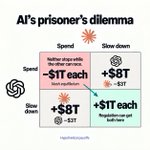
Why would arguably the most technologically advanced companies on Earth advocate a slowdown?
Because staying at the frontier can become a financial liability. You have to keep spending to defend your position, even when staying ahead no longer justifies the cost. Cutting back alone risks handing the market to your competitor.
The numbers in the image are hypothetical, but the incentives are straightforward. Both companies land in the red because losing the race costs more than continuing to spend. They land in a so-called Nash equilibrium, even though both would earn more in the green square.
Regulation could move them there by imposing a slowdown.

Lukas Kidzinski retweeted

How does an AI solving a problem prevent mathematicians from "achieving the primary goal of conceptual understanding and insight"? If a mathematician needs to work on the problem from scratch with pencil and paper in order to gain that important understanding and insight, how does an AI publishing a proof prevent anybody from doing that?
unavailable
It’s exciting to live in times when you can solve literally any open problem if only you have access to anonymized notes of a researcher working on that problem and $22M worth of tokens 🫢


