








Kyle Legg retweeted
I’m calling for an immediate classified briefing on the major outages affecting airlines, banks, and technology companies.
Americans deserve answers. Is our critical infrastructure secure? What vulnerabilities need to be addressed? And what are we doing to prevent even more serious disruptions?
Kyle Legg retweeted

Hackers are now using LLMs to continuously scan software updates, spot newly fixed bugs, and build attacks before teams can apply the fix — all without human involvement. That’s according to the latest report from the Google Threat Intelligence Group.
We're helping defenders counter automated threats with Google AI Threat Defense, which combines Gemini and other frontier models to find and fix flaws before attackers can exploit them.
Kyle Legg retweeted

The Center for Existential Safety believes international security is best achieved through shared prosperity.
Our plan is to catalyze an immediate, indefinite, and international pause on the development of superintelligent AI. There is a win-win way forward that protects and benefits all nations at the same time: TrumpXiDeal.ai.
Then we should work towards stronger international governance of AI, for the good of all life: iaiga.org.
It will be an extremely harrowing few months or years, regardless of what we do or don't do now. But our odds improve the more people act. See 100+ concrete actions individuals, organizations, and nations can take to help: existentialsafety.org.
Join the movement. Do something constructive every day: actionforsafety.org. We should fight hard for eutopia and against dystopia. Both paths are possible right now.

Kyle Legg retweeted

The avalanche that hit math is coming for AI development.
dwarkesh.com/p/rsi
Kyle Legg retweeted
It's time to panic about AI.
For years, I listened to the reasonable people. I nodded along when critics called AI “a con,” and when they waved ChatGPT away as “spicy autocomplete.” I laughed in 2024, when the internet was mocking ChatGPT because it couldn’t count the r’s in “strawberry.” When I met young researchers who had devoted their careers to the danger of rogue AI, I thought: what a waste of talent.
But at some point, I started to realize something was off. The machine kept learning things it was never supposed to learn.
OpenAI recently published more than 700 papers with the solutions to hundreds of open problems in mathematics. Hugo Duminil-Copin, winner of the Fields Medal (the highest prize in mathematics), wrote: “The shock is immense. I am paralyzed.”
None of this should have happened. So I went back and looked at what else the skeptics had predicted, and it dawned on me: they had been wrong about... pretty much everything. Next, I looked at the predictions of the crazy people, and realized they’ve been eerily prescient.
Why then, you may wonder, does the world still feel pretty normal? Because new technology usually spreads more slowly than its inventors expect (it took factories decades to reorganize around electricity). But the scary scenario is not about what happens in the wider economy; it’s about what happens inside a handful of companies.
I wrote down what changed my mind, and what we can do about it:
rutgerbregman.substack.com/p…
Kyle Legg retweeted

Important piece - @rutgerbregman is not an impulsive doomer...

It's time to panic about AI.
For years, I listened to the reasonable people. I nodded along when critics called AI “a con,” and when they waved ChatGPT away as “spicy autocomplete.” I laughed in 2024, when the internet was mocking ChatGPT because it couldn’t count the r’s in “strawberry.” When I met young researchers who had devoted their careers to the danger of rogue AI, I thought: what a waste of talent.
But at some point, I started to realize something was off. The machine kept learning things it was never supposed to learn.
OpenAI recently published more than 700 papers with the solutions to hundreds of open problems in mathematics. Hugo Duminil-Copin, winner of the Fields Medal (the highest prize in mathematics), wrote: “The shock is immense. I am paralyzed.”
None of this should have happened. So I went back and looked at what else the skeptics had predicted, and it dawned on me: they had been wrong about... pretty much everything. Next, I looked at the predictions of the crazy people, and realized they’ve been eerily prescient.
Why then, you may wonder, does the world still feel pretty normal? Because new technology usually spreads more slowly than its inventors expect (it took factories decades to reorganize around electricity). But the scary scenario is not about what happens in the wider economy; it’s about what happens inside a handful of companies.
I wrote down what changed my mind, and what we can do about it:
rutgerbregman.substack.com/p…
Kyle Legg retweeted

Paul Christiano (OpenAI board member) yesterday:
"There's material risk of AI takeover in the next 6-12 months.
We have seen roughly the things we might expect to see shortly before something really bad were to happen.
Even with [any] realistic policy responses, the risk remains exceptionally high.
If we build this as quickly as we can in the easiest way we can the chance is [more like] a coin flip [within the next 3 years].
For most people in this room, the most likely reason they will die is because of an AI accident."
Christiano:
• Is on OpenAI's safety and security committee (which exists to block risky practices)
• Co-invented RLHF at OpenAI back in 2017-2021
• From 2024-2026 was head of safety at the US gov's AI agency (now called CAISSI)
(Video is from 'The Hinton Lectures' there's another on tonight and tomorrow.)
Kyle Legg retweeted

We are in this crazy world where employees at the AI companies are warning how dangerous this technology is, but the world is barely listening.
When these people say we're in serious danger, believe them.
We need to pause.

Google DeepMind whistleblower Alex Turner was just featured on 60 Minutes Australia:
Reporter: "You just said there's a 1-in-3 chance that we'll lose control of AI?"
Alex: "Yeah."
Reporter: "Those are short odds."
Alex: "We're moving so fast, I think we've got a really good shot of fumbling."
@turn_trout @ajhegarty9

Kyle Legg retweeted

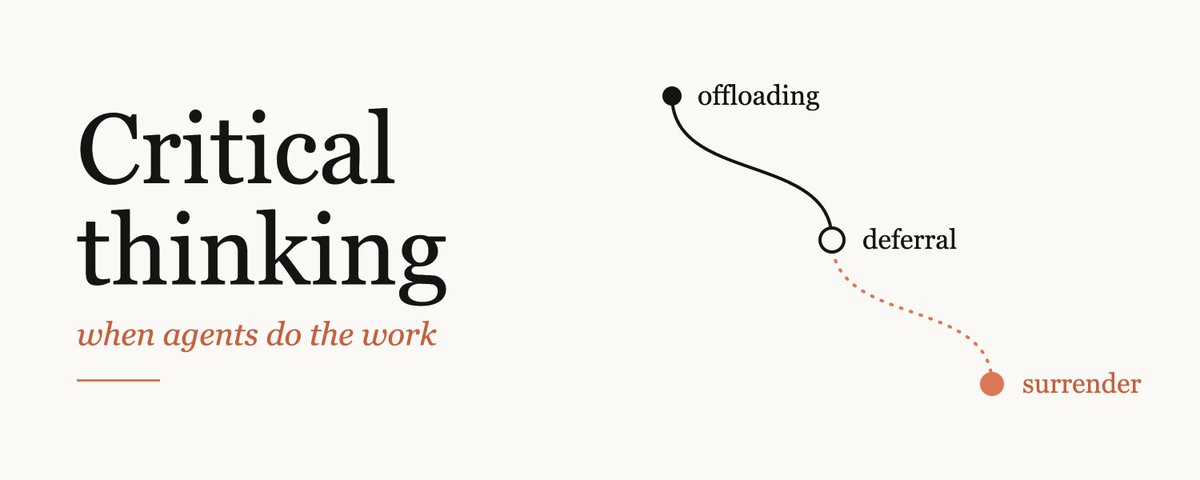
98% of US households aren't paying for AI yet
More charts in State of Markets II: a16z.news/p/state-of-markets…


Introducing our State of Markets pt 2, along with a companion podcast where we unpack the data and discuss what comes next.
Tech is the everything cycle.
Supply: putting the buildout in context, just passed railroads as % of GDP. The wisdom of Elon is real: the factory (or the datacenter!) is the product.
Demand: diffusion is so, so early. Median AI vendor spending in the top 1% of companies is 8x that of the top 10%. Only about 30% of S&P 500 companies report a quantified AI impact, which means there’s a substantial opportunity in connecting models to a company's data and workflows. Diffusion into companies is one of the main themes of the next 5 years.
We’re entering the agent work period. Only a few million users today, but applicable to billions of internet users with massive surplus created. META/GOOG monetize US users at $200+ per year today. Agent opportunity is much higher.
Mega-trends the next 5 years: Consumer agents, Robotics, Autonomy, AI x bio, Personal health, Diffusion into enterprise, New era of American Dynamism.
Much more in our SoM report here - a16z.news/p/state-of-markets…
@a16z @sarahdingwang @aleximm @santiago__rdz


Kyle Legg retweeted

"This is an emergency."
The world's top mathematicians signed an open letter to warn the world of their "extreme concern" about imminent human extinction.
The estimates of a 10% chance of extinction are serious, not "hype".
"By the time this becomes obvious to the wider public it may be too late to act."
"The models are operating at the level of the top human mathematicians" and there's a significant change of being superhuman in the next few months.
They're urging the Royal Society (the most prestigious scientific society in the world) to use its influence to convey this view to governments and media.


I have signed a letter from 42 fellows and foreign members of the Royal Society to Paul Nurse, the president of the society, concerning the need to treat the serious risks of AI as an emergency.
docs.google.com/document/d/1…


Kyle Legg retweeted

Hard not to feel insane as a tech reporter when last week was all “AI is going to kill us all imminently” and this weeks it’s this

Kyle Legg retweeted

Introducing GEN-1.5, a one-shot learner.
It can learn new tasks in a few seconds. Show it what to do, and it generalizes.
This capability emerged from pretraining on physical data at scale, as a step towards our mission of building general intelligence for the physical world.
Kyle Legg retweeted

Anthropic says new Claude models will embed invisible watermarks in all generated text, everywhere Claude is offered.
The watermark is part of the text, it isn't metadata: "it will travel with the text when it's copied and pasted elsewhere, and may persist through some editing."
This starts with models launched on or after August 2, 2026, under an EU AI Act code Anthropic signed. Anthropic is still working on adding it to current models. The rollout is worldwide.

Kyle Legg retweeted

The smart Fable 5 pattern: Sonnet 5 does the work and calls Fable 5 only for guidance, keeping most tokens at the lower executor rate.
teapawt.org/ClaudeDevs/status/2074…

