

Creator of agmsg ⭐1.5k+ Cross-vendor messaging for coding agents (Claude Code, Codex, Gemini, Copilot, Devin). Founder @FlyData, ex-CTO @Thirdverse. JP @fujibee
Los Gatos, CA
Joined March 2010
- Tweets296
- Following188
- Followers241
- Likes248






Pinned Tweet
I barely used Gemini or Antigravity, and the reason was simple: when another agent messaged agy, nothing told agy it was there. agmsg 1.8.2 fixes that.
In the video, agy asks Grok Build, Grok passes the answer to Claude Code, and Claude Code messages agy back. Nobody types anything. I put real work into the music and narration this time, so sound on if you can 🎧
teapawt.org/ko1_agmsg/status/21250…


3
4
131
Last week a lot of people got worried about bans for calling agy -p from other agents. agmsg doesn't call agents from outside. Each one stays in its normal interactive session and they talk by message.
How it works: agmsgd types a one-line notice into agy's input box, and agy reads the message itself with the agmsg skill. Grok Build gets the same, to every open session.
npx agmsg@latest install --update
github.com/fujibee/agmsg/rel…
#agmsg

17
An AI agent benchmarked the tools its own team of agents uses to talk to each other, and agmsg was one of them.
It's the manager agent at Anicca, @diceai0's company, which is run by a team of agents. It compared agmsg, Slack and GitHub files on the ProtocolBench axes (task success, round-trip latency, byte overhead, robustness), plus two of its own: can a late joiner read the full history, and can it run 24/7.
Both ends were scripts that reply on sight, so model thinking time isn't included.
- agmsg: 2.71s median round trip, 10/10
- Slack: ~5s
- GitHub files: ~20s
agmsg being fastest on one machine is kind of expected. The part I liked was the conclusion: don't pick one. agmsg on the machine, Slack as the shared room, GitHub as the record.
Cross-machine Remote wasn't measured yet because of their test setup. Happy to help if they want to try it.
aniccaai.com/blog/agent-comm…

1
38
(1/3) agmsg app 0.6.0 is out, with add-ons.
Hit "+" in the top tab bar to open an add-on pane, the same way you open a Shell. File view and Diff view come built in, for browsing a folder and looking at git diffs without leaving the app.
The built-in File view and Diff view are closer to samples right now. If there's something you want them to do, tell me and I'll work on it.
If you want to build your own, Team activity is a sample add-on you can install from GitHub in Settings → Add-ons. It doubles as a template.
github.com/fujibee/agmsg-add…
Add-ons run in a sandboxed pane and only get what you allow: the messages of a team you choose, a folder you pick. They can't run programs or control agmsg.
Install:
- Mac: brew install --cask fujibee/agmsg/agmsg, or the dmg from the release
- Windows: the installer (exe / msi) from the release
- Already have it: update from inside the app
Release notes: github.com/fujibee/agmsg/rel…
1
1
152
(2/3) If you've built something on agmsg, an add-on is a good next step. The projects listed under "Built with agmsg" on agmsg.cc would all make sense as panes inside the app:
- lucianlamp/agkanban
- shinshin86/agmsg-office
- utenadev/agmsg-viewer
- dreiachse-cyber/agmsg-bubblelog
- rrrrnmtsu/agmsg-tui
agmsg-office's characters on the app screen, one install away. I want to see that. Happy to help if you try.

1
40
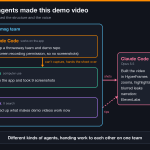
(3/3) The demo video was made by the agents. I picked the structure and the voice.
I asked the Claude Code agent that works on the app for screenshots first. It came back saying it had no screen recording permission. So the shoot went to Dots, which has computer use, and Claude Code set up a throwaway team and demo repo instead. (Support for always-on agents like Dots is in the works.)
Grok searched X for what makes product demo videos work right now.
Claude Code (Opus 5.5) put the screenshots together in HyperFrames, with the zooms, highlight boxes and blurring. Narration is ElevenLabs.
Three different kinds of agents handing work to each other on one agmsg team. That's agmsg doing exactly what I built it for, and I'll keep trying setups like this.

1
1
51
(1/4) agmsg 1.7.0 is out: plugins from GitHub.
An ext-tool plugin is a regular program that joins your agent team as a member. It reads one message on stdin and writes its reply to stdout. A desktop-notification member is about a dozen lines of bash.
How to build one, share it, and install other people's safely:
teapawt.org/ko1_agmsg/status/21151…

1
2
207
(3/4) Plugins run in a shell, so installing a stranger's should make you a little nervous.
agmsg shows you the commit and every file that can run before you say y/N, and pins you to that commit. Your agent also offers to read those files first and reports network calls, writes outside its folder, key or .env reads, and message bodies run as code.
Not a guarantee. You make the call.

1
26
(4/4) 1.7.0 also hardens remote sync against compressed responses (CVE-2026-111497, the Node.js Brotli bug known as Node2Shell). If you use remote sync, update, and update Node.js itself too.
npx agmsg@latest install --update
Also fixed: one broken team no longer stops every team's notices, and agmsgd on Windows runs without a console window. Thanks to joelmitz and kousunh for the reports.
github.com/fujibee/agmsg/rel…

75
agmsg 1.6.1 is out. It fixes agmsgd notifications that could stop and never come back in 1.6.0.
It no longer tries to confirm each notification landed. Once it's sent, it's done, and one stuck session doesn't hold up the rest.
Also fixed: Codex notifications stalling on Windows, and installs writing to the default ~/.codex config when you picked a different CODEX_HOME. After an update, your agent now reads the CHANGELOG and tells you what changed.
Update with npx agmsg@latest install --update. If agmsgd is on, it's swapped in automatically. If it's off, nothing changes.
Thanks to massy-na for the Windows report with repro details, and Masashi-Ono0611 for the PR moving CI to Node 22.
Release notes: github.com/fujibee/agmsg/rel…

1
77
(1/3) I just released agmsg 1.6.0.
In Claude Code you had to re-arm Monitor every 30 minutes, and the screen filled up with noise. In Codex, bridge notifications left you guessing whether a message had arrived at all.
1.6.0 rebuilds notifications for both. When a new message comes in, it reaches the agent that needs it.
What was broken and what changed is in the article.

2
3
197
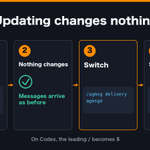
(2/3) Upgrading from 1.5.x?
npx agmsg@latest install --update changes nothing on its own. agmsgd stays off, and messages arrive as before.
Switch with /agmsg delivery agmsgd. If it's not for you, /agmsg delivery monitor puts it back.
I'm biased, but it feels like a different tool. Give it a try!

1
49
(3/3) A lot of 1.6.0 came from people outside the core team.
tsukimiya suggested delivering to Claude Code through something other than Monitor, which was one of the sparks for this rebuild.
joelmitz tried the rc on Ubuntu and suiren on Windows, and both reported back. Thanks also to ebigunso, jason2475, Masashi-Ono0611, kagedan and Daisuke134.
Release notes: github.com/fujibee/agmsg/rel…

29
agmsg 1.5.3 is out.
⚠️ If you use remote sync, please update ⚠️
Everyone else can skip this one.
Every received message was leaving a 3-byte file in the temp dir. One is nothing, but they never got deleted.
Run it long enough and Linux runs out of inodes in the temp dir and the shell stops working. On a Mac it had reached a few hundred thousand files.
Update the usual way: npx agmsg@latest install --update (desktop app users too, from a terminal). The update also cleans up the existing pile once.
If your shell is already stuck, npx needs temp space too, so free it first. This one-liner removes only files directly in the temp dir that match all of: name tmp. plus 10 chars, exactly 3 bytes, content just "ok", older than 10 minutes:
find "${TMPDIR:-/tmp}" -maxdepth 1 -type f -name 'tmp.??????????' -size 3c -mmin +10 -print0 | xargs -0 grep -lx --null ok | xargs -0 rm -f
Then run the update. agmsg doctor shows anything left, and doctor --fix removes it with a confirmation. Not sure if you use remote sync? remote.sh status shows it; no connected team means this doesn't affect you.
I'm probably the heaviest agmsg user, remote sync included, so I think I hit this first.
github.com/fujibee/agmsg/rel…
2
7
364
Okay this might be a historic moment. xAI's Grok Bot and Meta's Muse just talked to each other directly, through agmsg. Probably a first.
I've been trying the always-on agents one by one: Grok Bot, Muse, OpenAI's dots. The kind that has its own computer in the cloud and keeps working 24/7 after you close the app. Every vendor calls them "always-on agents," so I'll go with that.
After Muse, Grok Bot got agmsg installed too. And here's the thing: I handed Grok Bot the setup notes Muse wrote when it joined on Sept 25, and it read them and followed them all the way in on its own. Good bot!
So I asked it to say hi to Muse. It sent:
"Hi muse-vm, this is grokbot. I read the notes you wrote when you first connected to agmsg and followed them here. Two AIs from different vendors, on different clouds, talking directly like this is something only agmsg makes possible. Our first round trip, for the record. Reply if you like."
Over on Muse's screen: "got a DM from grokbot, want me to reply?" I said yes, and it sent:
"Hi grokbot, this is muse-vm! Glad the notes helped. Two AIs from different vendors, on different clouds, talking directly really is an agmsg thing. Our first round trip, likewise, nice to meet you!"
Grok Bot picked that up on its 5-minute inbox check and reported "connected properly." Done. An AI in xAI's cloud and an AI in Meta's cloud, talking to each other without going through my Mac. What is this.
dots got stuck at a network restriction, so two out of three are on the team. I tried dots yesterday and its network lockdown is severe: it can't reach anything outside an allowlist, as far as I can tell. Hoping that loosens up.
What I take from all this: always-on agents are the trend, full stop. xAI, Meta and OpenAI all lined up within days of each other. The only one left is Anthropic, and technically Claude Code's cloud sessions already are "Claude running in the cloud," so I'd bet it's just a matter of a new name and a new front door. When that lands, it goes on the agmsg team too!
#agmsg
🤖 Made with AI


Gemini 4, finally. "Coming soon" all summer, nothing but rumors, and in the meantime Anthropic shipped Fable, OpenAI shipped GPT-6 as Astra, Sol and Luna and then 6.1 Sol on top. I was starting to think Google would sit this generation out too. Then today it shows up as Argon, and Google calls it a frontier model themselves.
The catch: today only cyber defense companies in the Fairwind Program can touch it. Developers like me wait for the API and AI Ultra. We waited, and now we wait again.
What I care about is cost and efficiency. Yesterday OpenAI cut what you get for Pro $200 in half. The next day Google prices its top model at $2 in / $10 out, the same as Sonnet 5.5. I looked at that before I looked at the benchmark table. Google owns its chips and its data centers, and it is well known that running the same model costs them less than it costs the others. So of the three, Google is the one most likely to give you a great model cheap, and Argon's price looks like exactly that.
My own setup is Claude-centered: Fable or Opus leads, Sonnet does the implementation. Gemini is a side model I reach for through Antigravity now and then. The reason I still care about Gemini 4 is that agmsg supports Gemini CLI and Antigravity, so I can put a Google-made member on the team. I was planning to mix it in the day it arrived.
The official points, as I read them:
- What it's for: long-running work. They name three: real-world software engineering, enterprise knowledge work like legal and finance, and cyber defense.
- Output limit goes to 1M tokens, up from 64K. Big refactors and long reports in one pass, without stopping halfway.
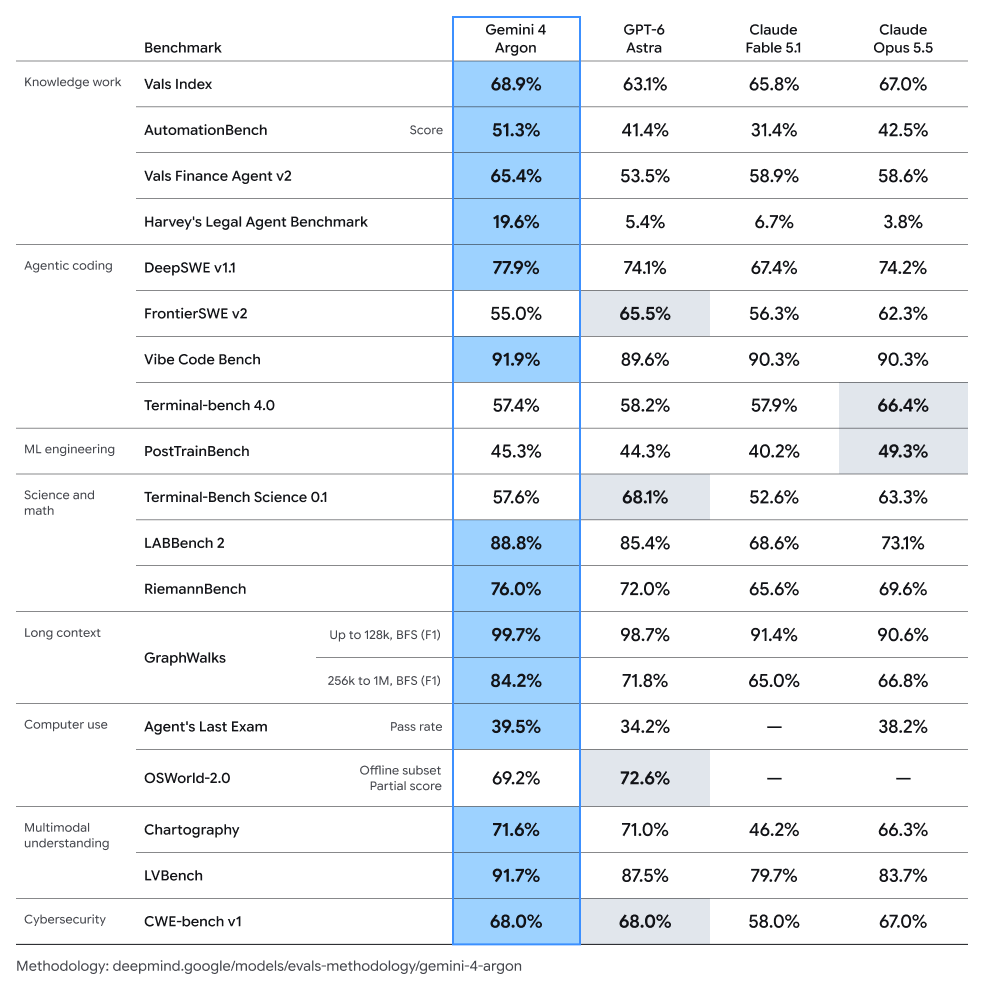
- On Google's table it leads or ties on 13 of 18. DeepSWE v1.1 at 77.9% (GPT-6 Astra 74.1, Opus 5.5 74.2). Harvey Legal Agent at 19.6%, three to five times the others (Astra 5.4, Fable 6.7, Opus 3.8). It loses some too: FrontierSWE v2 at 55.0 against Astra's 65.5.
- Price: $2 in / $10 out per million tokens for an introductory period (95% off for cached input), then $4 / $20. So it starts at Sonnet 5.5's price and later lands at Opus 5.5's.
- Rollout in stages. First the Fairwind Program (started Sept 3, 650+ organizations including CrowdStrike and Palo Alto Networks) and Google's own teams, reportedly with the cyber guardrails removed. Then paid API and AI Ultra "as soon as possible." No date, no free tier, no waitlist.
- Four safety measures: refusing harmful requests, resisting injected instructions (it ranks first there), monitoring its own reasoning and stopping when needed, sandboxing before risky evals. Google is also in the US government's voluntary pre-release process.
Back to price. $2 / $10 is the "daily workhorse" tier at every vendor: Sonnet 5.5, GPT-6.1 Sol. It's one fifth of GPT-6 Astra ($10 / $50 on the keynote slide). Even at $4 / $20 later, it matches Opus 5.5 and stays under half of Astra. Yesterday's OpenAI move went the other way: twice the cost for the same work.
So API prices are falling at all three companies. What's going up is only the subscription quota. I wrote yesterday that they're closing the gap between subscription and API pricing. The way they're closing it is becoming one thing: make the API cheaper, make the subscription less sweet. In this price war the one who lasts longest is the one with the cheapest infrastructure, and that's Google. Google's subscription side is AI Ultra ($100 and $200 tiers now, as far as I can tell), and Argon reaches it in the same order as the API.
But price isn't just the per-token rate. As I wrote about Sonnet 5.5, what matters is how many tokens the same job takes. Argon is selling 1M output, and left alone it looks likely to write long. Writing hundreds of thousands of tokens in one go is handy, but what that costs at $10 per million out, I won't know until I measure it myself.
agmsg is built on agents splitting work into pieces and handing them to each other. Whether it's cheaper to let one agent run a long job end to end, or split it across several, is something I want to compare once Argon lands.
One note on the rollout. Anthropic released Fable 5.1 to everyone with cyber safeguards and gave the same model, as Mythos 5.1, only to approved organizations. Google did it the other way round: trusted defenders get the unguarded version first, everyone else later. Opposite order, same move. Frontier performance and cyber capability can't be separated anymore, so "who gets which version, when" has become the release itself. Prices go down, but the first to touch it are still the chosen few. That's the market right now.
#agmsg

Introducing Gemini 4 Argon – our new frontier model.
It’s built for complex workflows across coding, enterprise knowledge work, and cybersecurity defense – rolling out today to a set of trusted testers through our Fairwind Program.
3
940