

Postdoc @ Charite, Berlin w/ Matthew Larkum Former PhD student @ NIN, Amsterdam w/ Christiaan Levelt. Predictive coding, sleep, inhibition, chandelier cells
Berlin, Germany
Joined January 2010
- Tweets5.3K
- Following414
- Followers366
- Likes2.2K




Pinned Tweet
I’m very excited to share our latest preprint:
‘Experience-dependent predictions of feedforward and contextual information in mouse visual cortex’
biorxiv.org/content/10.1101/…

Koen Seignette retweeted

🎉 Huge congratulations to Doris Dijksterhuis (@DorisDijk) for winning the 2024 Brain Award for Scientific Excellence, and to Koen Seignette (@kseignet) for receiving the 2024 Brain Award for Collaborative Excellence! 🏆
Learn more about their work here 👇nin.nl/news/winners-brain-aw…


Koen Seignette retweeted

Proud of our work and my PhD baby. Now out in Science: Pronouns reactivate conceptual representations in human hippocampal neurons. Thanks to @Pieters_Tweet, @MatthewWSelf and the others for this great study! science.org/doi/10.1126/scie… – at Bonn, Germany

Koen Seignette retweeted

We are looking for postdocs funded by an ERC starting grant to investigate the mechanisms of cortical predictive learning! Opportunities to use in vivo whole cell recordings, 2-photon imaging VR for mice, and more. Please reach out if you are interested! elxw.fa.em3.oraclecloud.com/…
Koen Seignette retweeted
Our preprint is out! During my PhD at the @NIN_knaw, we studied the role of concept cells (found in the human hippocampus) in language comprehension.
biorxiv.org/content/10.1101/…
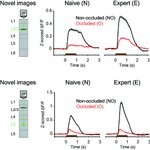
Taken together, our results show that mouse V1 responds to contextual information in the absence of feedforward inputs with stimulus-specific signals. Responses to occluded and non-occluded images occur in separate populations of neurons and are experience-dependent.
Check out the preprint for many more analyses and details. Huge thanks to my amazing PhD advisor @CN_Levelt and all other co-authors: Leander de Kraker @paolo_papale Lucy Petro Barbara Hobo @JMontijn Matt Self @mattlark @Pieters_Tweet @LarsMuckli
What about responses to novel images that were left out of the training?
They increased for both non-occluded and occluded stimuli, suggesting that prediction errors computed in higher brain regions enhance stimulus-specific responses in V1.

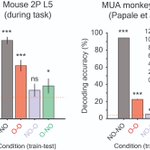
Furthermore, decoding patterns were highly similar between mouse, monkey and human, despite using different neural recording techniques! This suggests that similar neural mechanisms underlie these responses across species.

Is there stimulus-specific information in responses to occluded stimuli?
Yes! We performed linear discriminant analysis to train and test a classifier on responses to non-occluded (NO) and occluded (O) stimuli and found significant decoding across nearly all conditions.

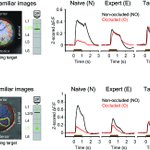
Interestingly, many L2/3 neurons responded to either the non-occluded stimuli or the occluded stimuli, especially in expert mice and during task engagement. This separation into two populations was less pronounced in L5.

Although L2/3 and L5 neurons in naive mice responded to non-occluded and occluded familiar stimuli, visual experience had huge consequences: responses to non-occluded stimuli decreased while responses to occluded stimuli increased.

In addition to the Naive and Expert conditions, where mice passively viewed the stimuli, we also recorded during Task engagement. We made sure to only include neurons whose cRF was on the occluded area.

Here, we asked whether similar signals exist in single neurons of mouse V1 and how they depend on prior visual experience. We recorded L2/3 and L5 neurons in V1 using 2P Ca imaging before and after familiarizing the mice with a subset of natural images.

These responses to occluded visual scenes contain stimulus-specific information and may represent predictions related to the missing content...
Earlier work in humans and monkeys used partially occluded natural images to eliminate feedforward inputs, showing that V1 responds to occluded stimuli

Neurons in primary visual cortex (V1) respond to stimuli present in their classical receptive fields (cRFs) and contextual information provided through lateral and top-down connections. It is difficult to experimentally disentangle contextual from feedforward inputs...
Koen Seignette retweeted
Come and join our lab at the University of Edinburgh! Link to the job posting in the comments below.

Koen Seignette retweeted

Happy to share work finally out 🥳
It helps resolve the recent debate about sound-evoked activity in mouse visual cortex: both auditory and behavior related activity exist with distinct spatiotemporal profiles!
PhD work @CogSysNeuroSci , now @Neuro_CF
nature.com/articles/s41593-0…
