

Physics and astronomy teacher, twin mom, and high-altitude ballooner.
Omaha
Joined April 2009
- Tweets1.4K
- Following249
- Followers259
- Likes2.3K




Dr. Kendra Sibbernsen retweeted

Liftoff! The spaceMIRA surgical robot invented by @NebEngineering's Shane Farritor is on its way to the International Space Station. go.unl.edu/fzps #Nebraska #UNL @NASA @Space_Station

Dr. Kendra Sibbernsen retweeted

New Blog Post!!
It's one of those set ups that was so simple I was a little annoyed that I hadn't ever done something like this earlier. I finally finished up a blog post about the Newton's Law Blocks complete with videos and designs to make your own. 😎
passionatelycurioussci.weebl…


Dr. Kendra Sibbernsen retweeted

Our cutdown did not cut, so the balloon descended slowly by opening the vent all the way.
This was a first out of 85 balloon flights for Kendra and Michael, to find the balloon partially inflated upon recovery. #NEBP

Dr. Kendra Sibbernsen retweeted
The base station crew and the launch/recovery team for the Nebraska #NEBP team


Dr. Kendra Sibbernsen retweeted
Nebraska #NEBP students watched the annular eclipse near Roswell, NM.

Dr. Kendra Sibbernsen retweeted
We launched our balloon from Hondo, NM along with two other #NEBP steams.

Dr. Kendra Sibbernsen retweeted
The Nebraska Nationwide Eclipse Ballooning team went to Roswell, NM for the annular eclipse.
While we were waiting for a battery to be serviced on our rental truck, Michael and I walked across the street to the International UFO Museum.


Dr. Kendra Sibbernsen retweeted

While Western Washington University professor Jackie Caplan-Auerbach doesn't love the email inbox exploding with interview requests, she's enjoying the opportunity to share the utility of seismic data and, in a way, her life's work.
cascadiadaily.com/news/2023/…
Dr. Kendra Sibbernsen retweeted

After two nights of earth-shaking dancing at Swift’s Seattle “Eras” tour concert at Lumen Field, enthusiastic Swifties caused seismic activity equivalent of a 2.3 magnitude earthquake, according to seismologist Jackie Caplan-Auerbach cnn.it/3DuF2CG

Dr. Kendra Sibbernsen retweeted

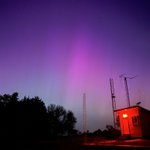
WEDNESDAY NIGHT AURORA FORECAST:
The Northern Lights may return to the U.S. tomorrow night or early Thursday morning as we anticipate the arrival of a significant coronal mass ejection which was released near the Sun's southwest limb yesterday (see previous posts).
INTENSITY/TIMING: We aren't expected to see the full brunt of the solar storm, and there are disagreements about how much of an impact Earth will recieve from the storm, but currently, we estimate that arrival of the storm at Earth is likely between the late Wednesday and early Thursday Zulu-day windows (Wednesday at 2:00pm Eastern to Thursday at 8:00am Eastern).
CONSIDERATIONS: A more forceful impact will result in an earlier arrival and stronger one, and a moderate or strong geomganetic storm is as such not out of the question. Official modelling efforts by NOAA/SWPC suggest a later (mid-day Thursday) and as such, weaker arrival, meaning less of an aurora viewing opportunity for those in the U.S.
WHERE: For a standard moderate geomagnetic storm, aurora may be seen across the Northeast, in the northern and central Plains of the U.S., and in the northern Rockies along the northern horizon in dark areas away from light pollution.
CLOUDS: Favorable over Great Plains, but unfavorable over Midwest/Great Lakes. Favorable for Rockies, Northeast, Northwest.
It's best to wait for confirmation that the solar storm has arrived using solar wind data before aurora chasing--while we feel arrival of this storm is likely, there is considerable uncertainty in storm intensity. I never recommend or will suggest travelling long distances for a CME!
See more details below and on our website at spacewxwatch.com/

Dr. Kendra Sibbernsen retweeted

Our @SETIInstitute press release on the record-breaking observations by our network of citizen astronomers of the Pinwheel Galaxy Supernova. #citizenscience bit.ly/44EUZ4S


Dr. Kendra Sibbernsen retweeted

Supernova #SN2023ixf has passed magnitude 12 in V and B, 12.4 mag in R. Increasing in brightness at around 0.05 mag/hour last night, although this rate appears to be decreasing.

Dr. Kendra Sibbernsen retweeted

Supernova 2023ixf in the Pinwheel Galaxy, M101. taken with @Unistellar #eVscope2 through the clouds this evening. This SN was discovered by Mr. Itagaki last night (2023 05 19.727)
#eVscope

Dr. Kendra Sibbernsen retweeted

Look in the upper arm of this galaxy- you'll see a star appear to blink in and out of existence. That's a supernova! Very recently discovered in m101: the Pinwheel galaxy (which I happened to be shooting when this happened)
Dr. Kendra Sibbernsen retweeted

Since Circuit Construction Kit just won @fnoschese wonderfully conducted sim March Madness bracket, it is a great time to remind people that the sim has a realistic "non-ohmic" bulb these days!
Just go to the advanced options on the lab screen and choose "Add Real Bulbs"
💡🎉
Dr. Kendra Sibbernsen retweeted

Scorpio is a robot that can assist to automate in the security patrolling process. This robot can be operated in remote controlled and autonomous modes
[video: buff.ly/3PAdFfs]
Dr. Kendra Sibbernsen retweeted

(Thread) In the first What If? book, I answered a question about cooking a steak by dropping it from space. At one point, I commented—jokingly!—that if anyone put a steak in a hypersonic wind tunnel to gather better data, I’d love to see the video.
Well, I have good news.

Dr. Kendra Sibbernsen retweeted
Cool result from the Eurybates occultation on Oct 23 in France. @unistellar Citizen astronomer J-M Ladruze nearby Sancerre detected a double occultation. Binary, Bean shape, or a sungrazing event with a large crater? More to come. #afa #eurybates #occultation – at San Francisco, CA
