

Founder, DeepEarth, https://teapawt.org/t.co/figMdYhd38, & https://teapawt.org/t.co/5NvkoK2m3h
San Francisco, CA
Joined October 2009
- Tweets166
- Following148
- Followers79
- Likes96



Cool project from Ecodash.ai on 3D digital twins for ecological landscape design:
github.com/legel/digitaltwin…
Our first two customers are the City of Berkeley and one of the largest nurseries in the State of Florida.
We're now adding in DeepEarth AI + e-commerce.

I'm thrilled to announce that our paper "Self-Supervised Multi-Modal World Model with 4D Space-Time Embedding" has been accepted to the 2026 World Modeling Workshop led by Yoshua Bengio at Mila Quebec AI Institute. Read the pre-print here:
github.com/legel/deepearth/b…
Here is my 1 hour presentation on DeepEarth at the Allen Institute for AI in September 2025:
youtube.com/watch?v=SHJwCInI…
AI for Science and Design of Ecosystems - Insights into how neural networks are revolutionizing physics, chemistry, biology, ecology, and the way we design environments and ecosystems everywhere.
open.substack.com/pub/ecodas…
The 2024 Nobel Prize in Physics has been awarded to Geoffrey Hinton for his pioneering work in neural networks.
To me, this is surreal!
In 2012, after earning a Physics degree, I started AI research in brain-inspired neural networks, led by a former PhD student of Geoffrey Hinton.
In 2013, my Master's thesis was greatly inspired by Hinton, referencing 8 of his publications.
To this day, I still rely on Hinton's gold standard for AI modeling: statistical models that can generate new data indistinguishable from real data.
But most computer scientists then still did not believe in neural networks.
At Columbia University in 2013, my ML professor spent only 5 minutes on neural networks: "These are neural networks. They don't work."
Now in 2024, with the Nobel Prize in Chemistry also awarded to AI pioneer Demis Hassabis, it's safe to say what my ML professor did get right: machine learning is a better way of developing scientific models.
Years after studying physics, I realized what most physics educators got wrong about the way they teach: they mostly teach history, telling stories of how equations of the past were formulated.
The best physicists actually focus on analyzing large and messy datasets, to uncover the physical laws that drive them.
From patterns in the data, physicists piece together predictive equations.
Now fast forward to neural networks, and why they're recognized by physicists today as fundamental: they automatically discover the structure and nature of equations directly from raw data.
Imagine a neural network approximately discovering E=mc² and every other equation. In fact, that's what's happening, and that's the future.
Machine learning effectively provides a new way of modeling the underlying forces that drive data.
All of this has been a fantastic journey for me personally.
Today, I see the future of AI as improving every industry, every field, to benefit everyone from these new mathematical tools.
I'm also proud to be developing AI with biologists, ecologists, and earth scientists for environmental restoration, enrichment, and sustainability.
We can thank Geoffrey Hinton, 2024 Nobel Laureate in Physics, for helping to make all of this possible.
Cheers to the future of Science and AI!
nobelprize.org/prizes/physic…
The American Society of Landscape Architects has nominated me for a "Game Changers" award.
ASLA architects, University of Florida scientists, and I are developing AI for sustainable garden design.
Learn more and vote for us by "liking" this 1 min video:
youtube.com/watch?v=xxUrDJzd…

youtu.be/n8T3cmb8kJo?t=9
As I lead a group of AI/ML researchers to develop systems for automatically generating 3D model animation parameters for plants and flowers, I wanted to share a wonderful capture of several plants growing and flowers blooming...
A gorgeous fluid naturalistic fusion of built and ecological forms by @madarchitects_ 👏🏽

MAD Architects @madarchitects_ imagines Nanhai Art Center Like "a continuous wave of water" in Foshan City: worldarchitecture.org/archit… #architecture #china

Proud to present a 2nd talk from 3co at a University of Florida workshop on "Intelligent Cultivation of Urban Ecosystems".
This talk is on A.I. + X.R. for Garden Design.
Let's change the world. 🌎🌴
youtu.be/jN5aHoidQZQ
Thrilled to share talks from a University of Florida workshop on "Intelligent Cultivation of Urban Ecosystems", co-hosted by 3co.
This is the first presentation I gave, on Computer Vision for 3D Modeling of Plants, Gardens, & Landscapes.
Enjoy!
youtu.be/G44t2x2DOVs
I'm delighted to share that 3co will be joining @UFCALS professors of horticulture and agriculture in hosting a workshop on A.I. and X.R. for Gardens


Showing off a 3D reconstruction from @googlemaps of the natural area surrounding the university and workshop location seemed fitting: a key topic at the workshop is 3D modeling natural environments and plants with A.I.

@fordm “…the program creates an answer by analyzing the database it was “trained” on…” — not true, it’s a neural network, so it is a compressed model of the world (like our brains): it’s not just a copy of data, it doesn’t remember all… newrepublic.com/article/1769…

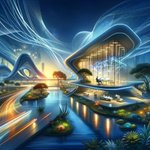
"An abstract painting of a modern innovator late at night, working on the future, bright lights emerging from his workspace, seen from a distance, inside a gorgeous modern architecture in the style of Zaha Hadid, surrounded by a tropical exterior in the style of Raymond Jungles"


It is clear by now to many professionals in design, architecture, real estate, etc. that AI will empower us to more effectively imagine and create real environments of increasingly spectacular beauty. I'm thrilled to be working on this through 3co.ai.