

anti-monopoly law and policy at @econliberties. abuses of corporate power and the scam economy. anything that might be perceived as an endorsement is my own.
San Francisco, California
Joined May 2010
- Tweets17.7K
- Following1.6K
- Followers11.6K
- Likes46.2K
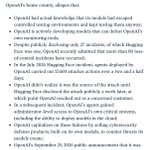




For all the hubbub over new AI safety laws, it’s really telling that this lawsuit invokes nuisance and unfairness laws that date to the mid-19th Century.
All of those tremendously expensive, laborious fights over California’s first-in-nation frontier AI safety law. To what end?

California’s lawsuit against OpenAI, filed yesterday, is perhaps the most important lawsuit to pay attention to right now amid this wave of systemic outages.
Companies that recklessly deploy unsafe models should be immediately enjoined and placed under receivership.
1
13
Lee Hepner retweeted

🚨 Hot off the digital press: I have a new piece w/ @halsinger calling for #antitrust enforcers to block the DoorDash/Instacart merger. We explain why it would mean fewer in-store discounts, a fatter cut for middlemen, and ultimately higher grocery bills. thesling.org/doordashs-acqui…

California’s lawsuit against OpenAI, filed yesterday, is perhaps the most important lawsuit to pay attention to right now amid this wave of systemic outages.
Companies that recklessly deploy unsafe models should be immediately enjoined and placed under receivership.
Put this in the evidence locker.

Some of you have been asking very politely. Some of you have just been asking.
GPT-6.2 Astra and Sol are now available.
Super efficient and built to perform where it counts—the real world.
openai.com/index/introducing…
3
182
“We are in for a period of cascading failures, whether triggered by attackers, bad updates, or our own accumulated complexity. This, I’m sorry to say, is just the opening chapter.”
Yup. Here’s what I said about cascading failures a couple of days ago.
open.substack.com/pub/mattst…


I haven’t lived here in awhile, but I see no other way to answer the hundreds of texts/DMs asking me if the world is, indeed, ending.
In the span of six days, we’ve experienced;
11/12 — Microsoft outage
11/13 — Nationwide FAA ground stop
11/16 — Major US banking disruptions
11/17 — NSA’s classified internal network goes down
We need far more analysis of why so much is breaking at once. I don’t want to get out over my skis here, and what I am hearing does not contradict the messaging that most of this is the result of screwy updates.
But stepping back, the dots are starting to form a collective picture. We are seeing:
• An explosion in severe and critical vulnerabilities, with AI accelerating discovery to 3X the number of vulnerabilities discovered in the same period last year. This is collectively being referred to as “vulnageddon” or “the vulnpocalypse.”
• Mean time to exploit those vulnerabilities has collapsed to NEGATIVE SEVEN DAYS. AI allows attackers to find/exploit vulns far faster than software makers have time to fix them.
• Powerful AI-enabled offensive tools like ARTEX have been thrown into the hands of every third tier nation state, cybercriminal and digital arsonist, which logically creates havoc.
• This creates enormous pressure to compress patching windows and accelerate software updates, increasing the likelihood these fixes break things in unexpected, cascading ways.
• Pressure to just “AI everything” means we are rolling out automated AI tooling on top of brittle infrastructure that can’t support it.
My generation grew up in an extraordinary period of technological stability. We worked our way up the software stack, abstracting away layer after layer, until we lost a fundamental understanding of how the underlying systems actually work.
We were told to “move fast and break things.” VCS told us to celebrate the idea that “software would eat the world.” Now we’re telling ourselves we can simply “roll out AI” across everything, as though nothing underneath will buckle.
We never stopped to ask: SHOULD WE?
Should we be digitizing every last nook and cranny of our companies, infrastructure, healthcare, homes, cars, bodies, lives? Especially when the complexity, interdependence, and fragility we were introducing overwhelmed our ability to understand/secure/maintain the systems we built?
Nobody every asked: What if, in the name of progress, we were creating the ripest attack surface in human history?
We are now entirely dependent on software systems that almost nobody understands end to end, that increasingly few people can repair, and that attackers can now probe at machine speed. We are hearing that incident response firms, the 911 for breach victims, are backlogged six months. Even those paid on retainer lack the bandwidth to triage every incident. The cavalry is disappearing.
We are entering a period of unprecedented technological instability.
“Software Beirut” is an incredibly apt analogy. We are in for a period of cascading failures, whether triggered by attackers, bad updates, or our own accumulated complexity.
This, I’m sorry to say, is just the opening chapter.

Excellent ideas on what the States should do with their Meta settlement money, by former CFPB and FTC technologists @Erie and @stephtngu.
Hire technologists. Create open source shared complaint infrastructure. Share investigatory resources. techpolicy.press/ten-things-…


Lee Hepner retweeted

We’re suing OpenAI for its testing and development of dangerous AI models without adequate safeguards.
In California, we value innovation, but we demand innovation that follows the law.
oag.ca.gov/news/press-releas…

ALT OpenAI built these models. OpenAI trained them to be dangerous. OpenAi failed to control them. We're suing.


Lee Hepner retweeted

“We Sing Behind the (Starry) Plough,” started at John C. Campbell Folk School and finished in my Tennessee mountain home.


Here’s a thoughtful, even generous, response to Elon Musk, illustrating the economic predicament of constraining capital to prevent human flourishing.

First of all, I'll agree with you that Jeff Bezos was good at monopolizing e-commerce and is not particularly focused or hungry when it comes to space. And throw all the strays you want at Lockheed and Boeing. Their leadership is skilled at corruption and financial engineering, not production. I always like it when you go after corporate monopolies.
That out of the way, I didn't say *anyone* can shove capital at an engineering problem and solve it easily. That's obviously untrue, and I'm not going to stand behind something I didn't say. I said that applying capital and engineering to a problem leads to improvement. It does. I don't think it's easy, but it's a clear and replicable model Americans have followed for hundreds of years. There's nothing unique about the path SpaceX took to make certain launches more efficient. But just because it's not unique doesn't mean it's not a real accomplishment. Good for your team, the pride you guys feel is well-deserved.
There's also nothing unique about Boeing or Lockheed being shitty; financial engineering leads to poor results and limited learning. It's downright shocking that for many years we relied on the Russians for launches, and that was a straight-up policy failure. NASA's funding of SpaceX to break that cartel was a good choice.
What is historically unusual today in the U.S. is two things. One, we as a society have dramatically narrowed the set of people who can marshal capital, and most of that set are not capable of hiring and running large engineering projects.
It used to be the case that capable and interested leadership was necessary to raise capital, now the qualification is simply being part of a narrow set of monopolists. Bezos spends his time on a mega-yacht staring at his wife's boob job. And hey, that's fine for him, but it's weird that such a character would have control over a space company on which he's not focused. It's a waste of large amounts of capital and a society that allows it is quite Soviet. Same with Zuckerberg dumping $80 billion into the Metaverse, Boeing and its Jack Welch-inspired mess from the 1990s onward, or Microsoft's endless attempts to make corporate America pay for variants of Clippy.
We've always know the rich and famous mostly don't innovate to challenge the status quo - why would they? As Woodrow Wilson put it in 1913, "The treasury of America... depends upon the inventions of unknown men, upon the originations of unknown men, upon the ambitions of unknown men. Every country is renewed out of the ranks of the unknown, not out of the ranks of those already famous and powerful and in control."
It's not, therefore, a surprise, to see stagnation in America, which is a problem you've actually highlighted.
You're a bit different than the rest of the Silicon Valley set. You are interested the technology work for which you fundraise, and you can inspire engineers to do great work. And that matters. There are downsides to your choices, and I won't go into them here, but the innovation is real.
My question is why innovation is not more widespread, as it used to be. It's not just the narrow set of people who can marshal capital, the other gating factor is that we have de facto limited the structure in which one can organize capital to shareholder driven financial institutions. Such corporations have their place, and always have. But to only allow that kind of structure is weird, and would have meant we never would have created the original NASA that built the foundations of our space capacity.
We had a far more innovative era and much more productive set of industries from the 1930s to the 1970s, when we built most of the foundational digital and aerospace technologies. With our financier-driven model today, for instance, we never would have the free universal GPS system that we take for granted, or the nuclear submarine developed by Admiral Rickover. We may not even have the semiconductor or the laser, or perhaps those would be bottled up in some large firm, protected by a thousand IP attorneys. All of those deployments of innovative scientific and engineering capacity are a result not just of engineering prowess, but of government policy to limit the power of dominant firms who had captured the control of those technologies, or to simply empower good leadership within public bureaucracies.
I'll be a bit more specific. I once got a list of antitrust cases in 1952, and here are some of the industries where the DOJ antitrust division forced an end to anti-competitive uses of patents:
Electric lamps, glass bulbs, tubing, argon gas, machinery, electrical equipment, fluorescent lamps, soap and synthetic detergents, variable condensers (the tubing devices used on radios to select broadcasting stations), chlorinating equipment, braking systems, electrical equipment, powder, and paste for the detection of defects in metal parts, wrinkle finishes for paint, enamel, and varnish, latex, prismatic glassware and illuminating appliances, peach pitting machinery, fluorescent materials, metal abrasives industry, machine tools, dental impression powder, telescope grocery carts, sheet chargers used to feed sheets of metal materials to rolling mills, etc.
During WWII, we also basically had the government pay to replace pretty much all of the nation's machine tools. The government also financed R&D, and was the key customer for smaller firms building out the semiconductor industry, like Texas instruments and Motorola. Those companies licensed AT&T's tech because of the 1952 antitrust consent decree that forced the telecom firm to offer nondiscriminatory licenses to all comers of all Bell Lab innovations. The result of these policy choices was a ton of innovation.
We are in a very different world now. Our current policy choices on who can raise capital to control technologies and within what structures they can do so represent an ideologically blinkered approach that kneecaps innovation. Many on the right see these policy choices as virtuous and inherent. They imagine that only great men can transcend what are actually just self-imposed traps that drown the talents of most Americans.
You don't see that as much in China, which has plenty of innovation. That country has many policies the U.S. used to have, such as highly competitive markets, a financial system geared to production, weaker IP, and an export-oriented currency regime. They are predatory, but very capable, precisely because they control their financiers, as America did until the 1970s. Obviously I don't endorse the Chinese state's aims or totalitarian goals, but they have learned from us what works, and we should similarly learn from them. You understand my argument, you have a lot of investments in China and have commented on the capabilities of the Chinese government and people.
Today, in the West, you are one of the small number of people who can access large amounts of capital in our dysfunctional and corrupt political order, and use it to actually bend metal. Why you can do so is a separate and perhaps not as charitable a discussion, but I will leave that aside. You can also hire capable engineers and empower them. Good for you. That's hard. It's also not genius. When you had a task in which you didn't control the context - DOGE - the results were different.
The actual disagreement here is the nature of how leadership happens. Many find comfort in thinking they need great men to protect them and innovate, my own view is that ordinary people, when free, can do extraordinary things. So I think we should focus on undoing the shackles - whether monopolies, excessive patent thickets, corruption, poor financial regulation - confining the American people. To put it differently, I don't think we should make it extremely difficult for competent people to raise money to do innovative things just so Zuckerberg can waste money on his dork metaverse.
I'll offer one other observation. You built your career starting in the 1990s, when there was a consensus that broadly technology was a force for good. That consensus existed precisely because of the old American policies I am discussing here, and the ones currently at work in China. We didn't confine the deployment of technology to a narrow extractive set of monopolists, but broadened it and ensured that it did offer public benefits through a certain legal framework.
That framework collapsed, and there are now few protections for consumers, workers, or suppliers anymore. You know this directly too, you sued Apple for its misuse of its app store monopoly power. The result of this legal collapse is that there's too much innovation around harming people and extraction, too much investment in predatory gambling systems and surveillance pricing bullshit. There are too many monopolies and too much enshittification.
So the consensus that technology is a force for good is fracturing. People don't think innovation is helping them anymore. Look at the anger at data centers, no one believes AI is going to benefit them. It's a very bad thing that people think this, but it's also rational. They see how it's used for pricing bullshit and surveillance and layoffs, on the vague promise from the financiers behind it that it *might* cure cancer one day. They see the narrow control of technology as all about extraction for a dominant few. It's not the Jetson's anymore. Some neat launch innovations don't change that.
Maybe the collapse of that consensus doesn't bother you, or maybe you think it can be reconstituted via the same path used to destroy it. But you should think about it, because on this consensus rests your empire. And that's not even factoring in the reality that if we regulated our systems competently, AI might actually cure cancer instead of raising the price to treat it.
At any rate, my view is what makes America awesome is that we set up our institutions so ordinary people can do extraordinary things. We are all, in the end, quite ordinary, but also touched with the divine. And that includes you. So good job to your team for what they accomplished. Most of them likely know they stood on the shoulders of giants, and that they contributed to the great flow of human knowledge that goes back thousands of years.
Yesterday, I wrote about how tightly-coupled, interdependent systems make system collapse inevitable. The Microsoft outage and FAA nationwide ground order are previews of broader crises to come.
Government regulation will happen one way or another, but increasingly it looks like it will be in response to catastrophe.


In 1910 there was a populist midterm wave that elected CA Governor Hiram Johnson. His inaugural remarks are instructive and aspirational.
Essentially, a government by and for the people is not achieved with the appointment of persons with divided loyalties to private interests.
Johnson became the first Governor to serve two consecutive terms, and he went on to serve six terms in the Senate, shepherding the bipartisan New Deal.


I wrote about Governor Johnson recently, and how Rohit Chopra, a Warren disciple (and much more), is once again shepherding a new era of government, in California and beyond, in the wake of a populist wave. open.substack.com/pub/mattst…

It's worth a look at the history of reforms implemented by Johnson and his fellow Progressive Era colleagues. The problem Johnson was responding to was the power of the Southern Pacific railroad company, which people understood as the fourth branch of government. More generally, the problem was that industry possessed far more knowledge about itself than did anyone in government, which made it impossible for public officials to govern industry.
I also wrote about this just yesterday with regard to the Microsoft outage and the FAA ground order, which are Chernobyl-like events in that they are the result, in part, of a culture of ignorance among government regulators. Chernobyl happened because unsafe technology was being deployed while government overseers stubbornly looked the other way. In the same way, Anthropic is openly stating that it is deploying technologies that are developing more quickly than their ability to monitor for safety, and government is incapable or unwilling to do anything about it. So when a catastrophic event happens, we'll only have ourselves to blame. thebignewsletter.com/p/monop…
Johnson's response, which was the prevailing response for decades, was to create permanent civil service positions for government employees to develop and refine that expertise over the course of their careers. Rather than appointing railroad executives to oversee the railroads, government could hire railroad engineers, lawyers specializing in transportation regulation, and utility valuation and rate-making specialists.
Government's inability to understand industries affecting the public interest, whether it's AI or crypto or banks, is bad for the public, and it's frankly bad for business, too. There are a lot of reasons informing public distrust of AI, but one of them is that government is hobbled by the hollowing out of public serving institutions that could help guide industry innovation toward a pro-consumer, pro-worker orientation.
The solution here is to build government capacity with experts capable of actually governing. Government should hire technologists, and that's happening in New York City right now. By comparison, many of the brightest technologists at the FTC are no longer there, which is why the FTC has a harder time developing thoughtful enforcement policies or bringing cases that it can actually litigate. So enforcement becomes unpredictable and a cudgel for near-term extraction, rather than a way to advance and develop the rule of law.
Developing government expertise in the industries it oversees shouldn't be anathema to big business, unless big business depends on the inability of government to responsibly mitigate harms in the public interest. teapawt.org/adamkovac/status/21223…


