
ML Researcher @DEShawResearch. Former PhD student @FU_Berlin, Visiting Researcher @MSFTResearch, and ML Intern @DEShawResearch.
Joined January 2021
- Tweets142
- Following312
- Followers646
- Likes1.8K





Pinned Tweet
(1/n) Can diffusion models simulate molecular dynamics instead of generating independent samples?
In our NeurIPS2025 paper, we train energy-based diffusion models that can do both:
- Generate independent samples
- Learn the underlying potential 𝑼
🧵👇
arxiv.org/abs/2506.17139
Leon Klein retweeted

Ever get tired of tiny timesteps bottlenecking your MD simulations?
We show how to train a model for large-timestep Hamiltonian dynamics directly on standard MLFF datasets. 𝗡𝗼 𝗿𝗲𝗳𝗲𝗿𝗲𝗻𝗰𝗲 𝘁𝗿𝗮𝗷𝗲𝗰𝘁𝗼𝗿𝗶𝗲𝘀, 𝗻𝗼 𝘂𝗻𝗿𝗼𝗹𝗹𝗶𝗻𝗴, 𝗻𝗼 𝘁𝗲𝗮𝗰𝗵𝗲𝗿 needed!🧵👇
Leon Klein retweeted

Excited to share our latest preprint: 𝗟𝗲𝗮𝗿𝗻𝗶𝗻𝗴 𝗛𝗮𝗺𝗶𝗹𝘁𝗼𝗻𝗶𝗮𝗻 𝗙𝗹𝗼𝘄 𝗠𝗮𝗽𝘀: 𝗠𝗲𝗮𝗻 𝗙𝗹𝗼𝘄 𝗖𝗼𝗻𝘀𝗶𝘀𝘁𝗲𝗻𝗰𝘆 𝗳𝗼𝗿 𝗟𝗮𝗿𝗴𝗲-𝗧𝗶𝗺𝗲𝘀𝘁𝗲𝗽 𝗠𝗼𝗹𝗲𝗰𝘂𝗹𝗮𝗿 𝗗𝘆𝗻𝗮𝗺𝗶𝗰𝘀 🎉

Leon Klein retweeted

I'm excited to open the new year by sharing a new perspective paper
I give a informal outline of MD and how it can interact with Generative AI. Then, how far the field has come since the seminal contributions, such as Boltzmann Generators, and what is still missing

Leon Klein retweeted

How can ML assist sampling from equilibrium distributions?
On the coming Tuesday (Nov 25th), 4pm-5pm UK time, we will have Leon Klein @leonklein26 to talk about “Efficient Generation of Molecular Boltzmann Distributions with Normalizing Flows” 🔥
Zoom link and more info 👇
Leon Klein retweeted
Fantastic work by Michael Plainer and friends. Energy-based diffusion models to ensure that the denoising distribution equals exp(-u(x)), with the energy u(x). A keystone for connecting molecular dynamics, statistical mechanics and generative AI.

(1/n) Can diffusion models simulate molecular dynamics instead of generating independent samples?
In our NeurIPS2025 paper, we train energy-based diffusion models that can do both:
- Generate independent samples
- Learn the underlying potential 𝑼
🧵👇
arxiv.org/abs/2506.17139
(6/n) With this, we can run coarse-grained Langevin dynamics directly, without the need for any priors or force labels.
This works across biomolecular systems including fast-folding proteins like Chignolin and BBA.
Here is a comparison with and without our regularization:

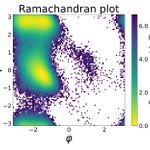
ALT Comparison of equilibrium distributions obtained by iid sampling and Langevin simulation (sim) across different systems and methods. While classical iid sampling recovers the reference equilibrium distribution, performing simulation with the learned score reveals inconsistencies when models are not trained with Fokker-Planck regularization, i.e., p(x) != p_0(x). Regularized models achieve consistent behavior across systems.
(7/n) Check out our paper and code:
Paper: arxiv.org/abs/2506.17139
Code + models: github.com/noegroup/ScoreMD
And also, our self-contained notebooks!
Colab (JAX):
colab.research.google.com/dr…
Colab (PyTorch):
colab.research.google.com/dr…

Leon Klein retweeted
After a 4-year journey, we are super happy to see this paper out in @NatureComms - @ElezKatarina et al: High-throughput molecular dynamics + active @machinelearning enable efficient identification of an experimentally-validated broad coronavirus inhibitor.
nature.com/articles/s41467-0…

Leon Klein retweeted

Really excited to (finally) share the updated JAMUN preprint and codebase! We perform Langevin molecular dynamics in a smoothed space which allows us to take larger integrator steps. This requires learning a score function only at a single noise level, unlike diffusion models.
Leon Klein retweeted

Our development of machine-learned transferable coarse-grained models in now on Nat Chem! doi.org/10.1038/s41557-025-0…
I am so proud of my group for this work! Particularly first authors Nick Charron, Klara Bonneau, @sayeg84, Andrea Guljas.

Leon Klein retweeted

Come check out SBG happening now! W-115 11-1:30 with
@charliebtan
@bose_joey
Chen Lin
@leonklein26
@mmbronstein

Leon Klein retweeted

Main Conference:
📜 Title: Scalable Equilibrium Sampling with Sequential Boltzmann Generators
🕐 When: Wed 16 Jul 11 a.m. PDT — 1:30 p.m. PDT
🗺️ Where: West Exhibition Hall B2-B3 W-115
🔗 arXiv: arxiv.org/abs/2502.18462
w/ @charliebtan @WillLin1028 @leonklein26 @mmbronstein @AlexanderTong7

Leon Klein retweeted
🎉Personal update: I'm thrilled to announce that I'm joining Imperial College London @imperialcollege as an Assistant Professor of Computing @ICComputing starting January 2026.
My future lab and I will continue to work on building better Generative Models 🤖, the hardest AI4Science applications in computational biology 🧬and chemistry 🧪, and also a sprinkling of Deep Learning theory 📚 that supports these goals.
