

CRM that builds a world model of your business.
San Francisco, CA
Joined May 2021
- Tweets1.3K
- Following876
- Followers28K
- Likes3.4K








Pinned Tweet
We’ve raised $47M in Series A funding led by @a16z to reimagine CRM as a world model of a business.

Today we're announcing @lightfld's $47M Series A led by @a16z to reimagine CRM as a world model of a business.
For agents to do customer-facing work, they need to understand how your business actually works.
Salesforce wasn't designed for this. It was built 20+ years ago for humans to update records. Layer agentic processes on top and you get low quality output, because the underlying data is incomplete and lacks the structure agents need.
@lightfld updates itself from every interaction, forming a trustworthy model of your business for people and agents. Since launching last November, 5,000+ companies have signed up - and we're ripping out legacy CRM at mature organizations with hundreds of users.
Companies on Lightfield grow faster than their competitors. It finds prospects that look like your best customers and books meetings with them. It captures commitments from every conversation and automates follow-ups. It diagnoses weaknesses in your funnel and learns from your best sellers to codify what works.
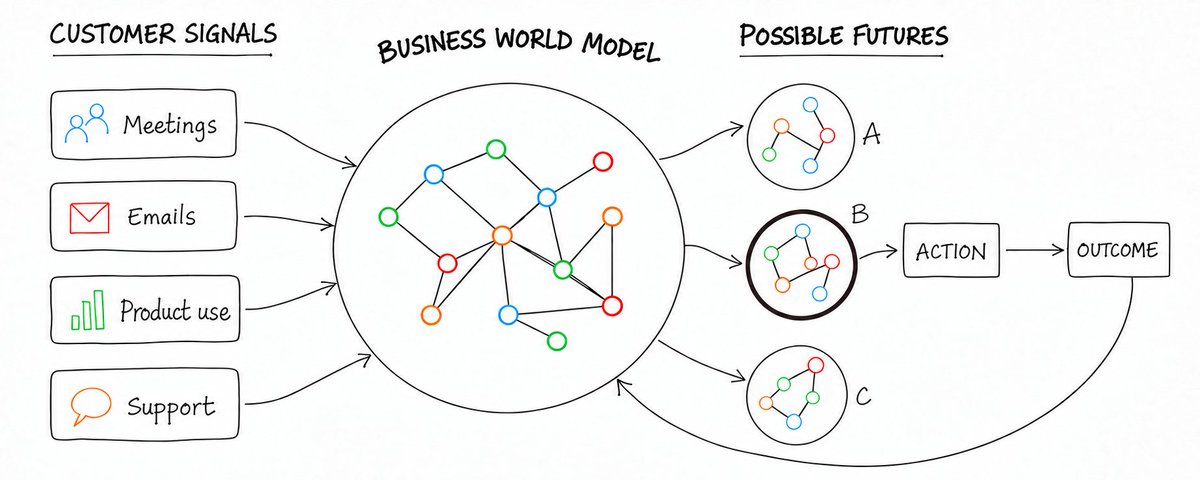
The companies of the future will run on a business world model, not a Salesforce-era database. Our mission is to put that capability in the hands of every employee, and every agent, at every company.
Lightfield's plugin for @ChatGPT and Codex is now live.
Ask any question about your company or customers, and get answers grounded in a world model of your business.
Install it in ChatGPT: chatgpt.com/plugins/plugin_a…

Lightfield now supports native integration with @meetgranola.
Connect your personal or team account to have transcripts and enhanced notes automatically added to meeting records.

Lightfield's Chief AI Officer @vesko_st tested whether an agent can build and maintain the classifiers to do its repetitive work, with Claude Opus writing the classifiers and TypeSafe's Jev running them.
When given the same training data, agent-built classifiers matched or beat a conventionally fine-tuned model on all six tasks we tested.
Read our latest research to see how agents can hand off repetitive ‘system one’ judgments to classifier models, and how we’re bringing this into Lightfield.


Last night we hosted 50 founders and go-to-market leaders at the Exploratorium for a conversation between @joeschmidtiv and @keithpeiris on how to choose the right sales strategy for your company: "Lighthouse" (win a few marquee customers first) or "Landgrab" (close as many logos as fast as possible).
#SFTechWeek


Inc. covered how GTM agent failures trace back to the CRM, and how Lightfield is reimagining CRM as a business world model.
inc.com/hillary-remy/crm-tec…

Lightfield retweeted

Win marquee customers or race to capture the market? It depends.
Join me and @joeschmidtiv (@a16z) to talk about sales and early GTM strategy.
Oct 6 · 6:30pm · Exploratorium #SFTechWeek
Details + “Lighthouse or Landgrab” essay below.
Lightfield retweeted

Thanks @linear . We utilized some of these techniques at @lightfld and are seeing PR's clear CI 36% faster 🚀. All still on GitHub actions without changing out the runners yet.


Agents were shipping code faster than our CI pipeline could keep up.
Our team optimized our pipeline, leading to a roughly 15% faster test suite and 50% reduction in runner-time spent per test, all while our test suite grew 4x in size.
@moofeez explains how:
linear.app/now/ci-bottleneck…

Lightfield's Chief AI Officer @vesko_st benchmarked TypeSafe's Jev model on text understanding, including customer-conversation tasks.
With extended thinking turned off, Jev matched Opus 5 on accuracy at 40 to 150 times lower cost.
Full write-up, including initial thinking on how we'll be using Jev in our own platform:
lightfield.app/blog/testing-…


Lightfield retweeted

Everyone has been impressed by TypeSafe AI’s Jev — I wanted to see for myself how good it is — and how useful it could be for a product like @lightfld.
I started with text understanding, because it is the foundation of everything a decision model does: it has to understand the input, and it has to understand and follow the instructions you give it.
The short takeaway: TypeSafe's tiny "Jev" classifier is surprisingly good — roughly on the level of Claude Sonnet on classification tasks, while being a couple of orders of magnitude cheaper to run.
I looked at two kinds of work. First, general text understanding: three widely used reading-comprehension and commonsense benchmarks, where Jev performed on par with Opus. Because those may well sit in Jev's training data, I also hand-authored a fresh benchmark over a single random Wikipedia article — every wrong option drawn from the text, so nothing could be memorized. There, Jev landed alongside Sonnet and Opus (it tops CommonsenseQA and MMLU-CF, ties Opus on RACE-H, and is ~150× cheaper and ~10× faster on long-context questions).
Then I tried tasks closer to sales and customer relationships. There aren't many good public benchmarks, so I dug up older customer-service and negotiation datasets. On those, Jev is a bit better than Claude Haiku and slightly below Sonnet 5. Big caveat: none of these come from real B2B sales, so the findings are directional rather than a description of what we actually do at @lightfld .
Overall, the results look good enough that I think small, inexpensive classification models like Jev will have real uses, including in our own product.
Link to the full write-up below.
Verdigris left Salesforce after a decade to build an AI-native GTM on Lightfield.
The team migrated nearly 10,000 contacts, a 211-field custom implementation object, and all of the workflows that make their company run.
Today, Lightfield scores every open deal against Verdigris’s MEDDPICC methodology, automates processes across sales and implementation, and gives the entire company access to the same customer context.
Read how Verdigris rebuilt its GTM system on Lightfield.
lightfield.app/customers/ver…

Lightfield retweeted

Fun episode with Keith on all things Lightfield and their business world model. While the product they built is impressive on its own, it's even more so given they hard pivoted their way here.
The transformation story is riveting and their product is world class. Give the episode a listen and check out their product at lightfield.app


Lightfield co-founder and CEO Keith Peiris on killing a product with two million monthly users and rebuilding the CRM from scratch:
Lightfield's predecessor was an AI presentation tool growing faster than the team could buy inference to support it. Keith shut it down anyway. Nobody on the team liked the product.
Keith decided he wanted to attack the CRM space, a vertical that's notoriously hard to break into. A company's record of its customers is scattered across a whole stack of systems that often contradict each other.
His bet is reconciling them into one coherent source of truth, what Lightfield calls a business world model. Every agent a team might run sits downstream of it.
In this conversation with a16z's Alex Rampell and Joe Schmidt: the office space they traded for their first 10 customers, why a CRM ended up modeled on the Facebook timeline, three attempts at pricing before one worked, and why nobody at a 40-person company has a fixed role.
00:00 Intro
01:24 Why 2 million users wasn't enough
03:36 Why better models wouldn't have fixed it
06:41 Reconciling the data was the real product
08:16 How free rent bought their first 10 customers
10:12 A CRM does 3 jobs and only 1 matters
11:42 Autopilot CRM nobody has to update
14:56 No more rigid data models
17:11 How one customer modeled a whole marketplace
18:48 Taking customers from an incumbent
23:49 How to survive a new head of sales
26:03 Why the CEO still uses a spreadsheet view
30:55 Pricing models that failed before one worked
36:23 Fixed roles make product pivots impossible
40:02 Why slow shipping loses CRM customers
43:17 What Silicon Valley customers are actually worth
46:20 Why buyers need a reference who looks like them
50:40 What to ignore during a pivot
YouTube: youtube.com/watch?v=K5yGLO8c…
@keithpeiris @lightfld @arampell @joeschmidtiv

Lightfield retweeted

Lightfield co-founder and CEO Keith Peiris on killing a product with two million monthly users and rebuilding the CRM from scratch:
Lightfield's predecessor was an AI presentation tool growing faster than the team could buy inference to support it. Keith shut it down anyway. Nobody on the team liked the product.
Keith decided he wanted to attack the CRM space, a vertical that's notoriously hard to break into. A company's record of its customers is scattered across a whole stack of systems that often contradict each other.
His bet is reconciling them into one coherent source of truth, what Lightfield calls a business world model. Every agent a team might run sits downstream of it.
In this conversation with a16z's Alex Rampell and Joe Schmidt: the office space they traded for their first 10 customers, why a CRM ended up modeled on the Facebook timeline, three attempts at pricing before one worked, and why nobody at a 40-person company has a fixed role.
00:00 Intro
01:24 Why 2 million users wasn't enough
03:36 Why better models wouldn't have fixed it
06:41 Reconciling the data was the real product
08:16 How free rent bought their first 10 customers
10:12 A CRM does 3 jobs and only 1 matters
11:42 Autopilot CRM nobody has to update
14:56 No more rigid data models
17:11 How one customer modeled a whole marketplace
18:48 Taking customers from an incumbent
23:49 How to survive a new head of sales
26:03 Why the CEO still uses a spreadsheet view
30:55 Pricing models that failed before one worked
36:23 Fixed roles make product pivots impossible
40:02 Why slow shipping loses CRM customers
43:17 What Silicon Valley customers are actually worth
46:20 Why buyers need a reference who looks like them
50:40 What to ignore during a pivot
YouTube: youtube.com/watch?v=K5yGLO8c…
@keithpeiris @lightfld @arampell @joeschmidtiv
Lightfield retweeted

I try a lot of tools. Most don't survive a week.
@lightfld did.
I get a brutal volume of email. If I don't reply within ~10 minutes, it's gone.
Lightfield lets me query my entire inbox like an assistant and turns it into a to-do list I actually work from.
The morning suggested tasks alone have caught things I would've dropped.
I've run it in parallel with other tools and even head-to-head with CoWork; Lightfield does a better job.
If your inbox runs your day, worth a look.

In case you missed it, last week we announced our $47M Series A, led by @a16z.
Read the full story, as covered in @UpstartsMediaCo.
upstartsmedia.com/p/ai-sales…

Yesterday we announced our $47M Series A to reimagine CRM as a business world model. This article from co-founder @hliriani explains what that means and what we’re building next.

