

Ex-science editor sharing daily discoveries, innovations, space and tech news, and mind-blowing facts! #ScienceNews, #Science facts and more!
Toronto, Ontario
Joined April 2017
- Tweets9.9K
- Following7.3K
- Followers7.5K
- Likes39.2K


A kangaroo can't walk backwards. Its spring-loaded legs and heavy tail only work in one direction — and when it walks slowly, that tail becomes a fifth leg, pushing with as much force as its front and hind legs combined.
1
35
LiveScience.Tech retweeted

Astronomers have traced the remarkable merger of a pair of mismatched stars unfolding over just a decade. The finding offers clues to why some pairs of stars combine while others stay separate.
sciencenews.org/article/star…

The 'Jesus Christ lizard' really does run on water. A basilisk sprints upright on its hind legs, each foot slapping the surface so fast it traps a pocket of air — enough to carry it about 15 feet across a river before it sinks and swims.

16
Squeeze it and it turns solid in your fist. Let go and it pours through your fingers like honey. Oobleck — just cornstarch and water — is a non-Newtonian fluid: hit it and it fights back, but stand still in a pool of it and you slowly sink.

1
17
Nature built its own pavement. Northern Ireland's Giant's Causeway is ~40,000 interlocking basalt columns, formed ~60 million years ago when lava cooled and cracked into near-perfect hexagons — a stone staircase disappearing into the sea.

1
27
LiveScience.Tech retweeted

Astronomers spot ancient asteroid pair tagging behind Neptune
Read more here: live-science.visitlink.me/oC…

Koalas have fingerprints so human-like that even under a microscope, experts struggle to tell them apart. Each koala's print is unique — and they evolved them completely separately from us, a case of convergent evolution in a marsupial.
29
There's a planet where it rains molten glass — sideways. On HD 189733b, silicate clouds condense into glass shards, then 8,700 km/h winds whip them horizontal. That same glass haze is what makes the planet look deep blue. (Artist's concept: NASA/ESA Hubble)

24
Mars hides the tallest volcano in the solar system. Olympus Mons stands ~22 km high — nearly two and a half Everests — and spans ~600 km, about the size of France. Its slopes average just 5°, so gentle you'd barely feel the climb.

1
17
LiveScience.Tech retweeted
Biologist Gonzalo Quiroga-Artigas lifts the lid on the secret life of tardigrades in stunning detail for the Nikon Small World photography awards.
Read more here: live-science.visitlink.me/Y2…

Sunflowers don't just face the sun — they chase it. Young blooms track it east to west all day, then swing back overnight, steered by one side of the stem growing faster than the other. Once they bloom, they stop — and face east for good. (Timelapse: Britannica)
This lake turns animals to stone. Lake Natron in Tanzania hits pH 10.5 — as caustic as oven cleaner — and its minerals calcify anything that dies in it. Yet 2.5 million flamingos breed here: the poison keeps predators away.

1
29
LiveScience.Tech retweeted

A ladybird beetle spreading its wings captured with a high-speed camera. In real-time wing deployment from the fully folded state takes less than 0.1 seconds.
📽: University of Tokyo / Saito et al.
The potato-sized rocks on the deep seafloor that miners want for nickel and cobalt? They're alive. A new census found 4,139 tiny animals inside 244 nodules — roundworms, copepods, worms under a millimetre long. A nodule takes millions of years to grow.
42
A chameleon doesn't change colour to hide — it changes to talk. Tiny guanine crystals in its skin shift spacing to reflect different light, flipping green to yellow or red. Mood, rivals, temperature — all written on its skin. (Video: Pressmaster/Pexels)
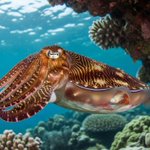
Cuttlefish can pass the marshmallow test. In a 2021 study, all six cuttlefish waited up to two minutes for their favorite snack — a live shrimp — instead of grabbing the prawn in front of them. Self-control on par with chimps. From an animal with three hearts.

1
33
LiveScience.Tech retweeted
🔭 It's a big week for skywatchers!
Look for the Leonids meteor shower Nov. 17-18 after the Moon sets, and keep an eye out for Mars and Jupiter shining close together. ✨
Also on Nov. 17, celebrate Voyager 1 traveling one light-day from Earth with us: nasa.gov/voyager

The Great Wall of China is partly held together by sticky rice. Ming-dynasty builders mixed rice soup into lime mortar — the starch made it denser, more water-resistant, and it keeps getting stronger with age. Centuries on, it's still holding.
42
Dolphins herd sardines into a spinning 'bait ball' — a living sphere 10–20 metres wide that lasts under 10 minutes. Then sharks, gannets and whales pile in. At its biggest, the sardine run is the largest biomass migration on Earth. (Video: Zlatin Georgiev / Pexels)
29
LiveScience.Tech retweeted

Love you Zack! Please help college students get REALLY CHEAP textbooks!
Request ANY textbook in PDF from TextbooksForLife (T4L) at: textbooks.dad
Yeah, any :)
