

Building LutraID - the gateway to Europe’s digital identity infrastructure. EUDIW · eIDAS 2.0 · EU Business Wallet Deep-tech R&D studio based in Slovenia.
Maribor, Slovenia
Joined February 2024
- Tweets198
- Following36
- Followers91
- Likes126







Pinned Tweet
We’ve updated our first blog post with the latest information on LutraID - your gateway to Europe’s digital identity infrastructure – to better align with the evolving vision as we get closer to key milestones and after many developments in the last 6 months. Read it here: id.lutralabs.io/blog/lutraid…


🪪 Introducing LutraID — the EU Business Wallet
Imagine a world where paperwork disappears, documents move instantly, and business workflows run automatically across Europe. We’re building exactly that.
id.lutralabs.io/

1
1
87
Did you know the @EUdigitalID is much more than an app on your phone? 📱
Behind every login, digital credential and signature stands a whole network: trust service providers, certificate authorities, relying parties (verifiers), supervisors and attestation providers (issuers).
In our new blog post, we explain who provides the wallet, who issues the data in it and who relies on that data. We also look at how registrars, access certificates and trusted lists keep the system trustworthy, and who supervises it all.
If your company will issue or verify credentials, this is a good place to start!
👉 Read the full post: id.lutralabs.io/blog/who-s-w…

How will the @EUdigitalID change digital customer journeys? 🤔
Let’s look at one concrete example: taking out car insurance fully online. 🚗
Identification → Document check → Signing
All with one wallet.
✅ Identification: the customer logs in with their EUDI wallet, with no passwords or manual data entry
✅ Document check: their driving licence and vehicle data are shared from the wallet and verified instantly
✅ Signing: the policy is signed with a qualified electronic signature (QES), which carries the same legal weight as a handwritten signature
The customer never has to visit a branch, send photos of documents or print anything.
LutraID supports all three steps through a single integration.
🎥 Watch the full video below 👇
youtube.com/watch?v=pN27ZDP6…
1
29
We're giving the LutraID platform a fresh look ✨
With @EUdigitalID rollouts just around the corner, we're reworking the platform's design and user experience: clearer flows, a cleaner interface and a smoother experience for everyone integrating EUDI wallets.
Here's a sneak peek of what's coming. More soon! 👀


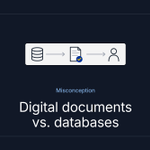
Misconception: digital documents will replace databases.
They won’t. And that’s fine.
A digital document (your ID, diploma, bank KYC, employee certificate, membership…) isn’t a replacement for a database. The registers stay where they are, with the organisations that hold and manage the data, whether that’s a public register, a university, a bank or a company. What’s new is that, alongside the register, there is now also a signed, verifiable copy of that data that the user holds and can share themselves.
So what actually changes?
- Verified data travels with the person. Users can share trusted data directly with whoever needs it, without scans, photocopies or manual checks. Often it’s only the attribute that’s needed, like “over 18,” instead of the whole document.
- Fewer doors into sensitive systems. The receiving party checks the issuer’s cryptographic signature instead of querying the source database. Fewer integrations and fewer parties with direct access means a smaller attack surface.
- The issuer doesn’t see where you use it. Issuance and use are decoupled by design. The organisation that issued your document isn’t notified when or where you present it.
Digital documents don’t replace the databases behind them. They change how trusted data moves on top of them: closer to the user, with less exposure and more privacy.
@EUdigitalID

🔞 Prove your age without handing over your ID.
With EUDI wallets, users share just one verified fact: “over 18: yes.” There are no ID scans and no birthdate, so users keep their privacy and businesses have less sensitive data to protect. With LutraID, you can set up your own age verifier in a few clicks.
Watch how it works 👇
youtu.be/uYFaER9ERbo
2
50
Tech demo time! 💻
In this demo we show how a company can use LutraID to ask a customer to sign a PDF with a qualified electronic signature (QES). The customer signs it on their phone with their @EUdigitalID.
It's a smooth experience from start to finish:
✅ No printing or scanning documents
✅ A simple interface
✅ You can sign anywhere, because you always have your phone with you
Check it out 👇
youtu.be/VzCStkuSYk8
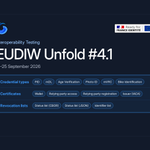
Another EUDIW Unfold (@france_identite) testing week completed: #4.1 Interop Week 🇪🇺
We tested our issuer, verifier and wallet: mdoc and SD-JWT VC issuance, plus OpenID4VP 1.0 + HAIP presentation.
42 test executions · 20 external solutions · 11 countries · 35 passed ✅
Full write-up: id.lutralabs.io/blog/another…
@EUdigitalID

Back for round two 🛠️
This week (21–25 September), LutraID is taking part in @EUdigitalID Unfold #4.1 Interop Week, our second interoperability testing week in the France Identité (@france_identite) ecosystem.
In June, we joined our first Interop Week and tested LutraID with 9 different wallet providers, focusing on age verification and PID, primarily across remote issuance and verification flows. The results were very positive, and the feedback went straight back into improving the product.
This time, we're returning as both an issuer and a verifier, running practical tests with wallet providers, issuers, verifiers and relying parties from across Europe. Testing is being expanded to additional credential types, including Photo ID, mVRC and bike identification, with a stronger focus on the trust layer: how wallet and relying party certificates and revocation lists are handled and validated across different implementations.
Why does this matter? EUDI Wallets are due in every Member State by the end of 2026, and banks, insurers and other regulated services will be required to accept them within the next year. As the specifications are being finalised, interoperability between solutions has to be tested again and again.
Thanks to France Identité and the EUDIW Unfold team for bringing the ecosystem together once again and helping move digital identity forward across the whole EU 👏
🔗 id.lutralabs.io

There is another core functionality of EUDI Wallets we haven’t spent much time talking about yet - qualified electronic signatures. 📝
EUDI Wallets (@EUdigitalID) are not only about credentials. Besides storing and presenting PID and other digital documents, EUDI Wallets will also enable natural persons to create qualified electronic signatures (QES). Under eIDAS, a QES has the equivalent legal effect of a handwritten signature across the EU.
Creating a QES requires a qualified certificate and a Qualified Electronic Signature Creation Device (QSCD). Today, the experience varies considerably - from smart cards and dedicated USB signing devices to existing remote signing services.
EUDI Wallets aim to make this much simpler. A wallet can work with a QSCD that is available locally, for example through a smart card or dedicated signing device, or with a remotely managed QSCD. In the remote model, often referred to as a Remote Qualified Electronic Signature (RQES) setup, a Qualified Trust Service Provider (QTSP) manages the signing infrastructure, while the wallet becomes the interface through which the user reviews and authorizes the signature.
The experience can be as simple as opening a document, reviewing what you are signing, and approving the operation with a PIN or biometrics. And there is an important requirement in eIDAS 2.0: natural persons must be offered the ability to create qualified electronic signatures by default and free of charge.
The framework is also designed to support interoperability between wallets and different qualified trust service providers, rather than tying users to a single national signing solution. 🇪🇺
🤖 Made with AI

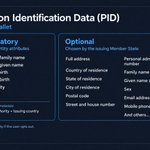
Person Identification Data (PID) is the @EUdigitalID core identity credential. It has a special legal status that other wallet documents do not: a driving licence, diploma, or similar credential is an Electronic Attestation of Attributes (EAA), while PID is the identity layer the wallet itself depends on.
It is defined in eIDAS 2.0 (Regulation (EU) 2024/1183) and specified in CIR (EU) 2024/2977. Every PID is issued in two formats at once - ISO/IEC 18013-5 mdoc (CBOR) for proximity use over NFC, BLE, or QR, and SD-JWT VC (JSON) for remote or online use.
A PID always contains the current family name, given name, date of birth, place of birth, nationality, and a portrait, plus issuing metadata such as authority and country. Portrait is the special case: it is a mandatory attribute in the PID Rulebook, but the user can opt out if they want, in which case the attribute is included empty.
Member States may also add optional attributes: full address, country, state, city, postal code, and street of residence, a personal administrative number, family name and given name at birth, sex, email address, and mobile phone number. They can also add national-only attributes in a domestic namespace.
“Optional” does not mean the user is free to leave those fields out of the credential. It means each country decides which extra attributes it actually issues - Slovenia, Germany, and Italy will not ship the same set.
That is fine for national services. For cross-border use, companies have to plan for it. You can always expect the mandatory attributes. You cannot assume address, national ID number, or a usable portrait. If your customers come from more than one country and you need more than the mandatory PID, check what the issuing country puts in the credential.
Users still share only what they approve. Presence in the PID and disclosure by the user are not the same thing.
🤖 Made with AI

From theory to practice: access and registration certificates from the official EUDI Wallet (@EUdigitalID) test infrastructure are now live on LutraID. 🏛️
Issuers and verifiers created on our platform can now be configured with these certificates. EUDI Wallets can now authenticate attribute providers and relying parties managed on LutraID, and see who they are interacting with and who is requesting data. In the picture, the official reference implementation shares PID and mDL with Lutra Labs Verifier.
This is a core building block of CIR (EU) 2025/848: the wallet only talks to registered parties, and the user can see who is asking and what for.
Step by step, we are putting the technology and regulation puzzle together.

Most digital credentials have an expiry date, and many can also be revoked before that date. 🪪🚫
A valid digital signature proves who issued a credential and that it has not been altered. However, it does not necessarily prove that the credential is still valid today. A driving licence may be suspended, a professional role may end, a credential may be compromised, or a user may lose control of their wallet. This is why revocation is an important part of the EU Digital Identity Wallet (@EUdigitalID) trust model.
Revocation is needed when a credential should no longer be trusted before its normal expiry. EU rules require revocation in certain cases, including requests from the credential holder, security compromises, and other situations defined by law, the issuer, or specific use-case policies. The ARF (Architecture and Reference Framework) also requires revocable credentials to be revoked when relevant attribute values change.
At a high level, the EUDI Wallet framework supports different approaches. Short-lived credentials, valid for 24 hours or less, can simply expire. Longer-lived credentials can use privacy-preserving mechanisms such as Attestation Status Lists or Attestation Revocation Lists, depending on the document format. Status lists use randomly assigned indexes, allowing a verifier to determine whether a credential is still valid without querying the issuer about a specific person or their attestation.
Wallet revocation is part of the same lifecycle. If a user’s wallet is revoked - at the user’s request, after loss or theft, or because it is no longer secure - the wallet provider marks the wallet attestation as revoked. PID providers must check that attestation and revoke the PID issued to that wallet. Other documents in the wallet may be revoked according to each issuer’s rules.
For relying parties, verification therefore goes beyond checking a digital signature. They also need to consider the credential’s validity period, the issuer’s trust chain, and, where applicable, its current revocation status.
The issuer’s trust chain and digital signature establish origin and integrity. Status and validity checks tell you whether the documents are still valid and should still be trusted.

What really stands behind the trust in EUDI Wallets (@EUdigitalID)?
In the previous post we talked about Access Certificates and Registration Certificates. An Access Certificate enables an EUDI Wallet to authenticate the organisation interacting with it. A Registration Certificate describes the registered organisation, its service, the intended use, and the attributes it has registered to request.
Together, these two mechanisms help protect users of the EUDI Wallet and ensure that only authorised organisations can request data. They do not, however, by themselves establish every legal authorisation or lawful basis for processing.
Additional trust information is published through two related but separate models. For QEAA Providers (Qualified Electronic Attestation of Attributes providers) and other qualified services, Member States maintain national eIDAS Trusted Lists, and the European Commission maintains the List of Trusted Lists (LOTL), which provides an authenticated entry point to those national lists.
Other actors in the EUDI ecosystem are represented through Commission-published Lists of Trusted Entities (LoTEs). These include Wallet Providers, PID Providers, PuB-EAA Providers, Access Certificate Authorities and Providers of Registration Certificates. The entities are notified by Member States, while the resulting LoTEs are signed and published by the Commission. For non-qualified EAA providers (for example, private-sector issuers of non-qualified educational or professional credentials), their trust model can be defined by internally defined rulebooks or other custom trust models, depending on the use case.
This common trust infrastructure also supports cross-border validation. For example, an EUDI Wallet can obtain an Access Certificate Authority’s trust anchor from the relevant LoTE and use it to validate an Access Certificate issued in another Member State, including its certification path and revocation status, without needing bilateral agreements between Member States.
🤖 Made with AI

1
50
How can EUDI Wallet (@EUdigitalID) users know who is requesting their data and whether the request matches what that organisation has registered? 📱🔐
Two certificates are central to this protection: the Access Certificate and the Registration Certificate. Both providers (or credential issuers) and relying parties (or verifiers) receive them.
The Access Certificate proves who is interacting with the wallet. During issuance, it authenticates the PID or attestation provider. During verification, it authenticates the relying party requesting the user’s data.
The Registration Certificate proves what the organisation registered. During issuance, it contains the issuer’s entitlement and the credential types it is registered to issue. During verification, it contains the relying party’s intended use, registered attributes, and privacy policy, allowing the wallet to detect mismatches.
Member States will operate national registers and certificate providers within a harmonised EU framework. At Lutra Labs, we are already prototyping this lifecycle in LutraID. As national production processes become available, our goal is to help organisations navigate registration and use the resulting trust artefacts correctly, whether they connect directly or through an intermediary.
Together, these certificates create a two-part trust model: authentication on one side and verifiable registration context on the other. They help the wallet answer four questions: Who is asking? What have they registered? Does the current request match the registered scope? Does the user approve?
As we share more personal data online, mechanisms like these will be essential for making digital interactions secure, transparent, and trustworthy. 🇪🇺
🤖 Made with AI

Another important piece of the puzzle towards the full @EUdigitalID picture is now in place! 🧩🪪
Congrats to the @openid Foundation on completing and releasing the full conformance test suites for OpenID4VCI and OpenID4VP - this has been a long time coming!
These protocols define the standards for how digital documents and credentials will be securely exchanged and shared. We’re happy to start using and early testing them with LutraID - results look promising. We’ve successfully passed all of them. For example the OpenID4VCI + HAIP 1.0 issuer tests (mdoc, issuer-initiated):
certification.openid.net/pla…
These tests focus on the core protocols and don’t yet cover the complete EUDIW picture (for example, additional trust model verifications), but they are an excellent foundation for interoperability. They are pushing the ecosystem forward and preparing it for the end-of-2026 rollout of digital wallets. 🇪🇺
You can find all test results for the conformance tests here:
certification.openid.net/pla…

Time to showcase another demo in these hot summer days - renting a car fully digital 🚗☀️
In this demo, a user presents two digital documents to complete the car rental: their mobile Driving Licence (mDL) and Person Identification Data (PID), both straight from their digital wallet.
No need to upload scans of a passport or licence, type personal details by hand, or overshare more data than is actually needed to rent a car.
The same process will work across all EU countries, with the same smooth flow as other digital documents and platforms. This will soon be possible with the EU Digital Identity Wallet (@EUdigitalID).
Try the demo: lutraid-demo.lutralabs.io
Watch it here: youtu.be/e_r92Ft5ZBw?si=aGiF…
Digging through the complex world of eIDAS (@EUdigitalID) just got a little easier. Giuseppe De Marco created an excellent technical references search engine & report - a comprehensive collection of thousands of eIDAS-related legal acts, specs and cross-references.
peppelinux.github.io/eidas-r…
We’ve updated our profile to better reflect what we’re building.
LutraID is the gateway to the European digital identity infrastructure - helping organisations issue, verify and manage credentials under eIDAS 2.0. Starting with EUDI Wallets (@EUdigitalID) and later also EU Business Wallets (EBWs).
id.lutralabs.io/